
Inlet Capacity Calculator
Sizing storm drain inlets? This inlet capacity calculator covers grate, curb, and combination types by grate size, rainfall intensity, and drainage area.
Last updated:
Length of grate or curb opening in flow direction.
Width of grate perpendicular to flow. Not used for curb or slot inlets.
From local IDF curves. Typically 10-year, 5-minute peak intensity.
Total area draining to this inlet.
Fraction of rainfall that becomes runoff. 0.95 for pavement, lower for grass/gravel. Higher slopes increase C slightly.
For estimation only. Structural work requires review by a licensed engineer. Local building codes take precedence over any calculator output.
How This Is Calculated
Design flow (Q) = C x i x A, where C = 0.95 (impervious), i = storm intensity (in/hr), A = drainage area (acres). Convert CFS to GPM: Q x 448.83. Grate capacity = grate area (sq in) × 2.5 GPM/sq in x efficiency. Curb capacity = opening length (in) × 15 GPM/in x efficiency. Inlets needed = design flow / inlet capacity (rounded up).
Source: Design flow via the simplified Rational Method (Q = CiA). Inlet interception capacities are linearised approximations — actual HEC-22 calculations use weir/orifice flow equations that depend on spread width and flow depth. Results are suitable for preliminary sizing; final drainage design should use full HEC-22 methodology. Storm intensities per local IDF curves referenced from NOAA Atlas 14 (transitioning to Atlas 15). Source-set correction of 2026-08-12: the HEC-22 attribution for the 50% grate clogging factor has been withdrawn. Section 7.1.3 gives no clogging figure, and the 50% appears only as an assumed input inside Example 7.5, which is illustrative rather than a recommended design value. The 50% is unchanged and now ships unverified, and no replacement figure has been substituted for it. It is held deliberately: a lower clogging factor would assume a cleaner grate, raise computed inlet capacity and undersize the inlet, which is the flooding direction. The HEC-22 citations elsewhere on this page cover the rational method and the weir and orifice interception methodology, which are unaffected by this withdrawal.
8 min read
What Happens When Inlets Cannot Keep Up with Rainfall
A storm drain inlet that cannot keep up with rainfall intensity creates ponding, flooding, and liability on commercial sites. Standing water in a parking lot damages pavement through freeze-thaw cycling, creates slip and hydroplaning hazards for pedestrians and vehicles, and — if deep enough — floods ground-floor retail spaces and parked cars. Undersized inlets are not just inconvenient; they expose property owners to premises liability claims every time it rains.
The core question in inlet sizing is straightforward: how much water arrives at this point during the design storm, and can the inlet capture it fast enough? The rational method, codified in FHWA HEC-22 (Urban Drainage Design, 4th Edition, FHWA-HIF-24-006, February 2024), provides the calculation framework that most municipal stormwater ordinances reference. This calculator applies that method to give you a starting point for inlet count and type selection.
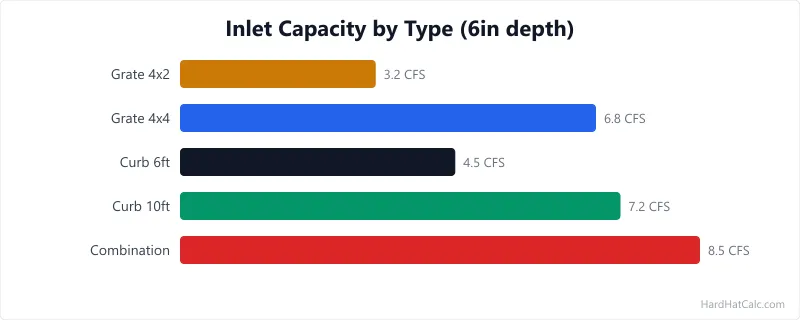
Inlet capacity depends on three things: the type of inlet (grate, curb, combination, or slot), the physical dimensions of the opening, and the depth of water at the inlet during peak flow. A grate inlet sitting flush with pavement captures water falling through its openings from above. A curb inlet captures water flowing along the gutter and entering a horizontal opening in the curb face. Each type has different capacity characteristics, clogging tendencies, and cost profiles that make them suited to different site conditions.
Municipal codes typically specify the design storm return period (commonly 10-year for parking lots, 25-year for critical infrastructure) and may mandate specific inlet types or minimum sizes. Always check your local stormwater management ordinance before finalizing inlet selections — the results from this calculator are estimates for planning, not engineering submittals. If the site drainage ties into a structure with concrete footings, verify that the footing dimensions and bearing capacity account for the water table and soil drainage conditions around the foundation.
Calculating Design Flow with the Rational Method
The rational method is the most widely used approach for estimating peak stormwater runoff from small drainage areas (under 200 acres). It produces a single peak flow value in cubic feet per second, which you then convert to gallons per minute for comparison against inlet capacity ratings. Below is the step-by-step process.
Determine the drainage area. Measure all impervious surface (pavement, roofing, concrete) that drains toward this specific inlet. For a parking lot, this is the paved area between the inlet and the nearest high point or drainage divide. Express the area in square feet, then convert to acres by dividing by 43,560.
Find the design storm intensity from local IDF curves. IDF (Intensity-Duration-Frequency) curves are published by NOAA in Atlas 14 and available through the NOAA Precipitation Frequency Data Server. Select the return period required by your local code (typically 10-year) and the time of concentration for your drainage area (5 minutes is common for small paved areas). The result is rainfall intensity in inches per hour.
Select the runoff coefficient (C). For impervious surfaces like asphalt and concrete, C = 0.95. For a mixed surface with some landscaping, C drops to 0.70–0.85 depending on the ratio of paved to permeable area. Use the weighted average if your drainage area includes both paved and unpaved surfaces.
Apply the rational method formula: Q = C x i x A. Multiply the runoff coefficient by the storm intensity (in/hr) by the drainage area (acres). The result is peak flow in cubic feet per second (CFS).
Convert CFS to GPM. Multiply the CFS value by 448.83 to get gallons per minute. This is the flow rate the inlet must handle during the peak of the design storm. Compare this number against the inlet's rated interception capacity to determine if one inlet is sufficient or if multiple inlets are required.
For the gutter system feeding water to ground-level inlets from roof drainage, the gutter sizing calculator handles downspout sizing and gutter capacity.
Inlet Types and Their Capacities
Each inlet type offers a different balance of capacity, clogging resistance, cost, and suitability for specific site conditions. The table below compares the four main types used in parking lot and roadway drainage. All cost figures are as of March 2026, US national averages for standard installations including the catch basin structure and frame/grate.
| Inlet Type | Typical Capacity Range | Best For | Installed Cost (March 2026) |
|---|---|---|---|
| Grate Inlet | 300–2,000 GPM | Parking lots, plazas, loading docks | $800–$1,500 |
| Curb Inlet | 200–1,000 GPM | Roadways, streets, residential subdivisions | $1,200–$2,000 |
| Combination (Grate + Curb) | 500–3,000 GPM | Intersections, high-flow areas, sag points | $1,500–$2,500 |
| Slot Drain | 100–500 GPM | Sidewalks, driveways, pool decks, pedestrian areas | $500–$1,200 |
Prices and rates on this page are our own estimates as of the date shown; they change often. Enter your own figures for a current result. Grate inlets provide the highest capacity per dollar for open pavement areas. Their main weakness is clogging — leaves, trash, and sediment accumulate on the grate and reduce effective capacity by 30–50% in areas with tree cover. This page applies a 50% clogging factor to grate inlet capacity in any area where debris accumulation is expected. That factor ships unverified as of 2026-08-12: HEC-22 section 7.1.3 states no clogging figure at all, and the 50% that appears in its Example 7.5 is an assumed input to a worked example rather than a value the manual recommends.
Curb inlets resist clogging better because water enters from the side rather than through a grate, but they intercept less flow at high velocities because fast-moving gutter flow overshoots the opening. Curb inlets perform best in low-gradient streets where gutter flow velocities stay under 5 feet per second.
Combination inlets offer the highest total capacity by capturing flow through both the grate and the curb opening simultaneously. They cost 20–40% more than a grate inlet alone but make sense at sag points (low points in the pavement profile) where all flow converges and capture efficiency is critical.
Grate vs. Curb vs. Combination Inlets
Choosing the right inlet type for a given location depends on the site geometry, expected debris load, pedestrian and vehicle traffic patterns, and budget. Here is how the three main types compare in practice.
Grate inlets are the workhorse of parking lot drainage. They sit flush with the pavement surface, collect water from all directions, and handle the highest flow rates per unit of opening area. Standard grate sizes range from 18x18 inches for light-duty applications to 36x36 inches for heavy-flow areas. The trade-off is clogging: any flat grate collects debris. In a parking lot lined with trees, grate inlets can lose 30–50% of their rated capacity to leaf accumulation during autumn. Regular maintenance (clearing the grate after storms) prevents 30-50% capacity loss from debris accumulation. For ADA-compliant pedestrian areas, grate openings must be small enough to prevent cane tips and wheelchair wheels from catching — typically 1/2-inch maximum slot width.
Curb inlets have no horizontal grate to clog, making them the preferred choice in tree-lined streets and residential areas. Water enters through a horizontal opening in the curb face, flowing into the catch basin below. The limitation is capture efficiency: at high gutter velocities (above 4–5 feet per second), water flows past the opening rather than turning into it. Longer curb openings improve capture but increase cost and reduce curb structural integrity. Deflectors (vertical vanes inside the opening) can redirect high-velocity flow into the basin.
Combination inlets pair a grate with a curb opening for maximum capture. The curb opening catches flow that the grate misses, and the grate catches flow that overshoots the curb opening at high velocities. This redundancy makes combination inlets the best choice for sag points — low spots where all flow converges and any bypass means ponding. The higher installed cost ($1,500–$2,500 vs $800–$1,500 for grate only) is justified at critical drainage points.
For commercial parking lots where inlet placement affects the overall layout, the parking lot size calculator plans stall counts and aisle widths around drainage infrastructure.
Debris, Clogging, and Real-World Performance
How much capacity is lost to debris? Plan for a 50% clogging factor on grate inlets in any area with tree cover, landscaping, or litter — a conservative design effectively doubles the required inlet capacity. That 50% figure ships unverified and is no longer attributed to HEC-22, which sets no clogging factor of its own; the 50% inside its Example 7.5 is an assumed input to that example. In practice, a 2x2 ft grate rated at 720 GPM under clean conditions should be designed as if it handles only 360 GPM. Curb inlets are less affected (plan for 10–20% capacity reduction) because their side-entry design sheds debris more effectively.
Does grate bar pattern matter? Yes. Parallel bar grates aligned with the flow direction pass water efficiently but also pass debris — and the parallel slots trap bicycle wheels, which is a safety and liability issue. Reticuline (mesh-pattern) grates resist bicycle wheel intrusion and meet ADA requirements but clog faster with small debris. Curved vane grates offer a compromise: angled bars direct flow into the basin while shedding debris to the side. For parking lots without bicycle traffic, parallel bar grates with transverse rods maximize hydraulic capacity.
What about maintenance frequency? Inlet grates in commercial parking lots should be inspected and cleared monthly during leaf-fall season (October–December in most US regions) and after any storm event exceeding the 2-year return period. A single clogged inlet at a sag point can pond an entire section of a parking lot. Budget $50–$100 per inlet per cleaning visit for a vacuum truck or manual debris removal. Many commercial property management contracts include storm drain maintenance — verify that your contract specifies clearing frequency and response time after major storms.
When should inlets be replaced rather than maintained? Cast iron grate frames typically last 30–50 years, but corrosion, vehicle loading, and repeated freeze-thaw cycles can crack the frame or warp the grate. A warped grate that no longer sits flush creates a trip hazard and a noise complaint from vehicles driving over it. Replacement cost for the grate and frame assembly runs $200–$600 for standard sizes (March 2026); the catch basin structure below rarely needs replacement unless it has cracked from settlement or root intrusion.
For roof drainage that feeds into your site's storm system, the shingle and underlayment estimator estimates the roofing materials above the gutter line.
Worked Examples
Example 1
Scenario: A 10,000 sq ft commercial parking lot with a single 2x2 ft grate inlet, design storm intensity of 4 in/hr.
Calculation: Design flow: Q = 0.95 × 4 × (10,000 / 43,560) = 0.8724 CFS. Convert to GPM: 0.8724 × 448.83 = 392 GPM. Grate area = 24 × 24 = 576 sq in. Inlet capacity = 576 × 2.5 × 0.50 = 720 GPM. Interception efficiency: 720 / 392 = 184%, capped at 100%. Inlets needed: 1. Cost: 1 x $1,200 = $1,200.
What this means: A single 2x2 ft grate inlet has ample capacity for a 10,000 sq ft parking area at moderate rainfall. The safety margin means the inlet can handle about twice the design flow before overtopping — valuable headroom for storms that exceed the 10-year event or for partial clogging.
Takeaway: Oversizing individual inlets is cheaper than adding more inlets. A 2x2 grate costs roughly the same to install as an 18x18-inch grate but handles nearly twice the flow, giving capacity headroom for storms that exceed the design event.
Example 2
Scenario: A 40,000 sq ft warehouse parking lot with 3x3 ft grate inlets, design storm intensity of 7 in/hr (Gulf Coast).
Calculation: Design flow: Q = 0.95 × 7 × (40,000 / 43,560) = 6.107 CFS. Convert to GPM: 6.107 × 448.83 = 2,741 GPM. Grate area = 36 × 36 = 1,296 sq in. Capacity per inlet = 1,296 × 2.5 × 0.50 = 1,620 GPM. Interception efficiency per inlet: 1,620 / 2,741 = 59%. Inlets needed: ⌈2,741 / 1,620⌉ = 2. Cost: 2 x $1,200 = $2,400.
What this means: Two 3x3 grate inlets together handle 3,240 GPM against a 2,741 GPM design flow — an 18% safety margin. In a 7 in/hr region, even large inlets get pushed hard. If clogging is expected, a 50% clogging factor would reduce each inlet to 810 GPM, requiring 4 inlets.
Takeaway: High-rainfall regions (Gulf Coast, South Florida) push inlet counts higher than anywhere else. A lot that needs one inlet in Chicago needs two in Houston. Budget accordingly and consider combination inlets for higher per-unit capacity.
Frequently Asked Questions
- How do I calculate the flow rate for a storm drain inlet?
Use the rational method: Q = C × i × A, where C is the runoff coefficient (0.95 for pavement, 0.85 for roofs, 0.35 for lawns), i is the design storm intensity in inches per hour from local IDF curves (NOAA Atlas 14), and A is the drainage area in acres. Convert the result from cubic feet per second (CFS) to gallons per minute (GPM) by multiplying by 448.83. This gives you the peak flow rate the inlet must handle during the design storm event. For roof drainage feeding into the site system, the gutter sizing calculator handles downspout capacity upstream of the inlet. For rural sites with on-site wastewater, the septic system cost estimator covers the parallel below-ground budget.
- What is the difference between a grate inlet and a curb inlet?
A grate inlet sits flush with the pavement surface with a metal grate covering the opening — water falls through the grate into the catch basin below. A curb inlet is a horizontal opening in the curb face — water flows along the gutter and into the opening from the side. Grate inlets handle higher flow rates per unit area but can clog with debris (leaves, trash, sediment). Curb inlets resist clogging better but intercept less flow, especially at high gutter velocities. Combination inlets use both a grate and a curb opening for maximum capacity. For the parking area around the inlets, the parking lot size calculator plans stall counts and aisle widths around drainage points.
- How many storm drain inlets do I need for a parking lot?
Divide the total design flow (from the rational method) by the capacity of each inlet to get the minimum count. A 20,000 sq ft parking lot at 5 in/hr rainfall generates roughly 975 GPM of runoff. A single 2x2 ft grate inlet handles about 720 GPM — so you need at least 2 inlets. In practice, add inlets to prevent ponding at low points and ensure no point on the lot is more than 150–200 feet from an inlet. Most lots under 20,000 sq ft need 2–3 inlets; larger lots need proportionally more. If the lot includes a concrete section, the concrete slab weight calculator verifies thickness for vehicle loads.
- What design storm should I use for inlet sizing?
Most municipal codes specify the design storm for drainage: typically a 10-year return period, 5-minute duration event. This means the rainfall intensity that statistically occurs once every 10 years in a brief intense burst. Some jurisdictions use 25-year events for critical infrastructure like hospital parking or underground utilities. Check your local stormwater management ordinance — the design storm return period and duration are specified there. Using a less frequent event (25-year vs 10-year) means larger inlets but better protection against flooding. The same rainfall data feeds the gutter sizing guide for roof drainage upstream of ground-level inlets.
More Materials calculators
Browse all materials calculators — Paint coverage, roofing bundles, tile adhesive, welding time, parking lot sizing, and more.