
Parking Lot Size Calculator
Free parking lot size calculator covering ADA-compliant spaces, striping quantities, and paving cost estimates. Enter total spaces and stall dimensions.
Last updated:
Include both standard and ADA spaces in this total.
Standard stalls are 8.5–9 ft wide. Compact stalls start at 7.5 ft.
Most codes require 18 ft minimum for 90-degree stalls.
Two-way traffic aisles: 24 ft. One-way angled: 12–18 ft.
ADA minimums are tiered: 1 for 1–25 spaces, 2 for 26–50, 3 for 51–75, up to 2% for 501+. See ADA table below.
L-shaped lots add ~12% to total area due to dead space.
How This Is Calculated
Row depth = 2 × stall depth + aisle width. Spaces per double-loaded row = floor(row depth / stall width) × 2. Row width = (spaces per row / 2) × stall width. Standard area = rows needed × row depth × row width. ADA area = ADA spaces × 13 ft × stall depth (8 ft stall + 5 ft access aisle). Striping = (spaces + 1) × stall depth + spaces × stall width. L-shape adds 12% for dead space. Paving cost = total area × $5/sq ft + striping × $0.35/ft.
Source: ADA accessible space requirements per 2010 ADA Standards for Accessible Design. Paving costs based on contractor pricing data. Source-set correction of 2026-08-12: the ITE (Institute of Transportation Engineers) Parking Generation Manual attribution for the parking geometry has been withdrawn rather than moved to a later edition. That manual reports observed peak parking DEMAND, in vehicles per unit of land use, and carries no stall dimensions, aisle widths or layout geometry at all, so no edition of it could source these figures. Stall sizes, aisle widths and the square-feet-per-space allowance are unchanged and now ship unverified; treat them as common practice figures and check the local zoning ordinance, which governs in any case.
5 min read
How Parking Lot Sizing Works
A parking lot is not just rows of painted lines on asphalt. Every commercial lot is a system of stall dimensions, aisle widths, circulation lanes, and accessibility zones that must work together to meet local codes and keep traffic flowing. Undersizing any of these elements creates a lot that frustrates drivers, violates ADA requirements, or fails municipal permitting.
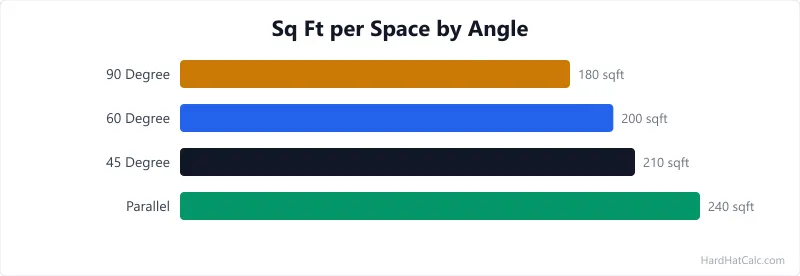
The core unit of any lot layout is the double-loaded row: two rows of stalls facing each other across a shared drive aisle. For 90-degree perpendicular parking, the standard aisle width is 24 feet for two-way traffic. Angled layouts (45 or 60 degrees) allow narrower aisles — as low as 12 feet for one-way flow — but each angled stall consumes more linear frontage along the row. Most commercial lots use perpendicular parking because it packs the most spaces per acre, even though the aisles are wider.
Stall dimensions vary by jurisdiction, and the jurisdiction is what governs. A 9 ft × 18 ft stall is the common minimum for full-size vehicles, though this page no longer attributes that figure to a published standard. Compact stalls can be as narrow as 7.5 ft × 15 ft, but many cities cap compact stalls at 15–30% of total spaces. If you are bidding a paving job and the architect's drawings show all compact stalls, double-check the local zoning ordinance — some jurisdictions have banned compact-only lots entirely.
ADA Accessibility Requirements
The Americans with Disabilities Act sets minimum accessible parking requirements based on total lot size. These are federal minimums — state and local codes may be stricter.
| Total Spaces | Required ADA Spaces | Van-Accessible (of ADA) |
|---|---|---|
| 1–25 | 1 | 1 |
| 26–50 | 2 | 1 |
| 51–75 | 3 | 1 |
| 76–100 | 4 | 1 |
| 101–150 | 5 | 1 |
| 151–200 | 6 | 1 |
| 201–300 | 7 | 2 |
| 301–400 | 8 | 2 |
| 401–500 | 9 | 2 |
| 501+ | 2% of total | 1 per 6 ADA |
Each ADA space must be at least 8 feet wide with a 5-foot access aisle (shared between two spaces when adjacent). Van-accessible spaces require an 8-foot access aisle instead. The access aisle must connect to an accessible route to the building entrance — not strand the user in the middle of a driving lane.
Signage is mandatory: a post-mounted sign at 60 inches minimum height, with the international symbol of accessibility and "Van Accessible" where applicable. Ground-level paint alone does not satisfy the requirement.
Laying Out a Lot: Step by Step
Survey the parcel boundaries. Measure the usable area after setbacks, easements, stormwater retention, and landscaping buffers. Many municipalities require 5–15% of the lot area as landscaped islands — that area is lost to parking.
Choose the stall angle. Perpendicular (90-degree) parking is the most space-efficient for large lots. Angled parking (45 or 60 degrees) works better for narrow parcels or one-way traffic flow. Parallel parking is the least efficient and rarely used in surface lots.
Set stall and aisle dimensions. Check your local code for minimums. For 90-degree stalls with two-way aisles, 9 ft × 18 ft stalls and 24 ft aisles are the standard starting point. Tighter dimensions save area but make the lot harder to get around in, increasing fender-bender rates.
Place ADA spaces first. They must be closest to the building entrance on the shortest accessible route. Place them before laying out standard rows — retrofitting ADA spaces into an already-optimised layout usually wastes more area than planning them from the start.
Fill remaining area with double-loaded rows. Work from the building face outward. Leave circulation lanes at row ends (typically 24 ft) for vehicles to turn between rows. Dead-end rows require a turnaround area or back-out space.
Add fire lanes and emergency access. Fire codes typically require a 20-foot-wide fire lane kept clear at all times. This lane can double as a circulation aisle if it meets the width requirement.
Calculate striping quantities. Count every painted line: stall side lines, stall front lines, ADA markings, fire lane markings, directional arrows, and handicap symbols. Striping contractors charge by the linear foot for lines and per-unit for symbols.
Asphalt vs. Concrete: Paving Cost Comparison
Choosing between asphalt and concrete affects both upfront cost and lifetime maintenance budget. The right choice depends on climate, traffic volume, and how long the owner plans to hold the property.
Asphalt costs $3–$7 per square foot installed as of March 2026 (US national averages, based on contractor pricing data). Prices and rates on this page are our own estimates as of the date shown; they change often. Enter your own figures for a current result. It is faster to install, can be driven on within 24–48 hours, and is easier to repair with patching. However, asphalt requires sealcoating every 2–3 years ($0.15–$0.25/sq ft) and has a typical lifespan of 15–20 years before major resurfacing. In hot climates, asphalt softens and develops ruts under heavy vehicles.
Concrete costs $5–$12 per square foot installed. It takes 5–7 days to cure before traffic can use it, and any crack repairs are more visible and expensive. On the other hand, concrete lasts 25–35 years with minimal maintenance, reflects more light (reducing lighting costs), and handles heavy truck traffic better than asphalt. In freeze-thaw climates, concrete can spall if not properly sealed.
For most commercial lots under 200 spaces, asphalt wins on upfront cost. For high-traffic lots (retail, warehouse) or lots in extreme heat, concrete pays for itself over a 20-year horizon. Use the slab weight estimator to verify that your chosen thickness supports the expected vehicle loads. Some owners use a hybrid: concrete for drive aisles and loading zones, asphalt for stall areas. If you are estimating costs for a roofing project on the same commercial property, bundling the paving bid with the roofing bid can sometimes get better contractor pricing.
Stormwater and Drainage Considerations
Large impervious surfaces like parking lots create stormwater runoff that municipalities regulate heavily. Before finalising your lot size, check whether your jurisdiction requires on-site stormwater management — most do for lots over 5,000 square feet.
Common requirements include retention ponds, permeable paver strips, bioswales, or underground detention systems. These features eat into your usable parking area, sometimes by 10–20%. A 50-space lot that looks perfect on paper may only fit 42 spaces after the stormwater engineer carves out a bioswale along the north edge.
Permeable pavers are an alternative for low-traffic areas. They cost $10–$20 per square foot but can eliminate or reduce the need for separate detention, which may offset the premium. When planning a commercial build that also involves structural work like concrete reinforcement, coordinate the site grading between the parking lot contractor and the foundation crew — conflicting grades cause drainage failures that are expensive to fix after paving.
Worked Examples
Example 1
Scenario: A small medical office needs a 30-space lot with 2 ADA spaces on a rectangular parcel, using standard 9 ft × 18 ft stalls and 24 ft two-way aisles.
Calculation: Row depth = 2 × stallDepth + aisleWidth = 2 × 18 + 24 = 60 ft. Spaces per double row = floor(rowDepth / stallWidth) × 2 = floor(60 / 9) × 2 = 12. Rows needed = ⌈28 / 12⌉ = 3. Row width = (12 / 2) × 9 = 54 ft. Standard area = 3 × 60 × 54 = 9,720 sq ft. ADA area = 2 × 13 × 18 = 468 sq ft. Circulation = (9,720 + 468) × 0.15 = 1,528 sq ft. Total = 11,716 sq ft. Striping = 31 × 18 + 30 × 9 = 828 ft. Cost = 11,716 × $5 + 828 × $0.35 = $58,871 (the engine carries the unrounded area through the cost step).
What this means: The lot requires about 11,700 sq ft of paved area with 828 linear feet of striping, costing roughly $58,900 for asphalt paving and line marking.
Takeaway: Even a 30-space lot needs over a quarter acre when you include ADA zones, aisles, and circulation — always budget more area than the raw stall count suggests.
Example 2
Scenario: A property developer is planning a 150-space L-shaped lot for a retail centre, with 5 ADA spaces, 9 ft × 18 ft stalls, and 24 ft aisles.
Calculation: Row depth = 2 × 18 + 24 = 60 ft. Spaces per double row = floor(60 / 9) × 2 = 12. Rows needed = ⌈145 / 12⌉ = 13. Row width = (12 / 2) × 9 = 54 ft. Standard area = 13 × 60 × 54 = 42,120 sq ft. ADA area = 5 × 13 × 18 = 1,170 sq ft. Circulation = 43,290 × 0.15 = 6,494 sq ft. Subtotal = 49,784 sq ft. L-shape factor × 1.12 = 55,758 sq ft. Striping = 151 × 18 + 150 × 9 = 4,068 ft. Cost = 55,758 × $5 + 4,068 × $0.35 = $280,211 with the unrounded area carried through.
What this means: The L-shaped lot demands nearly 56,000 sq ft (about 1.28 acres) and roughly $280,000 in paving and striping.
Takeaway: L-shaped lots carry a 12% area penalty from dead space at the inside corner — compare the cost against reshaping to a rectangle before committing.
Frequently Asked Questions
- How many parking spaces do I need per 1,000 square feet of commercial space?
Zoning codes typically require 3–5 spaces per 1,000 square feet for retail, 2–4 for office, and 10–15 for restaurants. These ratios vary by municipality and building use, so always check your local zoning ordinance before designing the lot. Some cities also cap the maximum number of spaces to limit impervious surface area, which means you can have too many spaces as well as too few. For venues where seat count drives the parking requirement, the seating capacity calculator converts room area into max occupancy.
- What is the minimum aisle width for a two-way parking lot?
For 90-degree perpendicular parking with two-way traffic, the standard minimum aisle width is 24 feet. One-way aisles with angled parking can be as narrow as 12 feet for 45-degree stalls or 18 feet for 60-degree stalls. Fire codes may override these minimums — fire lanes must be at least 20 feet wide and kept clear, so if your aisle doubles as a fire lane, the fire code width governs. When the lot also handles stormwater, the inlet capacity calculator sizes drain grates around the aisle layout.
- How much does it cost to stripe a parking lot?
Parking lot striping costs $0.20–$0.50 per linear foot for standard 4-inch lines as of March 2026, based on US national averages. ADA symbols, directional arrows, and handicap markings are charged per unit, typically $5–$15 each. A 50-space lot usually costs $800–$1,500 for a full stripe job. Restriping an existing lot is cheaper than new striping because layout is already established, running $0.15–$0.35 per linear foot. If the pavement base needs reinforcement, spec the rebar grid for heavy-duty concrete sections.
- Do ADA parking spaces need to be van-accessible?
At least one of every six ADA spaces (or fraction thereof) must be van-accessible. A van-accessible space is the same 8-foot width as a standard ADA space, but requires an 8-foot-wide access aisle instead of 5 feet. Alternatively, some lots make all ADA spaces van-accessible by using 11-foot-wide stalls with 5-foot aisles, which satisfies both requirements with a simpler layout. The vertical clearance for van-accessible spaces must be at least 98 inches along the route from the space to the building entrance. The grading-volume estimator helps estimate earthwork if grading the lot to meet ADA slope requirements.
- How do I calculate the number of parking lot rows I need?
Divide your total spaces by the number of spaces per double-loaded row, then round up. A double-loaded row has stalls on both sides of a shared aisle. The number of spaces per row depends on the row length divided by the stall width — for a 90-foot-wide lot with 9-foot stalls, each side holds 10 stalls, so a double-loaded row holds 20 spaces. Three rows of 20 spaces covers a 60-space lot. Always verify that the total row depth (2 × stall depth + aisle width) times the number of rows fits within your parcel depth. To express each zone as a share of the total lot, the area-to-percentage converter handles that calculation.
More Materials calculators
Browse all materials calculators — Paint coverage, roofing bundles, tile adhesive, welding time, parking lot sizing, and more.