
Seating Capacity Calculator
Seating capacity calculator for theatre, banquet, classroom, and restaurant layouts. Enter room size for maximum seats and IBC fire-code occupant load.
Last updated:
Interior wall-to-wall length, not including lobbies or kitchens.
Interior wall-to-wall width.
Each style has a different square footage per person.
Percentage of floor area reserved for aisles, stage, bar, buffet, etc.
How This Is Calculated
Usable floor area = room length × room width × (1 − aisle allowance %). Max seats = usable floor area ÷ sq ft per person. Sq ft per person varies by style: theatre 7, banquet 11, classroom 20, restaurant 16.
Source: Square-footage-per-person values are widely used venue-planning rules of thumb; no authoritative public origin located 2026-09-01. Fire code occupant load factors per International Building Code (IBC) Table 1004.5.
6 min read
Choosing the Right Layout for Your Event
Before plugging numbers into any calculator, settle the layout question first. The seating style you choose changes capacity by 2–3x for the same room, and switching layouts after booking is the fastest way to lose money on a venue.
Define the event type. A corporate presentation needs theatre or classroom style. A wedding reception needs banquet rounds. A pop-up dinner needs restaurant layout. Match the layout to what attendees will actually do — listen, eat, write, or socialise.
Measure the room accurately. Use wall-to-wall interior dimensions, excluding permanent fixtures like built-in bars, stage risers, or kitchen pass-throughs. A 60 × 40 room with a 10-foot built-in stage is really a 50 × 40 room for seating purposes.
Account for non-seating zones. Dance floors, buffet tables, DJ booths, registration desks, and AV equipment all eat into seating area. The aisle allowance percentage in this calculator captures these zones — increase it for events with large non-seating footprints.
Check fire code occupancy limits. Your calculated seating capacity may exceed the room's posted fire code maximum. The fire code limit always wins. It accounts for egress width, exit count, and sprinkler coverage that a simple area calculation does not.
Walk the room before committing. Columns, doorways, alcoves, and uneven floors affect real-world capacity. A 2,400-square-foot room with four load-bearing columns in the middle loses 8–12 seats compared to a column-free space of the same size.
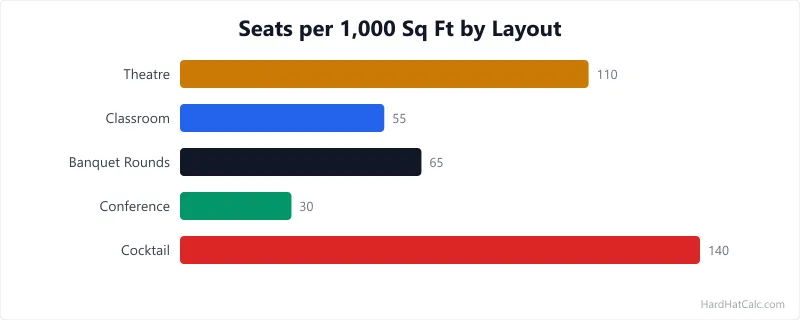
Square Footage Standards by Layout Type
The square footage per person for each seating style comes from IBC 2021 Table 1004.5 and widely used venue-planning rules of thumb; no authoritative public origin located 2026-09-01. These are not arbitrary numbers — they account for chair dimensions, table footprints, server circulation, and minimum aisle widths that keep a room functional.
Theatre seating is the tightest layout at 6–8 square feet per person. Chairs sit in straight rows with 30–34 inches between row centres (front edge to front edge). This leaves just enough room for someone to squeeze past seated attendees to reach a middle seat. Theatre style only works when nobody needs a writing surface and the event is short enough that attendees stay seated. For longer events, bump to 8–10 square feet per person to widen row spacing.
Banquet rounds are the standard for catered events. A 60-inch round table seats 8 comfortably or 10 tightly. Each table needs a 5-foot clearance radius around it for chair pushback and server access. That works out to about 11 square feet per person. Crowding tables closer than 5 feet apart makes server circulation difficult, slows food service, and creates noise complaints because diners at adjacent tables are practically touching.
Classroom layout consumes the most space per person: 18–22 square feet. Each attendee needs a 6-foot or 8-foot table shared with 1–2 others, plus chair space behind, plus a 4-foot aisle between table rows for movement. This layout is mandatory for training sessions, workshops, or any event where attendees need to write, use laptops, or reference materials.
Restaurant seating falls in the middle at 14–18 square feet per person. The mix of 2-top and 4-top tables creates irregular spacing that wastes more area than uniform rounds. Server lanes between table groups need 36–44 inches for carrying trays. If your restaurant plan involves a weld-fabricated custom railing or partition, factor the railing footprint into your floor plan before finalising table count.
Occupancy Limits and Fire Code Reference
Local fire codes set maximum occupancy limits that override structural capacity calculations. Always verify your venue's posted occupancy limit with the local fire marshal before planning events. Exceeding fire code occupancy limits is a code violation regardless of structural capacity.
Fire codes set maximum occupancy based on room use, not just area. The International Building Code (IBC 2021, Table 1004.5) and local fire marshals use these occupant load factors (the inverse of sq ft per person):
| Use Category | Sq Ft per Occupant (IBC) | Typical Max per 1,000 sq ft |
|---|---|---|
| Assembly, standing (no fixed seats) | 5 | 200 |
| Assembly, chairs only (no tables) | 7 | 142 |
| Assembly, tables and chairs | 15 | 66 |
| Business / office | 150 | 6 |
| Mercantile (retail, ground floor) | 60 | 16 |
| Educational / classroom | 20 | 50 |
| Kitchen (commercial) | 200 | 5 |
These limits include everyone in the room: guests, staff, performers, vendors. A 2,400-square-foot banquet room has a fire code max of about 160 people (2,400 ÷ 15). If your calculated banquet seating is 145 guests and you have 20 staff, the fire code limit is the binding constraint, not the seating math.
If your room has fewer than two exits, the fire marshal may reduce the posted occupancy further. For assembly spaces over 300 occupants, panic hardware on exit doors is typically required.
Common Capacity Mistakes
Experienced event planners still make capacity errors. Here are the most frequent ones:
Ignoring column placement. Structural columns are invisible on a floor plan until you try to place a table next to one. Each column kills 1–3 seats depending on its location. When scoping a venue with columns, walk the room with a tape measure and mark dead zones. If the venue involves structural changes, check whether the columns are load-bearing — you can frame the wall section to understand stud and plate layout before assuming any can be removed.
Forgetting the 36-inch aisle rule. ADA requires 36-inch minimum aisle width for wheelchair access in assembly spaces. Many banquet layouts that look fine on paper drop below 36 inches between table clusters once chairs are pushed back. Plan for 44 inches if you want comfortable circulation.
Over-counting restaurant seats. A restaurant capacity calculation often ignores the host stand, wait station, bus station, and POS terminal area. These fixtures consume 30–60 square feet each. A 1,200-square-foot dining room that "should" seat 75 often seats 55–60 once you account for everything that is not a table.
Using gross area instead of net area. The room's listed square footage usually includes coat closets, built-in shelving, and alcoves that cannot hold seating. Always measure the actual usable rectangle (or rectangles) and calculate from those dimensions.
Theatre vs. Banquet: When Each Layout Wins
The two most common event layouts are theatre and banquet, and they serve very different purposes. Choosing the wrong one does not just affect comfort — it changes the entire event dynamic.
Theatre layout maximises capacity. A 2,400-square-foot room seats roughly 275 people theatre-style versus 145 banquet-style. Use it for keynote presentations, film screenings, panel discussions, award ceremonies, or any event where attendees face forward and the primary activity is watching and listening. The downside: no tables means no food service, no note-taking surface, and limited networking. Attendees seated in the middle of a long row cannot leave without disturbing an entire row of people.
Banquet layout maximises interaction. Round tables seat 8–10 people who face each other, making conversation natural. Food service is straightforward because servers can reach every seat. Use banquet for weddings, galas, fundraising dinners, corporate dinners, and any event where the meal and conversation are the main event, not a speaker on stage. The trade-off is dramatic: you lose 40–50% of your seating capacity compared to theatre in the same room.
For large venues with parking requirements tied to seat count, the parking lot layout tool translates your guest count into stall and aisle dimensions. A hybrid approach works for events that need both: theatre-style seating in the front half for a presentation, then banquet rounds in the back half for dinner afterward. This sacrifices some of each style's advantage but avoids the awkwardness of asking 200 guests to stand while staff resets 25 round tables during a 15-minute intermission.
Worked Examples
Example 1
Scenario: A 60 × 40 ft hotel function room is being set up for a banquet dinner with round tables. The event planner reserves 20% of the floor for aisles, a buffet station, and a small stage.
Calculation: Gross area = 60 × 40 = 2,400 sq ft. Usable area = 2,400 × (1 − 0.20) = 1,920 sq ft. Banquet sq ft per person = 11. Max seats = floor(1,920 ÷ 11) = 174 seats.
What this means: The room can seat up to 174 guests at banquet rounds, leaving 480 sq ft for the buffet, aisles, and stage area.
Takeaway: Always cross-check against the fire code occupancy limit — at IBC 15 sq ft per occupant for tables-and-chairs assembly, this room maxes out at 160 total occupants including staff.
Example 2
Scenario: A 50 × 30 ft corporate training room needs classroom-style seating with 20% aisle allowance for movement and an AV cart.
Calculation: Gross area = 50 × 30 = 1,500 sq ft. Usable area = 1,500 × (1 − 0.20) = 1,200 sq ft. Classroom sq ft per person = 20. Max seats = floor(1,200 ÷ 20) = 60 seats.
What this means: The room accommodates 60 attendees at 6-foot tables with comfortable aisle spacing for trainers to move between rows.
Takeaway: Classroom layout consumes nearly 3× more area per person than theatre — switching to theatre style in the same room would seat about 170 people if tables are not needed.
Frequently Asked Questions
- How many square feet per person do I need for a banquet with a dance floor?
Plan for 11–12 square feet per seated guest, then add 3–4 square feet per person for the dance floor (assuming about half the guests dance at once). For 150 guests, that means roughly 1,800 sq ft for banquet seating plus 225–300 sq ft for the dance floor. Set the aisle allowance to 25–30% when using this calculator to account for the dance floor, DJ area, and buffet or bar stations. The area-to-percentage converter helps express the dance floor as a share of total room area for layout planning.
- What is the maximum occupancy for a room with one exit?
Most fire codes limit single-exit rooms to 49 occupants, regardless of square footage. Some jurisdictions allow up to 75 occupants with a single exit if the room has sprinklers and the exit is wide enough (44 inches minimum). If your room exceeds 49 people, you almost certainly need a second exit. Always confirm with your local fire marshal — this is not optional, and venues can be shut down mid-event for violations. If the venue has steel framing, check whether the fireproofing coverage meets the fire rating required for assembly occupancy.
- Can I use classroom seating for a dinner event?
Technically yes, but it is uncomfortable for dinner service. Classroom tables are typically 18–24 inches deep, which barely fits a dinner plate, glass, and utensils. Banquet rounds or rectangular banquet tables (30 inches deep) give diners enough elbow room for a multi-course meal. If the event starts as a workshop and transitions to dinner, consider using 30-inch-deep tables from the start — they work for both writing and dining, at the cost of slightly fewer seats than 18-inch classroom tables. If the venue has a parking lot, confirm that stall count meets zoning requirements for the actual seated capacity, not just the room square footage.
- How does ceiling height affect seating capacity?
Ceiling height does not directly change the number of seats, but it affects acoustic comfort and perceived crowding. Rooms under 9 feet feel cramped with more than 5–6 people per 100 square feet, even if fire code allows more. Rooms with 12-foot or higher ceilings tolerate denser seating because the extra volume reduces noise buildup and gives a more open feel. For theatre-style events with amplified sound, low ceilings also cause audio reflection problems that make speeches hard to follow beyond the first few rows. Adding wall soundproofing between event spaces helps control noise bleed when multiple rooms operate simultaneously.
- How do I calculate seating for an irregularly shaped room?
Break the room into rectangles and calculate each section separately. An L-shaped room becomes two rectangles; a room with a curved wall can be approximated as a rectangle using the shortest wall-to-curve distance as one dimension. Add the usable areas of each section, then subtract overlap and dead zones near corners. Irregular rooms typically lose 10–15% of their theoretical capacity to dead zones that cannot fit tables, so apply an extra 10% aisle allowance beyond what you would use in a rectangular space. The square-footage-to-percentage tool can express each sub-area as a share of the whole for layout planning.
More Materials calculators
Browse all materials calculators — Paint coverage, roofing bundles, tile adhesive, welding time, parking lot sizing, and more.