
Weld Time Calculator
Free weld time calculator for MIG, TIG, and stick processes. Enter weld length, thickness, and joint type to estimate time, filler, gas, and labour cost.
Last updated:
Total linear length of all welds on the project.
Thickness of the thinner piece being joined. 1/4" = 0.25 in.
Fillet is most common in structural fabrication. Groove is strongest for thick material.
MIG is fastest. TIG is most precise. Stick is most portable.
How This Is Calculated
Arc-on time = (weld length ÷ travel speed) × pass multiplier. Total time = arc-on time ÷ operating factor (MIG 35%, TIG 22%, stick 25%). Filler weight = weld cross-section × length × steel density ÷ deposition efficiency. Gas = (arc-on minutes ÷ 60) × flow rate. Labour = total hours × $80/hr.
Source: Travel speeds, operating factors and deposition efficiencies are this site's defaults, typical production practice for a qualified welder on mild steel. The efficiencies (MIG 95, TIG 98, stick 65 percent) sit inside the spreads manufacturer data sheets and trade press print: ESAB Atom Arc 7018 rows 69 to 77 percent and Hobart 718 / 718MC rows 62 to 73 percent for stick, and The Fabricator's consumables column at GMAW 92 to 98, SMAW about 65 and GTAW about 99 percent (the AWS Welding Handbook and the Lincoln Procedure Handbook, previously cited for them, are sold and were never opened; withdrawn 2026-09-02). Steel density 0.283 lb per cu in is 0.490 kcf / 1,728, the unit weight printed by MnDOT, MoDOT and FHWA bridge manuals. AWS D1.1 (Structural Welding Code — Steel) prescribes none of these figures, and the previous attribution to it is withdrawn as of 2026-09-02; the Lincoln Electric Procedure Handbook of Arc Welding was not opened and is no longer cited for them.
8 min read
MIG vs. TIG vs. Stick: How Process Choice Affects Time and Cost
The welding process you choose determines the project timeline more than any other variable. A 48-inch fillet weld on 1/4-inch steel takes roughly 15 minutes of total time with MIG, 35 minutes with TIG, and 25 minutes with stick. That 2× difference between MIG and TIG compounds across a project with hundreds of inches of welding.
MIG welding (GMAW — Gas Metal Arc Welding) is the production workhorse. A continuous wire electrode feeds through the gun, so the welder does not stop to change electrodes. Travel speeds of 10–25 inches per minute are typical production figures (this calculator's defaults), and the operating factor (percentage of time the arc is actually running) is the highest of any manual process at 30–40%. MIG excels on mild steel and aluminium in shop environments. The limitation is portability: MIG requires a shielding gas cylinder and wire feeder that do not travel easily to field locations. For fabrication shop work (railings, structural connections, equipment frames) MIG is almost always the fastest and cheapest process.
TIG welding (GTAW — Gas Tungsten Arc Welding) produces the highest-quality welds but at the slowest speed. The welder holds a non-consumable tungsten electrode in one hand and feeds filler rod with the other, which requires more skill and coordination. Travel speeds of 4–10 inches per minute are typical (this calculator's defaults), and the operating factor drops to 20–25% because of the manual filler feeding and frequent torch adjustments. TIG is the standard for stainless steel, thin aluminium, chromoly tubing, and any weld where appearance matters — visible architectural metalwork, food processing equipment, aerospace tubing, and motorcycle frames.
Stick welding (SMAW — Shielded Metal Arc Welding) is the most portable and forgiving process. It requires no gas cylinder and works outdoors in wind that would blow away MIG or TIG shielding gas. Travel speeds of 5–12 inches per minute are typical (this calculator's defaults), but the operating factor is only 20–30% because the welder must stop to chip slag and change electrode stubs every few minutes. Stick dominates field welding: pipeline work, structural steel erection, farm equipment repair, and anything done outside a shop. If the project involves structural steel beams, field connections are almost always stick-welded because the beams are too large to bring into a shop after erection.
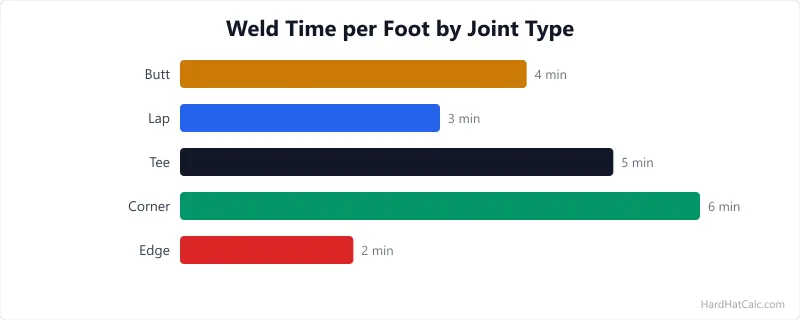
Travel Speed and Deposition Rate Reference
These figures are this site's defaults for typical production rates for a qualified welder working on mild steel; no welding code prescribes them. Actual rates vary by welder skill, position (flat, horizontal, vertical, overhead), and joint fit-up quality.
| Parameter | MIG (GMAW) | TIG (GTAW) | Stick (SMAW) |
|---|---|---|---|
| Travel speed (thin, ≤1/8") | 15–25 ipm | 6–10 ipm | 8–12 ipm |
| Travel speed (medium, 1/4") | 10–15 ipm | 4–6 ipm | 5–8 ipm |
| Travel speed (thick, 1/2"+) | 6–10 ipm | 3–5 ipm | 3–5 ipm |
| Deposition rate | 3–8 lbs/hr | 1–3 lbs/hr | 1–5 lbs/hr |
| Deposition efficiency | 93–98% | 95–99% | 60–70% |
| Operating factor | 30–40% | 20–25% | 20–30% |
| Shielding gas flow rate | 25–35 CFH | 15–25 CFH | None (flux) |
| Gas type | 75/25 Ar/CO₂ | 100% Argon | N/A |
| Electrode/wire cost per lb | $1.50–$3.00 | $5–$20 | $1.50–$4.00 |
Prices and rates on this page are our own estimates as of the date shown; they change often. Enter your own figures for a current result. Deposition efficiency is the percentage of filler material that ends up in the weld. MIG and TIG waste very little — the wire or rod melts directly into the joint. Stick welding wastes 30–40% of the electrode as stub ends and slag coating, which inflates the filler material cost per pound of deposited metal. This is the hidden cost of stick welding that does not show up in the per-rod price. For a deeper breakdown of how much filler metal each process actually deposits per hour, the deposition rate estimator compares processes side by side.
Labour rates for certified welders range from $25–$50 per hour (welder pay) but the shop billable rate — including overhead, equipment, consumables, and supervision — runs $65–$100 per hour as of March 2026, US national averages.
Operating Factor: The Gap Between Arc Time and Clock Time
Welding presents serious safety hazards including arc flash (UV radiation), toxic fumes, fire, and electric shock. Always wear proper PPE: auto-darkening helmet (shade 10+ for MIG/stick, shade 8+ for TIG), FR leather gloves, FR jacket or apron, steel-toed boots. Work in ventilated areas or use fume extraction. Keep a fire extinguisher within 10 feet.
Operating factor (also called arc-on time or duty cycle in estimating contexts) is the single most misunderstood variable in weld time estimation. It represents the percentage of total clock time that the welding arc is actually running. The rest of the time goes to fit-up, clamping, repositioning the workpiece, cleaning, electrode changes, inter-pass cooling, and reading the print.
A beginner estimator might calculate arc-on time for 100 inches of MIG welding at 15 ipm and get 6.7 minutes. The actual clock time will be closer to 19 minutes because the arc only runs about 35% of the total time. Forgetting the operating factor underestimates a weld job by 2–4× — which is how fabrication shops lose money on fixed-price contracts. The per-foot welding time reference by joint size tabulates these total-time figures for fillet welds across MIG, TIG, and stick so you can sanity-check an estimate at a glance.
Position affects operating factor heavily. Flat-position welding (the most efficient) keeps the operating factor near the top of the range. Vertical and overhead welding drop it to the bottom because the welder must control a smaller puddle, make shorter passes, and deal with gravity pulling the molten metal away from the joint. A project with 50% overhead welding takes 30–50% longer than the same welds done flat.
Joint fit-up quality also matters. If the two pieces being joined have uneven gaps, poor alignment, or mill scale on the surfaces, the welder spends extra time grinding, adjusting clamps, and compensating for inconsistent gaps — all of which is non-arc time. Spending an extra hour on fit-up and surface prep can save two hours of welding time by reducing rework and improving first-pass quality. The welding cost estimation guide covers how to build fit-up time, gas, filler, and labour into a complete job quote.
For projects that combine welding with other trades — like a pergola where welded steel brackets connect to wood posts — coordinate the welding schedule with the assembly schedule. Pre-fabricating welded brackets in the shop (where flat-position welding is possible) is always faster and cheaper than field-welding connections overhead.
Joint Types and When to Use Each
The four standard joint types each serve specific structural and practical purposes. Choosing the wrong joint for the application either wastes material (over-engineering) or creates a weak connection (under-engineering).
Butt joints connect two pieces aligned end-to-end in the same plane. They are the default for plate and pipe connections where the joint must carry full tensile strength. On thin material (under 1/4 inch), a square butt joint with no preparation is sufficient. On thicker material, the edges must be bevelled to allow full penetration — an unbevelled butt joint on 1/2-inch plate will only fuse the top surface while the root stays unwelded, creating a joint that looks solid but fails under tension.
Fillet joints form a triangular weld at the intersection of two pieces meeting at an angle — usually 90 degrees (T-joints and corner joints). Fillet welds are the most common joint in structural fabrication because they require no edge preparation (no bevelling) and are fast to weld. The weld size (leg length) is specified by the engineer, typically ranging from 3/16 inch to 3/4 inch depending on the load. A fillet weld sized at the material thickness provides roughly the same strength as the base metal.
Lap joints overlap two pieces and weld along one or both edges. They are simple to fit up and weld, but the overlapping material creates a stress concentration at the weld toe that makes lap joints weaker in fatigue than butt joints. Lap joints are common in sheet metal work, ductwork, and non-structural connections where the priority is ease of assembly rather than maximum strength.
Groove joints (V-groove, bevel, J-groove) are butt joints with prepared edges — the edges are ground or flame-cut to create a groove that allows the weld to fill the full thickness of the joint. Groove welds provide complete joint penetration (CJP) and are required by structural codes for connections that must develop the full strength of the base metal. The trade-off is time and cost: a V-groove on 1/2-inch plate requires 3–5 passes to fill, compared to a single pass for a fillet on the same thickness.
How to Estimate a Welding Job
List every weld on the project. Go through the fabrication drawings and catalog each weld: its length, joint type, weld size (fillet leg or groove preparation), and welding position (flat, horizontal, vertical, overhead). Group similar welds together — 20 identical fillet welds on a railing can be estimated as a batch.
Choose the welding process. This is usually dictated by the material, location, and quality requirements. Shop work on carbon steel: MIG. Field work or thick structural connections: stick. Stainless steel, thin material, or exposed decorative welds: TIG. Some projects use multiple processes — MIG for production welds, TIG for finish welds in visible areas.
Calculate arc-on time per weld group. Divide the total weld length by the travel speed for the process and material thickness. Multiply by the pass multiplier for groove or multi-pass fillet welds. This gives you the pure welding time.
Apply the operating factor. Divide arc-on time by the operating factor to get total clock time. For shop work with good fit-up, use the upper end of the operating factor range. For field work with difficult positions, use the lower end.
Price the consumables. Calculate filler wire/rod weight from the weld cross-section and length. Add 5–10% for waste (stub ends for stick, wire trim for MIG). Calculate shielding gas volume from arc-on time and flow rate. Price gas per cubic foot (typically $0.03–$0.08/cu ft for argon or 75/25 mix, March 2026).
Add labour cost. Multiply total clock hours by the shop or field rate. Do not forget mobilisation time for field work — getting the welder, equipment, and gas to the site and set up adds 1–4 hours to even a small field job.
Add a complexity buffer. For complex assemblies, overhead welding, or tight-access joints, add 15–25% to the estimated time. Weld estimating is notoriously optimistic — most shops track actual vs. estimated hours and find their initial estimates run 10–20% low.
Worked Examples
Example 1
Scenario: A fabrication shop needs to MIG-weld 48 inches of fillet joint on 1/4-inch mild steel for a handrail bracket.
Calculation: Travel speed for MIG at 1/4" = 15 ipm. Pass multiplier for fillet at 1/4" = 1.0. Arc-on time = 48 ÷ 15 × 1.0 = 3.2 min. Total time = 3.2 ÷ 0.35 = 9.1 min. Filler cross-section = 0.5 × 0.25² = 0.03125 sq in. Filler weight = (0.03125 × 48 × 0.283) ÷ 0.95 = 0.45 lbs. Gas = (3.2 ÷ 60) × 30 = 1.6 cu ft. Labour = (9.1 ÷ 60) × $80 = $12.
What this means: The job takes about 9 minutes of total shop time — roughly 3 minutes of arc time plus 6 minutes of setup, clamping, and cleanup. Filler and gas costs are minimal.
Takeaway: Short MIG fillet welds are fast and cheap in material. The labour minimum (travel, setup) often exceeds the actual welding time on small jobs.
Example 2
Scenario: A field crew needs to stick-weld 120 inches of butt joint on 1/2-inch plate for a structural steel connection.
Calculation: Travel speed for stick at 1/2" = 5 ipm. Pass multiplier for butt at 1/2" = 2.0. Arc-on time = 120 ÷ 5 × 2.0 = 48 min. Total time = 48 ÷ 0.25 = 192 min (3.2 hours). Filler cross-section = 0.5 × 0.25 = 0.125 sq in. Filler weight = (0.125 × 120 × 0.283) ÷ 0.65 = 6.53 lbs. Gas = 0 (stick). Labour = (192 ÷ 60) × $80 = $256.
What this means: This is a 3+ hour job requiring over 6 lbs of electrodes. The multi-pass butt joint on thick plate and low stick operating factor drive the time well beyond a MIG weld, which still needs 2 passes on 1/2-inch plate but finishes the same joint in about 69 minutes.
Takeaway: Thick-plate stick butt joints are labour-intensive. If the connection can be made in the shop instead of the field, switching to MIG cuts total time by roughly 64% (192 minutes down to about 69).
Frequently Asked Questions
- How much shielding gas does a typical MIG welding project use?
At a standard flow rate of 25–35 cubic feet per hour (CFH), a typical hobbyist MIG project uses 5–15 cubic feet of shielding gas per hour of total work time (not arc-on time). A 40-cubic-foot cylinder lasts roughly 3–8 hours of welding depending on flow rate and duty cycle. For production shops, 80-cubic-foot or 125-cubic-foot cylinders are more economical. Gas cost runs $0.03–$0.08 per cubic foot for 75/25 argon/CO2 mix, or $25–$45 per 80-cubic-foot cylinder refill as of March 2026, US national averages. The welding cost estimation guide covers how to build gas, filler, and labour into a complete job quote.
- What is the deposition efficiency difference between MIG and stick welding?
MIG welding has a deposition efficiency of 93–98%, meaning nearly all of the filler wire ends up in the weld joint. Stick welding has only 60–70% efficiency because the flux coating burns off (it becomes slag, not weld metal) and electrode stubs are discarded. For a job requiring 10 lbs of deposited weld metal, MIG needs about 10.5 lbs of wire while stick needs about 15 lbs of electrodes. This 45% difference in material consumption is a major hidden cost in stick welding that many estimators undercount. The deposition rate calculator converts these efficiency figures into purchase quantities for your specific joint dimensions.
- How do I estimate welding time for overhead position?
Overhead welding runs 40–60% slower than the same weld in the flat position. Reduce the travel speed by 40–50% and reduce the operating factor by 5–10 percentage points to account for more frequent stops, smaller weld puddles, and additional repositioning. A 48-inch fillet weld that takes 15 minutes in flat position may take 25–35 minutes overhead. If possible, redesign the assembly sequence so that welds can be made in flat or horizontal position by flipping the workpiece — this is faster, cheaper, and produces higher-quality welds. When comparing steel vs wood beams for a project, the overhead welding premium for field steel connections is a major cost factor.
- Why does TIG welding cost so much more than MIG?
TIG costs more for three reasons: slower travel speed (4–10 ipm vs. 10–25 ipm for MIG), lower operating factor (20–25% vs. 30–40%), and higher welder skill requirements. A certified TIG welder commands $5–$15 per hour more than a MIG-only welder. The filler rod is also more expensive per pound ($5–$20 vs. $1.50–$3.00 for MIG wire). These factors compound: a weld that takes 15 minutes with MIG may take 35 minutes with TIG, at a higher hourly rate, with more expensive filler. TIG is justified when weld quality, appearance, or material requirements demand it — but it is not the economical choice for production work. For a full cost breakdown including labour and overhead, the welding cost estimation guide walks through each line item.
- Can I weld galvanised steel with a standard MIG setup?
Technically yes, but with critical safety and quality caveats. The zinc coating on galvanised steel produces toxic zinc oxide fumes when heated — you must weld in well-ventilated space or use a fume extractor, and wear a respirator rated for metal fumes (P100 minimum). The zinc also contaminates the weld pool, causing porosity and weak bonds. Best practice is to grind the zinc off in the weld zone (1–2 inches on each side of the joint) before welding, then re-galvanise or apply cold galvanising compound after welding. This adds time but produces a sound weld and avoids most of the fume hazard. If the project involves sizing the steel beam itself, confirm the section before specifying weld details.
More Materials calculators
Browse all materials calculators — Paint coverage, roofing bundles, tile adhesive, welding time, parking lot sizing, and more.