
Steel Beam vs Wood Beam
Steel beam vs wood beam for residential spans: compare load capacity, cost per foot, fire performance, and installation — plus where LVL fits in.
When expanding a room in a Northumberland stone cottage, the first real decision I faced was not paint colour or flooring. It was whether the new opening in a load-bearing wall needed a steel beam or a wood beam. The structural engineer drew up options for both. The steel option was a single W6x20 flange beam spanning 14 feet. The wood alternative was a triple-ply LVL built up to match the same load rating. Both would work. Both had trade-offs I had not expected until I was standing in a half-demolished kitchen staring at exposed masonry.
That experience is the foundation of this guide. If you are removing a wall, reframing an opening, or planning a new build, the steel-versus-wood decision touches cost, timeline, labour complexity, and long-term maintenance. This post walks through each factor with real numbers so you can have a grounded conversation with your engineer or contractor before committing.
One thing to state up front: this guide helps you compare options — only a structural engineer can specify the exact beam for your project. Building codes vary by jurisdiction, and load calculations depend on your specific span, tributary area, and bearing conditions. Use the information here for planning, not as a substitute for professional design.
Quick Comparison Table
The table below summarises the key differences. Each row is explored in detail in the sections that follow.
| Criterion | Steel Beam | Wood Beam |
|---|---|---|
| Common types | W-beam, S-beam, HSS | Solid sawn, LVL, PSL, glulam, built-up |
| Max residential span (single beam) | Up to 40 ft (with appropriate section) | Up to 20–24 ft (engineered wood); 12–16 ft (solid sawn) |
| Cost per linear foot (material only) | $15–$45 | $5–$25 (solid sawn $5–$12; LVL $10–$25) |
| Installed cost per linear foot | $40–$120 | $15–$50 |
| Fire rating (unprotected) | ~15 min to failure at 1,000°F | Solid sawn: 30–60 min (chars predictably) |
| Installation difficulty | Heavy — often needs crane or beam cart | Moderate — can be carried by 2–4 workers |
| Typical lead time | 2–6 weeks (fabrication + delivery) | Available from stock at most lumber yards |
| Vulnerability | Rust and corrosion without coating | Rot, insects, moisture damage |
| Profile depth (for same load) | Shallower — saves headroom | Deeper — may reduce ceiling clearance |
Prices shown are US national estimates as of early 2026. Source-set correction of 2026-08-22: the attribution to RS Means residential construction cost data and regional supplier surveys is withdrawn (no such current product naming, subscription-only, never opened; no survey recorded); the figures are unchanged and ship unverified. Costs vary by region, supplier, and market conditions. Steel prices in particular fluctuate with commodity markets.
Load Capacity and Span
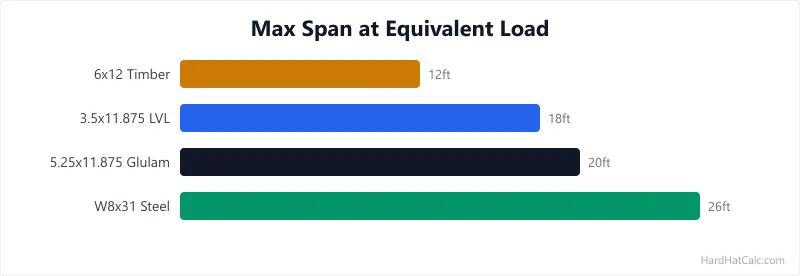
Steel wins on raw strength-to-weight ratio. A W8x31 steel beam (8 inches deep, 31 pounds per foot, a figure you can confirm with the steel weight calculator) can carry the same load as a 11-7/8-inch LVL over a 16-foot span. That difference in depth matters when every inch of headroom counts — basement conversions and low-ceiling renovations are where steel earns its keep.
For spans under 12 feet in standard residential framing, wood beams handle typical floor and roof loads without issue. A doubled or tripled 2x10 LVL handles most single-storey bearing walls at these distances. Push beyond 16 feet and the wood options get bulky. A 20-foot clear span in wood might require a 14-inch-deep PSL or a four-ply LVL, eating into ceiling height and adding weight that complicates installation.
Steel spans that distance with a shallower profile and less concern about long-term deflection. Under sustained load over years, wood beams can develop creep — a slow, permanent sag that steel resists. This matters most in living spaces where a visible sag in a ceiling line is both a structural and an aesthetic problem.
If you need to check whether a steel section fits your span and load, the calculator below runs the sizing maths for common residential scenarios.
Clear span between supports — the unsupported distance the beam must bridge.
Pounds per linear foot of beam. Use the load-bearing wall calculator to determine this if unsure.
W-flange is the standard for building construction. C-channel is used for lighter loads and headers.
For estimation only. Structural work requires review by a licensed engineer. Local building codes take precedence over any calculator output.
How This Is Calculated
Maximum bending moment M = (w x L²) / 8 where w = distributed load (plf) and L = span (ft). Required section modulus S = (M x 12) / Fb where Fb = 21,600 psi for A36 steel (0.6 x Fy, the traditional ASD-era allowable, below the AISC 360-22 ASD capacity for compact braced sections). Deflection check: δ = 5wL⁴ / (384EI), limited to L/360 for live load. The calculator returns the first section in its depth-ordered table that satisfies BOTH bending and deflection requirements — whichever governs — which is not always the lightest qualifying section. If required section modulus exceeds the table maximum, a warning is displayed. Total weight = beam weight per foot x span. Estimated cost = total weight x $2.25/lb (mid-range fabricated steel, March 2026).
Source: Simplified allowable-stress sizing: Fb = 0.6 × Fy = 21,600 psi for A36 steel applied to the elastic section modulus — the ASD-era allowable (printed as Fb = 0.6Fy in the AISC Engineering Journal beam-stress cases and as 0.60Fy for non-compact sections in reference tables), a conservative simplification that understates the capacity the full AISC 360-22 ASD method assigns compact, laterally braced sections. Deflection limit L/360 for floor members per IBC Table 1604.3 (2021 Seattle Building Code Chapter 16 and the Texas 2021 IBC adoption, both opened 1 September 2026). E = 29,000 ksi per the AISC Steel Bridge Design Handbook, Chapter 1. Section properties (Sx, Ix, weight per foot) from the AISC Shapes Database v16.0 (August 2023, consistent with the Steel Construction Manual, 16th Edition, 1st Printing); re-keyed 1 September 2026, when 20 of 46 cells moved by under 1 percent from an earlier print lineage.
For a deeper look at what happens when you remove a load-bearing wall, that calculator walks through the tributary load analysis that determines what your replacement beam actually needs to carry.
Cost Breakdown
Material cost favours wood by a wide margin. A solid sawn Douglas Fir 6x10 runs $5–$12 per linear foot. An engineered LVL of comparable capacity costs $10–$25 per linear foot. Steel W-beams for residential work typically fall between $15–$45 per linear foot for the raw material, depending on the section weight and current steel prices.
But material cost is only part of the picture. Installation cost is where the gap narrows or even reverses in some situations. Consider what a steel beam installation actually involves:
Steel beams are heavy. A W8x31 weighs 31 pounds per linear foot — a 16-foot beam tips the scales at nearly 500 pounds. Getting it into position inside an existing house usually requires a beam cart, temporary shoring, and sometimes a small crane. That means a crew of three to four and potentially equipment rental. If your steel beam needs site welding for bearing plates or moment connections, factor in steel connection and welding costs on top of the standard installation labour. Labour and equipment for steel installation typically adds $25–$75 per linear foot on top of the material.
Wood beams are lighter and more forgiving to install. Two workers can carry and position most residential wood beams. The tools required are standard carpentry equipment — no welding, no crane. Labour for wood beam installation adds $10–$25 per linear foot.
The total installed cost comparison:
- Steel beam installed: $40–$120 per linear foot
- Wood beam installed: $15–$50 per linear foot
Those ranges overlap in the middle. A short steel beam in an accessible new-build location can cost less installed than a long engineered wood beam in a tight renovation. Context matters more than the material itself.
To estimate the lumber and labour costs for a wood beam option, this calculator breaks down the pricing by species, grade, and beam configuration.
Species affects price, strength, and decay resistance.
Actual width — a nominal 4x is 3.5 inches.
Actual depth — a nominal 10 is 9.25 inches.
For estimation only. Structural work requires review by a licensed engineer. Local building codes take precedence over any calculator output.
How This Is Calculated
Board feet per beam = (actual width in. x actual depth in. x length ft) / 12. Cost per beam = board feet x cost per BF for species (SPF $2.80, Douglas Fir $3.60, SYP $3.10, LVL $5.50). Hardware estimate = $35 per beam (hangers + bolts). Total = (cost per beam + hardware) x quantity.
Source: Board foot calculations per standard lumber measurement conventions (board foot = 1" × 12" × 12"). Source-set correction of 2026-08-22: the material-pricing attribution to RS Means 2026 residential cost data and national lumber distributor averages is withdrawn. The 2026 RS Means catalog carries no "Cost Data" product line, the data is subscription-only and was never opened, and no distributor average was ever recorded; the free channels publish wholesale prices per thousand board feet and producer price indexes, not the retail per-board-foot prices this page ships (sweep record: audits/sourcing-1-retrieval/rsmeans/). The per-species prices are unchanged and ship unverified.
If you are framing a deck or floor system that feeds into your beam, the joist span calculator helps determine the loads your beam needs to support based on joist spacing and tributary width.
Fire Performance
This one surprises most people. Unprotected steel fails faster in a fire than solid wood.
Steel does not burn, but it loses structural strength rapidly as temperature rises. At around 1,000°F (538°C) — a temperature reached within 5–10 minutes in a typical residential fire — steel retains only about 50% of its yield strength (per AISC Design Guide 19: Fire Resistance of Structural Steel Framing and ASTM E119 standard fire test data). By 1,200°F, it has lost enough rigidity to buckle or collapse. An unprotected steel beam in a fire can fail in as little as 15 minutes.
Large solid wood beams char on the outside, and that char layer actually insulates the inner wood. A 6x10 timber beam can maintain structural integrity for 30–60 minutes in a fire because the nominal charring rate of softwood is approximately 1.5 inches per hour per NDS 2024 Chapter 16 (Fire Design of Wood Members) and the AWC Technical Report 10. The uncharred core retains its full strength. This predictable charring behaviour is why heavy timber construction has a well-established fire rating methodology codified in the NDS.
In practice, both materials get fire protection in finished construction. Steel beams are wrapped in drywall, sprayed with intumescent coatings, or encased in concrete. Wood beams in finished spaces are typically covered by drywall ceilings. The unprotected fire rating matters most during construction (before finishes are applied) and in exposed-beam designs where the structural member is visible.
Installation and Renovation Practicality
In a new build with open framing and crane access, steel installation is straightforward. The beam arrives fabricated to length, the crew lifts it into place, and it bolts to bearing plates. Total beam installation might take half a day.
Renovation is a different story. During my own room expansion project, the contractor had to thread a 14-foot steel beam through an existing doorway, down a hallway, and into position between two stone walls. The beam could not be tilted vertically because the ceiling was too low. It could not be brought through the new opening because the temporary shoring was in the way. The solution involved removing a window temporarily to slide the beam in from outside. That added half a day of labour and the cost of reinstalling the window frame.
Wood beams can be built up in place. A triple-ply LVL can be carried in as three separate planks and laminated together with construction adhesive and through-bolts on site. Each ply weighs a third of the total, making it manageable for two workers in tight spaces. This built-up approach is one of the strongest practical arguments for wood in renovation work.
There are situations where this advantage flips. If headroom is critical and every inch of beam depth matters, a shallower steel section might be the only option that avoids lowering the finished ceiling. In my Northumberland project, the stone walls had limited bearing surface, and the engineer specified steel specifically because the shallower profile avoided underpinning the existing foundations to accommodate a deeper wood beam. The access headache was worth avoiding the foundation work.
Long-Term Maintenance and Durability
Steel beams in dry interior environments need almost no maintenance. Once installed inside a wall or ceiling cavity, a steel beam can last the lifetime of the building without attention. The risk is moisture. In basements, crawl spaces, or any location where condensation occurs, uncoated steel corrodes. A primer coat and rust-inhibiting paint address this, but the coating needs inspection every 10–15 years in damp environments.
Wood beams are vulnerable to moisture, insects, and fungal decay. Pressure-treated lumber resists these threats but is not typically used for structural beams in interior framing — the treatment chemicals can corrode metal fasteners and hangers unless compatible hardware is specified. In dry, conditioned interior spaces, wood beams perform well for decades. In exposed or semi-exposed locations (porches, carports, crawl spaces), wood demands ongoing inspection and may need retreatment or replacement over a 30–50 year horizon.
Engineered wood products like LVL and PSL are more dimensionally stable than solid sawn lumber. They resist warping, twisting, and splitting because the manufacturing process randomises the wood grain orientation. For renovation beams that will be hidden inside walls, engineered wood offers a practical middle ground: easier to install than steel, more predictable than solid timber.
When to Choose Steel
Steel makes sense in specific circumstances. The following scenarios push the decision toward a steel beam:
- Long clear spans (16+ feet): Steel handles these with a shallower profile than any wood option, preserving headroom.
- Heavy point loads: When carrying concentrated loads from columns above, steel's consistent material properties simplify the engineering.
- Headroom-critical renovations: Basement conversions and low-ceiling remodels where every inch of beam depth matters.
- Termite-prone regions: Steel eliminates insect vulnerability entirely.
- Open-plan designs with minimal columns: Fewer support posts means longer spans, which favours steel.
The steel beam size calculator helps you explore which W-beam sections fit your span and load requirements before requesting a formal engineering specification.
When to Choose Wood
Wood beams are the practical default for most residential work. These situations reinforce that choice:
- Spans under 14 feet: Engineered wood handles standard residential loads at these distances without headroom penalties.
- Tight renovation access: Built-up beams can be assembled in place from individual plies, avoiding crane rental and access problems.
- Budget-sensitive projects: Lower material and installation costs, with stock availability at local lumber yards.
- Exposed beam aesthetics: Wood beams are a design feature in many interiors — steel beams need cladding to achieve the same look.
- DIY-friendly projects (non-structural): Decorative or lightly loaded beams where professional installation is not strictly required.
For estimating how much a wood beam will cost including species, grade, and labour, the wood beam cost calculator breaks it down by project specifics.
The Hybrid Approach
On larger renovations, you may not need to pick just one material. A common pattern in open-plan conversions uses a steel beam for the primary span (the long run across the widest opening) and wood beams for secondary spans that frame into it. If the project also involves roof truss selection, beam placement and truss bearing points need to be coordinated in the same structural drawing. The steel handles the heavy structural lift while wood keeps costs down on the shorter, lighter-loaded members.
My own project used exactly this approach. A single steel beam carried the primary span across the removed wall, and doubled LVL joists framed into it on either side. The engineer designed the connection details — steel-to-wood requires specific joist hangers rated for the interface — and the result was structurally sound without the cost of an all-steel framing system.
Whatever combination you choose, the structural engineer's stamp on the drawings is what your building inspector will want to see. The beam material is a means to an end. The end is a safe, code-compliant structure.
Frequently Asked Questions
- Can I replace an existing wood beam with steel to open up more headroom?
Yes, this is one of the most common reasons for swapping wood to steel in renovations. A steel beam rated for the same load is typically 2–4 inches shallower than the wood beam it replaces, which reclaims ceiling height. However, the swap requires a structural engineer to verify that the existing bearing points (posts, columns, foundation pads) can handle the concentrated loads that a steel beam delivers differently than wood. You will also need temporary shoring to support the structure while the old beam comes out and the new one goes in. A W-section selector determines the shape needed for your specific span and load.
- Does a steel beam need fireproofing in a residential wall cavity?
Building codes in most US jurisdictions (per IBC Section 704 and IRC Section R302) require steel beams in occupied spaces to be protected by a fire-rated assembly — typically 5/8-inch Type X drywall providing a 1-hour rating. The drywall enclosure is usually part of the standard wall or ceiling finish, so it adds no extra cost in most situations. In exposed-beam designs where the steel is left visible, an intumescent coating (a paint that expands into an insulating char when heated) is the alternative, though it adds $5–$15 per linear foot. Check your local building code — requirements vary by occupancy type and beam location. The fireproofing material calculator estimates SFRM and intumescent coating quantities for exposed steel.
- How do I know if my foundation can support a steel beam?
Steel beams concentrate their load onto smaller bearing points than wood beams, which means the foundation pads or posts beneath each end carry more force per square inch. Your structural engineer calculates the point load at each bearing location and compares it against the foundation capacity. In new construction, the foundation is designed around the beam loads. In renovations, existing footings may need reinforcement — a common solution is pouring a larger concrete pad beneath each bearing post. This is one of the hidden costs of retrofitting steel into an older structure that was originally framed for wood. A footing volume tool sizes the pad for the point load at each bearing location.
- Are engineered wood beams like LVL as strong as steel for residential spans?
For spans up to about 20 feet under typical residential floor and roof loads, engineered LVL and PSL beams can match the load capacity of smaller steel W-beam sections. The trade-off is depth: the wood beam will be deeper (taller) than the steel beam carrying the same load, which reduces available headroom. Beyond 20 feet, steel pulls ahead decisively — the wood sections required become impractically deep and heavy. Within that 12-20-foot range, both materials are structurally viable, and the choice comes down to cost, access, headroom, and your engineer's recommendation for the specific loading conditions. The LVL-vs-sawn pricer prices LVL and sawn lumber options for side-by-side comparison with steel.