
Fireproofing Material Calculator
Fireproofing material calculator for steel beams and columns. Enter member size, fire rating, and method for SFRM thickness and coating coverage.
Last updated:
Methodology reviewed by Doc. dr. sc. Bojan Milovanović, dipl. ing. građ., PhD, Civil Engineering (FCE, University of Zagreb)
Columns require thicker fireproofing than beams because they are exposed on all four sides.
Fire rating per building code. Columns in Type I buildings typically need 3 hours; beams 2 hours.
SFRM is the standard for concealed steel. Intumescent coatings are used when the steel is architecturally exposed; enter the DFT from your product's evaluation report below.
Combined length of all steel members to be fireproofed.
Perimeter of the steel cross-section exposed to fire. W10×22 beam: ~30 in. W14×48 column: ~48 in.
Dry film thickness the evaluation report lists for your member size and rating; intumescent method only. Examples opened for this page, both for a 1-hour W10×49 column: FIRETEX FX6002 173 mils (0.173 in., ICC-ES ESR-4766) and FIRETEX FX9502 187 mils (0.187 in., ESR-4767). FX6002 is certified from 16 mils (cure minimum) up to 160 mils on wide-flange beams and 420 mils on wide-flange columns.
Fraction of the wet coating that stays as dry film; intumescent method only. FIRETEX FX6002 prints 92% volume solids (0.92); its application manual puts solvent-based intumescent coatings around 70%.
For estimation only. Structural work requires review by a licensed engineer. Local building codes take precedence over any calculator output.
How This Is Calculated
SFRM thickness from the table by fire rating and member type (fibrous uses the same table, no thinning factor). Surface area = heated perimeter × length / 12. SFRM bags = surface area / (46 board feet per bag / thickness in inches). Intumescent: thickness = the DFT you enter from the product's ICC-ES report; sq ft per gallon = 1,604 × volume solids / DFT in mils; gallons = surface area / sq ft per gallon (shown under Coating Volume); pails = gallons / 5; the cu ft tile shows gallons × 0.133681. Cost = bags or gallons × unit price (site estimate).
Source: SFRM thickness tables are typical values for cementitious CAFCO 300 / ISOLATEK Type 300 at a W/D of about 0.6, kept on the safe side of the UL designs opened for this page (2026-09-02, own capture; hashes re-checked 2026-09-05): UL S721 prints 7/16 to 11/16 in. (1.5 h), 11/16 to 15/16 in. (2 h) and 1-3/16 to 1-7/16 in. (3 h) for a W6x16 beam; UL X790 prints 5/8 to 3/4 in. (1 h), 15/16 to 1-1/8 in. (1.5 h), 1-1/4 to 1-7/16 in. (2 h) and 1-13/16 to 2-1/16 in. (3 h) for W6x16 and W8x28 columns; UL N761 carries the open-web joist ladder. Fibrous SFRM carries no thinning factor: at identical pipe and tube column shapes, Isolatek's fibrous dry-mix design UL X827 (Types HP, D-C/F, II and II HS, as the design printout names them — it carries no trade name) lists 8 to 41% MORE thickness than its cementitious design UL X790 (CAFCO 300). Intumescent dry film thickness is an input you take from the product's ICC-ES evaluation report: ESR-4766 lists 0.173 in. for FIRETEX FX6002 and ESR-4767 0.187 in. for FIRETEX FX9502, both for a 1-hour W10x49 column. Coating coverage = 1,604 sq ft-mil per gallon x volume solids / DFT in mils; FIRETEX FX6002 prints 92% volume solids. SFRM bag yield is capped at 46 board feet per bag, the Isolatek CAFCO 300 gross-yield ceiling at the UL minimum average density of 15 pcf. The individual-reading tolerance for intumescent coatings is 80% of the specified thickness, as printed in ESR-4766 and ESR-4767 section 4.4.2 (ESR-4766's evidence section names ICC-ES acceptance criterion AC23, the criterion this page cites since 2026-09-12; ESR-4767 names a different criterion). Cost bands, productivity and expansion figures are this site's own estimates (disclosed in the cost section). Ruling record: audits/sf20-a8-rulings-2026-09-03.md.
- UL Design X790 — CAFCO 300 wide-flange columns (Isolatek printout)
- UL Design S721 — CAFCO 300 beams and joists (Isolatek printout)
- UL Design N761 — CAFCO 300 steel-joist floor and roof (Isolatek printout)
- UL Design X827 — Isolatek fibrous dry-mix SFRM, Types HP / D-C/F / II / II HS, pipe and tube columns (Isolatek printout)
- CAFCO 300 Short Form Application Guide (yield chart)
- CAFCO 300 / ISOLATEK Type 300 Technical Data Sheet
- ICC-ES ESR-4766 — FIRETEX FX6002
- ICC-ES ESR-4767 — FIRETEX FX9502
- FIRETEX FX6002 Application Manual (Sherwin-Williams)
9 min read
SFRM Thickness Requirements by Fire Rating
Spray-applied fire-resistive material thickness depends on three factors: the required fire rating (hours), the type of structural member (beam vs. column), and the weight-to-heated-perimeter ratio (W/D) of the steel section. Heavier steel sections need less fireproofing because their greater mass absorbs more heat before reaching the ASTM E119 limiting temperature: an average of 1,100 deg F (593 deg C) for loaded beams, and 1,000 deg F (538 deg C) for loaded columns.
| Fire Rating | Beams (W/D ≈ 0.6) | Columns (W/D ≈ 0.6) | Open Web Joists |
|---|---|---|---|
| 1 hour | 0.50 in | 0.75 in | 0.75 in |
| 1.5 hours | 0.75 in | 1.00 in | 1.00 in |
| 2 hours | 1.00 in | 1.50 in | 1.25 in |
| 3 hours | 1.50 in | 2.25 in | 2.00 in |
These are typical values for cementitious CAFCO 300 / ISOLATEK Type 300 (15 pcf, the density Isolatek calls commercial density) held on the safe side of the UL designs opened for this page. UL S721 prints, for a W6×16 beam, 7/16 to 11/16 in. at 1.5 hours, 11/16 to 15/16 in. at 2 hours and 1-3/16 to 1-7/16 in. at 3 hours; UL X790 prints, for W6×16 and W8×28 columns, 5/8 to 3/4 in. at 1 hour, 15/16 to 1-1/8 in. at 1.5 hours, 1-1/4 to 1-7/16 in. at 2 hours and 1-13/16 to 2-1/16 in. at 3 hours; UL N761 covers the joist ladder for the 12K5, 8K1 and 10K1 series. Where the table sits above a printed value it orders a little more material, never less. Actual required thickness depends on the specific UL design number, the SFRM product, and the W/D ratio of your steel section. Always reference the UL design for the exact thickness — the values above are for estimating quantities, not for specifying fire protection.
Fibrous SFRM is not thinner than cementitious. At identical pipe and tube column shapes, Isolatek's own fibrous dry-mix design UL X827 (Types HP, D-C/F, II and II HS — the design printout carries no trade name) lists 8 to 41% MORE thickness than its cementitious design UL X790 (CAFCO 300), so this calculator applies the same table to both methods and no reduction to the fibrous one.
Columns require thicker SFRM than beams at the same fire rating because columns are exposed to fire on all four sides (4-sided exposure), while beams protected by a concrete floor slab above are typically exposed on only three sides (3-sided exposure). The slab acts as a heat sink on the top flange, reducing the rate of temperature rise in the steel.
The W/D ratio directly determines the required SFRM thickness. A heavier beam (higher W) with a smaller heated perimeter (lower D) has a higher W/D ratio and needs less SFRM. A W14×48 beam (W/D ≈ 0.85) needs roughly 20% less SFRM than a W10×22 beam (W/D ≈ 0.52) for the same fire rating. The structural engineer or fire protection engineer calculates W/D for each member and specifies the corresponding thickness from the UL listing. For the structural sizing of the steel beams themselves, you can check steel beam sizing for span, load, and section selection.
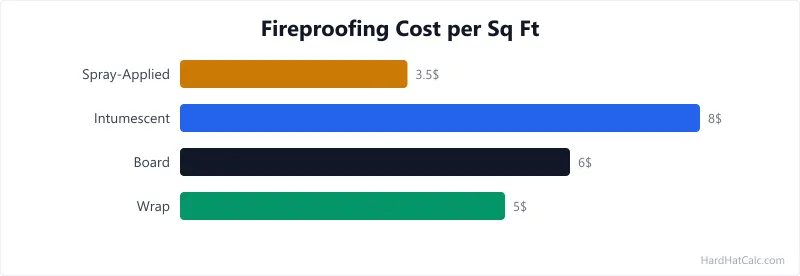
SFRM vs. Intumescent vs. Board: Choosing the Right Method
Three methods protect structural steel from fire, each suited to different project conditions and budgets.
SFRM (cementitious or fibrous) is the workhorse of commercial fire protection. A crew sprays the material directly onto the steel surface, building up thickness to match the UL listing requirement. Cementitious SFRM (Isolatek Cafco, GCP Monokote) is the most common: it is cheap ($8-$15 per bag), fast to apply (a crew can cover 3,000-5,000 sq ft per day), and bonds well to clean steel. The drawback is appearance — SFRM is a rough, grey-white coating that looks unfinished. It is standard practice behind drywall ceilings and inside wall cavities where appearance does not matter. SFRM is also fragile; it chips and breaks if struck, which makes it unsuitable for areas with regular human contact.
Intumescent coatings are thin-film paints that swell when exposed to fire, expanding to 20-50 times their original thickness and forming an insulating char that protects the steel. At room temperature, intumescent looks like ordinary paint — smooth, thin, and available in any topcoat colour. This makes it the only practical option for architecturally exposed steel (AES) in restaurants, lobbies, atriums, and lofts. The cost is 5-15 times higher than SFRM per linear foot, and application requires multiple coats with controlled drying conditions. The required dry film thickness (DFT) comes from the product's ICC-ES evaluation report, not from a generic ladder: the two reports opened for this page list 0.173 in. (ESR-4766, FIRETEX FX6002) and 0.187 in. (ESR-4767, FIRETEX FX9502) for a 1-hour W10×49 column, and FX6002 is certified from 16 mils up to 160 mils on wide-flange beams and 420 mils on wide-flange columns. Enter the figure from your report in the calculator.
Fire-rated board systems (gypsum board, calcium silicate board) encase the steel in a box of non-combustible panels. Two layers of 5/8-inch Type X drywall on a steel stud frame provide a 2-hour rating. Board systems are self-installed by drywall contractors (no specialty fireproofing crew needed) and produce a finished surface. The trade-off is bulk — the board enclosure adds 2-4 inches to each side of the steel, reducing usable space. Board systems work well for columns in corridors where the enclosure becomes an architectural element.
The bag and per-gallon prices, the 3,000-5,000 sq ft per day productivity figure, the 5-15 times cost ratio and the 20-50 times expansion at 350-400 °F quoted above are not taken from a published source. This is our own estimate; no published source backs these figures. Check your results against your product data or a licensed professional before acting.
Application and Inspection Requirements
SFRM application is a specialised trade with strict quality control requirements. The fireproofing contractor must be certified by the SFRM manufacturer (Isolatek or GCP), and the work is inspected against the UL listing specification.
Steel surface preparation is the first requirement. SFRM bonds to clean, bare steel — not to oil, mill scale, rust, or paint. For new construction, the steel arrives from the fabricator with a light mill scale that SFRM bonds to adequately. For retrofit work on existing painted steel, the paint must be tested for adhesion and compatibility. If welded connections need to be made before fireproofing, estimate the welding time and filler material first — SFRM cannot be applied over fresh weld spatter or flux residue. Some primers (inorganic zinc, alkyd) are compatible; others (latex, epoxy) are not. The SFRM manufacturer's approval is required before spraying over any existing coating.
Thickness measurement during application uses a wet-film gauge (for SFRM) or a dry-film thickness gauge (for intumescent). The applicator measures thickness at regular intervals — typically every 100 sq ft of coverage — and records the readings. The average measured thickness must meet or exceed the specified thickness. For intumescent coatings, the floor for any single reading is 80% of the specified thickness, as printed in ESR-4766 and ESR-4767, section 4.4.2 (ESR-4766 lists ICC-ES acceptance criterion AC23 in its evidence section; ESR-4767 names a different criterion). The SFRM-side individual-reading rule (AWCI Technical Manual 12-A) was not opened for this page; use the tolerance your UL design and specifier state. These measurements become part of the inspection documentation.
Density testing verifies that the SFRM was mixed and applied at the correct density. ASTM E605 specifies the core-cutting method: a circular punch extracts a plug of cured SFRM, which is weighed and measured. The density must fall within the range specified in the UL listing — 15 pcf minimum average (14 pcf minimum individual) for the CAFCO 300 series and 22 pcf for the 400 series per UL X790, with the CAFCO 300 data sheet printing 15 pcf. Low-density material (under-mixed or over-watered) does not provide the rated fire protection even at the correct thickness, and that is also why the bag yield caps at 46 board feet: Isolatek's own yield chart warns that exceeding 46 board feet per bag drops the density below 15 pcf.
Bond testing (ASTM E736) measures the adhesive strength of the SFRM to the steel substrate. The CAFCO 300 data sheet states a minimum bond of 150 psf over uncoated or galvanized steel; the 200 psf figure sometimes quoted for vertical surfaces was not found in any document opened for this page. Failed bond tests require removal and re-application — a costly rework item that proper surface preparation prevents.
Building Code Fire Rating Requirements
The required fire rating for structural steel depends on the building type, occupancy classification, and height/area. Here is how to determine the fire rating for your project.
Identify the building type from IBC Table 601. The International Building Code classifies buildings into Types I through V based on the fire resistance of structural elements. Type IA (fully fire-rated non-combustible) requires 3-hour columns and 2-hour beams. Type IIB (unprotected non-combustible) requires 0 hours — no fireproofing at all. Most commercial steel buildings fall into Types IA, IB, IIA, or IIB.
Check whether your building qualifies for a reduced type. Building area, height, and sprinkler systems can allow a less restrictive building type. A fully sprinklered building gets area and height increases (IBC 504, 506) that often permit Type IIA or IIB construction — which requires 1-hour or zero fire rating on the structural frame.
Determine the rating for each element. IBC Table 601 specifies hours by element: structural frame (columns, beams, bracing), floor assemblies, roof assemblies, and bearing walls. Columns always have the highest rating because column failure leads to progressive collapse. Roof structures in some building types have no fire rating requirement because the roof is not a means of egress.
Check occupancy-specific requirements. High-hazard (Group H), assembly (Group A), and institutional (Group I) occupancies may require higher ratings than the base table. Hospitals and detention facilities typically need the full Type IA construction.
Reference the correct UL design number. Every fire-rated assembly has a UL design number (for example X790 for contour-sprayed wide-flange columns, S721 for beams) that specifies the exact materials, thicknesses, and construction details. The architect or fire protection engineer specifies the design number on the drawings, and the fireproofing contractor builds to that specification. Isolatek serves its UL design printouts and per-shape thickness charts free from its own website, so the design for your product can be read before the estimate is made.
Cost Factors and Bidding Considerations
Fireproofing costs depend on more than just material quantity. Access, timing, cleanup, and retouching drive the total installed price far beyond the raw material calculation.
Mobilisation and containment represent a fixed cost regardless of project size. A fireproofing crew brings a spray rig, mixer, compressor, and scaffolding to the site. They cover all adjacent surfaces with plastic sheeting to contain overspray — SFRM is messy, and removing it from finished surfaces is expensive. This setup takes 1-2 days for a typical floor plate and costs $2,000-$5,000. On small projects (under 5,000 sq ft), mobilisation can exceed the material cost.
Retouching after other trades is a common cost that gets overlooked. Electricians, plumbers, and HVAC installers damage SFRM when running conduit, pipe, and ductwork through fireproofed steel. Every scrape, dent, and removed section must be repaired to maintain the fire rating. Retouching typically adds 10-20% to the base fireproofing cost and should be a separate bid item so the general contractor can charge it back to the trade that caused the damage.
Height and access affect labour productivity. Ground-floor steel that a worker can reach from a ladder costs less per linear foot than steel at 30 feet that requires scissor lifts or scaffolding. Multi-storey buildings typically see fireproofing costs increase 15-25% per floor above the second storey due to vertical material transport and equipment positioning.
The fully installed cost for SFRM runs $2-$6 per linear foot of structural steel for 2-hour ratings. Intumescent coating runs $15-$40 per linear foot for the same rating at older rule-of-thumb thicknesses; at the DFT an evaluation report actually requires (173 mils for a 1-hour W10×49 column), the coating alone can pass $39 per foot, as the second worked example shows. Board enclosures (two layers of Type X drywall) cost $8-$15 per linear foot including the stud framing. These ranges assume typical commercial conditions with reasonable access and standard steel sizes. Every cost figure in this section, the $11 per bag and $100 per gallon the calculator applies, and the mobilisation, retouching and height percentages are not taken from a published source. This is our own estimate; no published source backs these figures. Check your results against your product data or a licensed professional before acting. For projects that combine fireproofing with broader building upgrades, the energy retrofit cost estimator covers insulation and envelope improvements that complement the fire protection scope.
Worked Examples
Example 1
Scenario: A commercial office building has 500 linear feet of W14×30 floor beams requiring 2-hour fire-rated SFRM (cementitious). Average heated perimeter is 36 inches.
Calculation: Table SFRM thickness for a 2-hr beam = 1.0 inch (UL S721 prints 11/16 to 15/16 in. for a W6×16 beam at 2 h, so the table sits on the safe side). Surface area = 36 × 500 / 12 = 1,500 sq ft. Bags at 46 board feet per bag at 1 inch = ⌈1,500 / 46⌉ = 33 bags. Material cost = 33 × $11 = $363. Cost per linear foot = $363 / 500 = $0.73/ft.
What this means: Thirty-three bags of cementitious SFRM cover 500 feet of floor beams at 2-hour rating for about $363 in materials at the site's $11 per bag estimate. The bag count follows Isolatek's own yield ceiling of 46 board feet per bag: spraying a bag any thinner drops the density below the 15 pcf UL minimum, so a thinner estimate would also be a non-compliant one. The bulk of the installed cost is labour, equipment and cleanup rather than the product.
Takeaway: SFRM is the low-cost fire protection method for concealed structural steel; the product itself is a small share of the project cost. The bag price and the installed-cost bands on this page are the site's own estimates, disclosed in the cost section below.
Example 2
Scenario: An architect specifies FIRETEX FX6002 intumescent coating on 300 feet of exposed W10×49 columns in a restaurant renovation requiring a 1-hour fire rating. ICC-ES ESR-4766 lists 0.173 inches (173 mils) for that section and rating, the product prints 92% volume solids, and the boxed heated perimeter is 40 inches (2 × (10 + 10)).
Calculation: DFT = 173 mils = 0.173 inches (entered from ESR-4766). Surface area = 40 × 300 / 12 = 1,000 sq ft. Coverage = 1,604 × 0.92 / 173 = 8.53 sq ft/gal. Gallons = 1,000 / 8.53 = 117.2 gallons → 118 gallons (about 16 cu ft of coating) → 24 pails (5-gal). Material cost = 117.2 × $100 = $11,723. Cost per linear foot = $11,723 / 300 = $39.08/ft.
What this means: At the thickness the evaluation report requires, 300 feet of exposed columns take about 117 gallons of coating, roughly $11,700 in materials at the site's $100 per gallon estimate. That is over 30 times the SFRM material cost per foot in the first example: a 1-hour listing on a W10×49 needs 173 mils of dry film, not the 20 to 25 mils that older rule-of-thumb ladders quoted.
Takeaway: Never size intumescent coating from a generic thickness ladder. The ICC-ES report for the specific product, member size and rating is the only source of the DFT, and it drives every quantity and cost on this page. The per-gallon price and the installed-cost bands are the site's own estimates.
Frequently Asked Questions
- How thick does fireproofing need to be on structural steel?
SFRM thickness depends on the fire rating, steel section size, and member type. For a 2-hour rating on a typical floor beam (W/D ratio around 0.6), this page's table uses 1.0 inch of cementitious SFRM; UL S721 prints 11/16 to 15/16 in. for a W6×16 beam at 2 hours, so the table orders slightly more. Columns at the same rating use 1.5 inches (UL X790: 1-1/4 to 1-7/16 in. for W6×16 and W8×28) because they are exposed to fire on all four sides. For 3-hour ratings, the table moves to 1.5 inches for beams and 2.25 inches for columns. Always reference the specific UL design number for exact thickness — these figures are for estimating only. To size the steel section itself, the structural-steel section selector determines the W-shape before you specify fireproofing.
- What is the difference between SFRM and intumescent fireproofing?
SFRM (spray-applied fire-resistive material) is a thick, cementitious or fibrous coating sprayed onto steel at 0.5-2.25 inches depending on fire rating. It is cheap ($2-$6/lin ft installed, a site estimate) but looks rough and industrial. Intumescent coating is a thin coating whose required dry film thickness comes from the product's ICC-ES evaluation report (the two reports opened for this page list 0.173 in. for ESR-4766 and 0.187 in. for ESR-4767, both for a 1-hour W10×49 column) and it swells when heated to form an insulating char. It costs several times more per foot but looks like regular paint, making it the only practical option when structural steel is architecturally visible; the installed-cost bands on this page are the site's own estimates. The choice between steel and wood beams sometimes hinges on fireproofing cost — wood achieves fire ratings through charring without any additional coating.
- Does spray fireproofing contain asbestos?
Modern SFRM products do not contain asbestos. Asbestos-containing spray fireproofing was banned in the US in 1973 (EPA regulations under the Clean Air Act). Current cementitious SFRM is made from portland cement, gypsum, mineral wool or vermiculite, and binding agents. If you are working in a building constructed before 1980, existing spray fireproofing should be tested for asbestos before disturbing it — removal of asbestos-containing material requires licensed abatement contractors and regulated disposal. Pre-1980 buildings undergoing renovation may also need energy retrofitting to meet current code alongside the fireproofing update.
- Can you paint over spray fireproofing?
Cementitious SFRM can be painted with latex paint if needed, but this is uncommon because SFRM is almost always concealed behind ceilings and wall finishes. Painting SFRM does not affect its fire rating as long as the paint does not add significant thickness or alter the thermal properties. Intumescent coatings can and should be topcoated — most systems require a topcoat for UV protection, corrosion resistance, and colour. The topcoat must be compatible with the intumescent base coat — always use the topcoat specified by the intumescent manufacturer. If the SFRM is hidden behind drywall, the board-and-joint-compound estimator estimates the board and joint compound for the enclosure.
More Materials calculators
Browse all materials calculators — Paint coverage, roofing bundles, tile adhesive, welding time, parking lot sizing, and more.