
Sqft to Percentage Calculator
Square feet to percentage calculator for lease CAM shares, HVAC allocation, and cost splits. Enter total and partial areas for the percentage of total.
Last updated:
Total building area, lot area, or reference area.
The portion you want to express as a percentage of the total.
How This Is Calculated
Percentage = (partial area ÷ total area) × 100. Remaining area = total area − partial area. Remaining percentage = 100 − percentage.
Source: Area measurement standards per BOMA International (Building Owners and Managers Association) Office Standard. Code thresholds per IRC R303.1 and IECC fenestration limits.
6 min read
When Do You Need Area-to-Percentage Conversions?
This calculation looks simple on the surface — divide one number by another, multiply by 100. But in construction and real estate, knowing what percentage a space occupies is the entry point to decisions that involve serious money.
Commercial lease negotiations. Multi-tenant buildings allocate common area maintenance (CAM) charges based on each tenant's proportionate share. If your retail space is 1,200 sq ft in a 15,000 sq ft building, your share is 8%. That percentage determines how much you pay for lobby cleaning, parking lot maintenance, landscaping, and building insurance. Getting the base area wrong by even 50 sq ft can shift CAM charges by hundreds of dollars per year over a 5-year lease.
HVAC load allocation. Heating and cooling costs in a shared building are often split by floor area percentage. A tenant occupying 22% of the building pays 22% of the HVAC bill. But area alone is a crude metric — a south-facing office with floor-to-ceiling windows generates far more cooling load per square foot than an interior hallway. Sophisticated buildings use sub-metering, but most still fall back on area percentage.
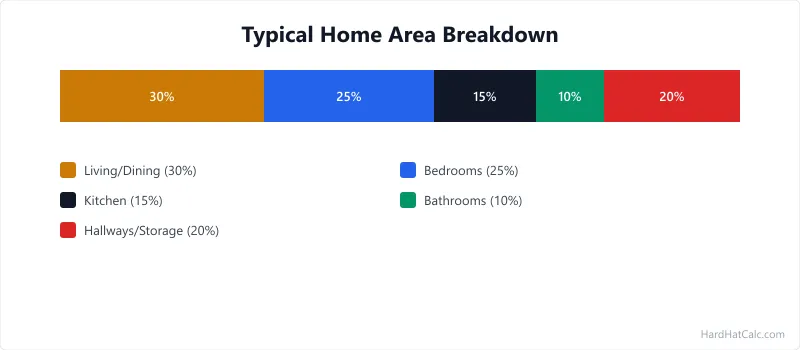
Renovation budgeting. When a contractor quotes a whole-house renovation, breaking costs by room percentage helps prioritise spending. If the kitchen is 12% of the floor area but accounts for 35% of the renovation cost, that ratio tells you where the money is going. Understanding these proportions helps you make informed trade-offs — maybe the 8% guest bedroom does not need the same finish level as the 12% kitchen. Pairing this area breakdown with a home energy retrofit estimate lets you allocate insulation and air-sealing budgets proportionally across the zones that leak the most energy.
Building code compliance. Many codes require that specific zones constitute a minimum percentage of the total building. For example, some energy codes require that fenestration (windows and glass doors) not exceed 30–40% of the above-grade wall area. Converting window square footage to a percentage of wall area tells you whether you meet the threshold.
Gross vs. Net Area: A Distinction That Changes the Answer
The percentage you calculate is only as accurate as the area numbers you start with. In real estate and construction, "total area" can mean at least three different things, and using the wrong one produces misleading percentages.
Gross floor area (GFA) includes every square foot within the building's exterior walls: hallways, stairwells, elevator shafts, mechanical rooms, wall thickness, and restrooms. This is the number an architect puts on the building permit and the number a tax assessor uses for property valuation. It is the largest measurement of the three.
Rentable area is the number landlords use for leases. It includes the tenant's usable space plus a proportionate share of common areas (lobbies, hallways, restrooms on multi-tenant floors). The industry standard for measuring rentable area is the BOMA International Office Standard (ANSI/BOMA Z65.1). Rentable area is always larger than the tenant's usable space because of the common area "load factor," which typically adds 10–20%.
Usable area is the actual space the tenant occupies — desk-to-wall, inside the demising walls. It is the smallest number and the one that matters for furniture planning, workstation counts, and interior buildout costs.
If a tenant's usable area is 1,000 sq ft, their rentable area might be 1,150 sq ft (with a 15% load factor), and the building's gross area might be 50,000 sq ft. The tenant's percentage changes dramatically depending on which base you use: 2.0% of gross, 2.3% of rentable on their floor, or 100% of their own usable area. For CAM charges, the landlord uses rentable area. For interior construction budgets, use usable area. For building code compliance, use gross floor area. Always confirm which "total area" applies before running the percentage. For commercial leases, the BOMA International Office Standard (ANSI/BOMA Z65.1) defines the measurement methodology.
Area Percentage in Construction Cost Allocation
When breaking down a renovation or new build budget by room or zone, two approaches give very different results.
Simple area-proportional allocation divides total cost by total area, then multiplies by each room's area. A 200-square-foot bathroom in a 2,000-square-foot house is 10% of the area, so it gets 10% of the budget. This is simple and wrong — bathrooms cost $150–$300 per square foot to renovate while bedrooms cost $50–$100 per square foot. Allocating equally by area underestimates wet-room costs and overestimates dry-room costs.
Weighted allocation assigns each room type a cost-per-square-foot multiplier, then allocates budget proportionally to the weighted areas. The bathroom's 200 sq ft at a 2.5× multiplier counts as 500 "weighted square feet," while the bedroom's 200 sq ft at 1× counts as 200. The bathroom's share of the weighted total is much higher, which matches reality. This approach is standard in professional cost estimating.
The difference matters for phased projects. If a homeowner renovates the kitchen in year one and the bedrooms in year two, the simple area method underestimates year-one spending (kitchen) and overestimates year-two spending (bedrooms). The weighted method lets the homeowner budget accurately for each phase. For a pergola addition or deck project, the cost per square foot is usually 1.5–2× the cost of interior living space because of foundation, drainage, and weather-exposure requirements.
How to Measure Area Accurately
Getting an accurate area measurement is the foundation of a meaningful percentage calculation. Sloppy measurements compound through every downstream number.
Use a laser distance meter. A $30–$50 laser measure is accurate to 1/16 inch across a room. Tape measures sag over long distances and are difficult to use solo. Measure wall-to-wall at floor level — baseboard moulding adds 1–2 inches to each wall that should not be included in floor area.
Break irregular rooms into rectangles. An L-shaped room becomes two rectangles, the same decomposition the step-by-step guide to calculating square footage walks through for rooms, walls, and angled bays. Measure each rectangle separately and add the areas. For bay windows, bump-outs, and alcoves, measure them as separate rectangles and add them to the main room area.
Decide whether to include closets. In residential real estate, closets are typically included in room area. In commercial space, storage rooms may or may not be included depending on the lease terms. Be consistent across all rooms when calculating percentages — including closets for some rooms but not others skews the comparison.
Account for wall thickness. In multi-unit buildings, the area "owned" by each unit often includes half the thickness of shared walls and the full thickness of exterior walls. A 6-inch shared wall between two units shifts 3 inches of width (about 2–3 sq ft per 10 linear feet of wall) to each unit. This matters more than you would expect in small units where every square foot affects the percentage.
Document your measurements. Sketch a floor plan with dimensions. Label each rectangle with its measured length and width and calculated area. This documentation prevents arguments later — especially in lease negotiations where the landlord's measurements and the tenant's measurements rarely agree on the first pass.
Common Percentage-Based Code Requirements
Several building codes and standards use area percentages as compliance thresholds. Knowing these benchmarks helps you use this calculator for code checks, not just general curiosity.
| Code Requirement | Percentage Threshold | Base Area | Source |
|---|---|---|---|
| Max fenestration (window) area | 30–40% of wall area | Above-grade wall area | IECC / local energy code |
| Min natural light (residential) | 8% of room floor area | Individual room | IRC 2021 R303.1 |
| Min natural ventilation | 4% of room floor area | Individual room | IRC 2021 R303.1 |
| Landscaping in parking lots | 5–15% of lot area | Total paved lot | Local zoning |
| Common area load factor (office) | 10–20% added to usable | Usable area | BOMA International Office Standard (ANSI/BOMA Z65.1) |
| ADA accessible parking | 2% of total spaces (501+) | Total parking spaces | ADA Standards |
When using this calculator for code compliance, always use the code's definition of "area" as your total. Energy codes define "wall area" as the gross area of the above-grade wall minus below-grade portions — not the interior surface area. If you are checking fenestration limits, the stud-cavity layout tool can help determine the total wall area including framed openings for windows and doors.
Worked Examples
Example 1
Scenario: A commercial tenant occupies 1,200 sq ft in a 15,000 sq ft multi-tenant building. Annual common area maintenance costs total $48,000.
Calculation: Percentage = (1,200 ÷ 15,000) × 100 = 8.00%. Remaining area = 15,000 − 1,200 = 13,800 sq ft. CAM share = 8.00% × $48,000 = $3,840 per year.
What this means: The tenant is responsible for 8% of common area charges, which works out to $3,840 annually or $320 per month on top of base rent.
Takeaway: A 50 sq ft measurement error in either direction shifts CAM by $160/year — always confirm the BOMA measurement method matches the lease before signing.
Example 2
Scenario: A homeowner wants to check whether the fenestration (windows and glass doors) on a new build exceeds the 40% code limit. Total above-grade wall area is 4,000 sq ft and total window rough-opening area is 1,100 sq ft.
Calculation: Percentage = (1,100 ÷ 4,000) × 100 = 27.50%. Remaining wall area = 4,000 − 1,100 = 2,900 sq ft.
What this means: At 27.5%, the fenestration ratio is within the 40% prescriptive limit, leaving room for an additional 500 sq ft of glazing before hitting the cap.
Takeaway: Staying 5-10% below the prescriptive limit provides a buffer for change orders — adding a patio door later would not trigger a code redesign.
Frequently Asked Questions
- How do I calculate my share of common area maintenance (CAM) charges?
Divide your rentable area by the total rentable area of the building, then multiply by 100 to get your percentage. Multiply that percentage by the total annual CAM charges to find your share. For example, 1,500 sq ft in a 25,000 sq ft building gives you 6%, so if annual CAM is $50,000, your share is $3,000. Always verify the landlord is using the same BOMA measurement standard for both your space and the building total — discrepancies in measurement method are the most common source of CAM disputes. If your lease includes parking, the parking lot size calculator estimates how much of the lot your allocated spaces represent.
- What percentage of a house does a typical kitchen occupy?
In US homes, kitchens typically occupy 10–15% of the total floor area. A 2,000-square-foot house usually has a 200–300 sq ft kitchen. Older homes (pre-1970s) tend toward the lower end, while modern open-plan homes push kitchen area toward 15% or higher because the kitchen merges with the dining and living areas. Despite occupying only 10–15% of the area, kitchens account for 25–40% of a whole-house renovation budget because of cabinetry, countertops, appliances, plumbing, and electrical density. The cabinetry material calculator estimates sheet goods and hardware for that portion of the kitchen budget.
- Does wall thickness affect area percentage calculations?
Yes, particularly in commercial buildings and condominiums where ownership boundaries run to the centre of shared walls. A 6-inch interior wall between two units means each unit "owns" 3 inches of wall width. Over a 30-foot shared wall, that is 7.5 square feet per unit. For small units under 500 square feet, this can shift the area percentage by more than 1%. Most lease agreements and condo declarations specify whether areas are measured to the wall centre, interior face, or exterior face — check the document before measuring. A framed-wall depth tool shows the actual stud-cavity dimensions that drive wall thickness.
- How do I calculate window-to-wall ratio for energy code compliance?
Add up the total area of all windows and glass doors (measured by rough opening, not glass area) and divide by the total above-grade wall area (including the window openings). Multiply by 100 for the percentage. Most energy codes cap this ratio at 30-40%. If you exceed the limit, you can either reduce window area or upgrade to higher-performance glazing (lower U-factor) to comply through the performance path rather than the prescriptive path. The calculation excludes below-grade walls and skylights — those have separate requirements. The window and door sizing calculator helps determine rough opening dimensions for each unit in the ratio.
- Is there a standard percentage for hallway and circulation space in a building?
In office buildings, hallways and circulation typically consume 15–25% of the gross floor area. In residential homes, hallways account for 5–10%. Hospitals and schools run higher at 25–35% because of wider corridors, waiting areas, and fire egress requirements. When designing a floor plan, keeping circulation below 20% for offices and below 10% for homes is a good efficiency benchmark. Anything above those thresholds suggests the layout could be reorganised to reclaim usable space. If removing walls to improve circulation, confirm whether each wall is load-bearing before drawing new floor plans.
More Materials calculators
Browse all materials calculators — Paint coverage, roofing bundles, tile adhesive, welding time, parking lot sizing, and more.