
Cabinetry Material Calculator
Cabinetry material calculator turns cabinet count and sizes into a cut list — plywood, MDF, or particleboard sheets, hinge pairs, edgebanding, and cost.
Last updated:
Width of a typical cabinet in the set. Standard: 12, 15, 18, 21, 24, 30, 36 inches.
Wall cabinets: 30-42 in. Base cabinets: 34.5 in. Tall cabinets: 84-96 in.
Wall cabinets: 12 in. Base cabinets: 24 in.
How This Is Calculated
Box area per cabinet = 2 × (depth × height) + (width × depth) + (width × 3). Face area per cabinet = (width × height) + (width × 6 × 0.5). Usable sheet area = 4×8 ft sheet (4,608 sq in) × 0.85 waste factor = 3,917 sq in. Sheets = total area ÷ usable area per sheet, rounded up. Edgebanding = exposed front edges in inches ÷ 12 × 1.15 waste factor. Cost = (sheets × cost/sheet) + (hinge pairs × cost/pair) + (edgebanding ft × cost/ft).
Source: Sheet goods calculations based on AWI (Architectural Woodwork Institute) Quality Standards, 2nd Edition. Cabinet construction dimensions per KCMA (Kitchen Cabinet Manufacturers Association) A161.1 performance standards. Yield calculations account for grain direction, saw kerf (1/8 inch), and 15% waste factor for typical kitchen layouts. Source-set correction of 2026-08-12: the "ANSI/" prefix previously attached to this standard here and in the source list has been removed, because the accreditation it asserts is unsupported. The kcma.org pages describing A161.1 are silent on ANSI accreditation, so this page no longer claims it. The A161.1 designation, the publisher, the standard's status and every shipped value are unchanged, and no source has been added in place of the removed prefix.
7 min read
Sheet Goods Yield: Why You Need More Than the Math Suggests
The material list for a set of kitchen cabinets runs to dozens of line items — and getting the sheet count wrong means either expensive waste or a project-stopping shortage mid-build. A 4×8 sheet of plywood contains 4,608 square inches (48" × 96") of surface area, but you never get to use all of it. Saw kerf removes 1/8 inch per cut. Grain direction forces specific panel orientations on plywood. Off-cuts too small to use pile up fast. The practical yield on cabinet work is about 85% of the raw sheet area — and that 15% loss is not a rounding error on a 10-sheet order.
The table below compares the three common cabinet sheet materials. All prices are as of March 2026, US national averages for unfinished 3/4-inch 4×8 sheets from major retailers.
| Material | Sheet Size | Usable Area (85% yield) | Cost per Sheet | Best For |
|---|---|---|---|---|
| Plywood (3/4") | 4 × 8 ft | 3,917 sq in | $55–$75 | Kitchen and bath cabinet boxes |
| MDF (3/4") | 4 × 8 ft | 3,917 sq in | $32–$45 | Painted doors and shelving |
| Particleboard (3/4") | 4 × 8 ft | 3,917 sq in | $22–$35 | Utility, garage, and budget builds |
Prices and rates on this page are our own estimates as of the date shown; they change often. Enter your own figures for a current result. These cost ranges reflect standard interior-grade panels. Cabinet-grade plywood with hardwood veneer (birch, maple) runs $70–$110 per sheet. Pre-finished melamine particleboard costs $30–$42 but eliminates the need for paint or edgebanding on interior surfaces.
Plywood vs. MDF vs. Particleboard for Cabinets
Choosing the wrong panel material for the wrong application is the most expensive mistake in cabinet building — not because the material costs more, but because the cabinet fails in service and you rebuild it.
Plywood is the strongest option and the industry standard for cabinet boxes. Its cross-laminated layers give it superior screw-holding strength, impact resistance, and dimensional stability. Plywood handles moisture better than any engineered panel — critical in kitchens where water splashes behind the sink and dishwasher steam vents into base cabinets. The trade-off is cost: $55–$75 per sheet, roughly double MDF. Most professional cabinet shops use plywood for every box component without exception.
MDF (medium-density fibreboard) has one genuine advantage over plywood: surface smoothness. The perfectly flat, grain-free surface takes paint flawlessly, making it the preferred material for painted shaker-style door panels. MDF is heavy (a 3/4-inch 4×8 sheet weighs about 97 lbs vs 60 lbs for plywood), weak at joints where screws can pull out under load, and swells permanently when exposed to water. Never use MDF for sink base cabinets or any location where water contact is possible.
Particleboard is the budget choice at $22–$35 per sheet. It is adequate for garage cabinets, utility shelving, and applications where the cabinets carry light loads and stay dry. Ready-to-assemble (RTA) furniture uses particleboard almost exclusively. The limitation is longevity — particleboard joints weaken over time, especially under repeated load cycling (opening and closing loaded cabinet doors). For a kitchen expected to last 15–20 years, particleboard boxes are a false economy.
The best combination for painted kitchen cabinets: plywood boxes, MDF door panels. For natural-finish cabinets with visible wood grain, plywood throughout. For the garage workshop where aesthetics do not matter, particleboard with melamine facing saves 50% or more on material cost. For painting those cabinet doors after assembly, see the materials calculators hub for paint estimation tools.
Hardware Selection and Quantity
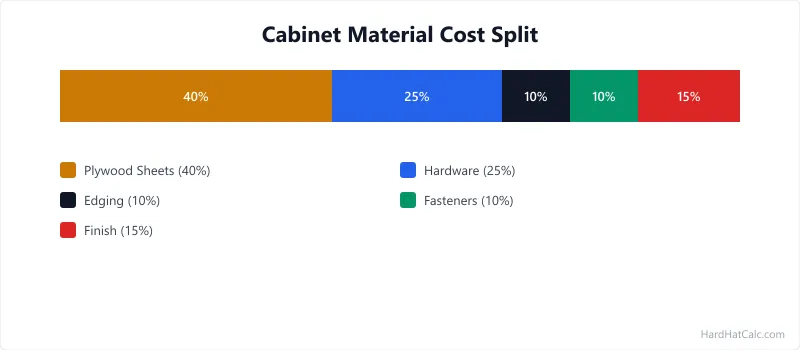
Hardware is the second-largest cost in a cabinet project after sheet goods, and the component most likely to be underestimated on the first order. A 14-cabinet kitchen needs roughly 14 hinge pairs, 16 pairs of drawer slides, 30+ pulls or knobs, and 50+ shelf pins — over 100 individual hardware items before you count screws, cam locks, and assembly fasteners.
Concealed European hinges (Blum, Hettich, Grass) are the industry standard for both frameless and face-frame cabinets. Each door requires one pair (two hinges). Full-overlay doors — where the door face covers the cabinet box edge — use 110-degree or 170-degree opening hinges depending on the adjacent cabinet configuration. Soft-close mechanisms add $2–$4 per hinge but eliminate the door-slamming that destroys finish and loosens joinery over time. As of March 2026, a quality concealed hinge pair runs $6–$10 for standard models and $10–$15 for soft-close versions at US retail.
Drawer slides deserve the same attention. Full-extension, ball-bearing slides (18-inch or 21-inch for base cabinets) cost $12–$25 per pair. Under-mount slides (Blum Tandem, Grass Dynapro) are more expensive at $25–$45 per pair but hide completely beneath the drawer box, creating a cleaner look. Soft-close drawer slides prevent the loaded silverware drawer from slamming shut — a feature that has moved from luxury to expectation in modern kitchens.
This calculator covers hinge pairs as the primary hardware estimate. Add drawer slides, pulls, and shelf pins separately based on your specific cabinet configuration — the count varies too much between projects to capture in a single formula. If your cabinet installation requires modifying wall framing, adding blocking for upper cabinets, or removing a header, a stud-layout planner plans the framing for the affected wall section.
Edgebanding: When and Where You Need It
Exposed plywood edges are the visual giveaway that separates amateur cabinet work from professional. Every visible edge needs treatment — either solid-wood nosing or iron-on edgebanding. Knowing which edges to band and how much material to order prevents both the embarrassment of visible plywood layers and the frustration of running out mid-project.
Which edges need banding? All front-facing edges that are visible when the cabinet is installed. That means the front edges of both side panels (full height), the front edge of the bottom panel, and the front edge of any fixed shelves. Back edges are hidden against the wall. Top edges of base cabinets are hidden by the countertop. Wall cabinet top edges are visible only if the cabinets do not reach the ceiling — band them if there is a gap above.
Do doors need edgebanding? It depends on the style. Slab (flat) doors need all four edges banded because the raw panel edge is fully exposed. Shaker-style doors use a solid-wood frame that wraps the panel edges — no banding needed. Raised-panel doors are the same: the frame covers the panel edges. This distinction matters for ordering: slab doors roughly double your edgebanding requirement compared to framed styles.
Iron-on vs. PVC edgebanding. Iron-on banding ($0.10–$0.20 per linear foot, March 2026 US prices) is the DIY standard — you press it on with a household iron and trim the overhang with a utility knife. It works well on plywood and MDF. PVC edgebanding with hot-melt adhesive ($0.20–$0.40 per foot) is the professional method, applied with an edgebanding machine for a tighter, more durable bond. For a kitchen that will see 20 years of use, PVC is worth the extra cost and effort.
How to calculate length. Measure all exposed edges in inches, convert to feet, and add 15% for trimming waste and alignment errors. The formula: (2 × side height + bottom width) × number of cabinets ÷ 12 × 1.15 for box edges. Add (2 × door height + 2 × door width) × number of slab doors ÷ 12 × 1.15 if using slab-style doors.
Planning Your Cut List
A cut list is the bridge between your material estimate and the lumber yard order. Skip this step and you will either waste sheets on inefficient cuts or discover mid-build that a critical panel does not fit on the remaining offcut. Cabinet shops treat the cut list as seriously as the design drawing itself.
List every panel by exact dimension. Write down sides, bottoms, shelves, doors, drawer fronts, and nailers for every cabinet in the set. Include the finished size after edgebanding (subtract 1/32 inch from each banded edge for the banding thickness). A 14-cabinet kitchen produces 50–70 individual panel dimensions.
Group panels that share a sheet. Panels of similar width or height can share a sheet more efficiently than random groupings. All side panels are the same height — they nest together better than mixing sides and bottoms on the same sheet.
Account for grain direction. Plywood grain must run vertically on visible side panels — this is not optional in quality cabinet work. Grain direction locks panel orientation on the sheet and reduces nesting flexibility. MDF and particleboard have no grain, so panels can rotate freely for tighter nesting.
Add saw kerf to every cut. A standard table saw blade removes 1/8 inch per cut. On a sheet with 6 rip cuts, that is 3/4 inch of material lost to sawdust alone. Kerf adds up: a sheet with 10 cuts loses over an inch of usable width.
Run the layout through a cut optimizer. Free tools like CutList Plus and Maxcut arrange panels on sheets to minimize waste. Manual layout typically wastes 20–25% of material; an optimized layout brings that down to 10–15%. The 5 minutes spent in the optimizer saves entire sheets on a large project.
Order 1–2 extra sheets as buffer. Cutting errors happen. A blade wanders, a measurement is misread, a panel splits at the edge. On a 10-sheet order, adding one extra sheet costs $28–$75 depending on material but prevents a project delay when the lumber yard is closed. Once the cabinets are installed, a ceiling coverage tool helps estimate paint for the rest of the kitchen remodel.
Worked Examples
Example 1
Scenario: A cabinetmaker building 14 standard kitchen cabinets (24" wide × 30" tall × 12" deep) in plywood with shaker doors.
Calculation: Box area per cabinet: 2 × (12 × 30) + (24 × 12) + (24 × 3) = 720 + 288 + 72 = 1,080 sq in. Total box area: 1,080 × 14 = 15,120 sq in. Sheets for boxes: ⌈15,120 ÷ 3,917⌉ = 4. Face area per cabinet: (24 × 30) + (24 × 6 × 0.5) = 720 + 72 = 792 sq in. Total face area: 792 × 14 = 11,088 sq in. Door sheets: ⌈11,088 ÷ 3,917⌉ = 3. Hardware: 14 hinge pairs. Edgebanding: (2 × 30 + 24) × 14 ÷ 12 × 1.15 = 1,176 ÷ 12 × 1.15 = 113 ft. Cost: 7 × $65 + 14 × $8 + 113 × $0.15 = $455 + $112 + $17 = $584.
What this means: 7 sheets of plywood at $55–$75 each is the dominant cost. Shaker doors do not need edgebanding on the frame — only slab doors require full edge treatment.
Takeaway: Plywood costs nearly double MDF for the same number of sheets, but delivers better screw-holding strength at the joints and survives water contact in kitchens far better. For cabinet boxes, plywood is worth the premium.
Example 2
Scenario: A DIYer building 6 garage storage cabinets (30" wide × 30" tall × 16" deep) from particleboard with slab doors.
Calculation: Box area per cabinet: 2 × (16 × 30) + (30 × 16) + (30 × 3) = 960 + 480 + 90 = 1,530 sq in. Total: 1,530 × 6 = 9,180 sq in. Sheets for boxes: ⌈9,180 ÷ 3,917⌉ = 3. Face area per cabinet: (30 × 30) + (30 × 6 × 0.5) = 900 + 90 = 990 sq in. Total: 990 × 6 = 5,940 sq in. Door sheets: ⌈5,940 ÷ 3,917⌉ = 2. Hardware: 6 pairs. Box edgebanding: (2 × 30 + 30) × 6 ÷ 12 × 1.15 = 540 ÷ 12 × 1.15 = 52 ft. Slab door edges: (2 × 30 + 2 × 30) × 6 ÷ 12 × 1.15 = 720 ÷ 12 × 1.15 = 69 ft. Total edgebanding: 121 ft. Cost: 5 × $28 + 6 × $8 + 121 × $0.15 = $140 + $48 + $18 = $206.
What this means: Particleboard at $22–$35 per sheet keeps the material cost well under $200 for the panels alone. Slab doors add significant edgebanding — 121 ft vs roughly 50 ft for framed doors.
Takeaway: Particleboard is adequate for garage and utility cabinets where moisture exposure is minimal. The savings — $37+ per sheet over plywood — adds up fast on a 5-sheet project. For garage use, save money on material and invest it in better hardware.
Frequently Asked Questions
- How many sheets of plywood do I need for 10 kitchen cabinets?
For standard 24" × 30" × 12" wall cabinets in 3/4" plywood, plan for about 4 sheets for boxes and 3–4 sheets for doors — roughly 7–8 sheets total at 85% yield. Base cabinets (24" deep × 34.5" tall) use more material per cabinet — about 1 sheet per 2 base cabinets. A mixed kitchen with 10 cabinets (6 wall + 4 base) needs approximately 8–10 sheets total. Always order at least one extra sheet for cutting errors and grain matching. If you plan to paint these cabinets once assembled, the cabinet paint calculator estimates primer and topcoat quantities by door count.
- Is MDF better than plywood for cabinet boxes?
No. MDF is heavier, weaker at joints (screws pull out more easily), and swells when exposed to water — all problems for cabinet boxes that hold weight and live in kitchens. MDF excels for door panels (especially painted shaker-style doors) because its surface is perfectly smooth with no grain texture to telegraph through paint. The best combination for painted cabinets: plywood boxes, MDF door panels. For natural-finish cabinets, plywood throughout. If the kitchen renovation extends to the walls, the framing-and-blocking layout tool helps plan blocking for heavy upper cabinets.
- How much edgebanding do I need per cabinet?
For a standard frameless cabinet (24" wide × 30" tall × 12" deep), you need about 7 linear feet of edgebanding for the box (two side front edges at 30" each plus the bottom front edge at 24", with 15% waste). Add 8–9 feet per slab-style door (all four edges). Total per cabinet with slab doors: roughly 15–16 feet. With framed doors (shaker, raised panel): only the 7 feet for the box, since the door frame covers its own edges. For the door frame sizing of any doorways near the cabinets, use the wall thickness to determine jamb width.
- What thickness plywood should I use for cabinet sides and shelves?
Standard cabinet box construction uses 3/4" (23/32" actual) plywood for sides, top, bottom, and fixed shelves. Adjustable shelves can use 3/4" for spans under 30" — wider spans need 3/4" with a front edge band or a 1" hardwood nosing to prevent sag. Back panels use 1/4" plywood or hardboard. Drawer bottoms use 1/4" plywood. Never substitute 1/2" for sides or bottoms — the screws holding the box together need the full 3/4" thickness for adequate holding strength. Before installing the kitchen ceiling finish, you can work out ceiling paint volume so drips do not land on new cabinets.
- How do I estimate hardware count for a full kitchen cabinet set?
Count one pair of concealed hinges per door (two hinges per pair). Each base cabinet typically has one door and one to three drawers; each wall cabinet has one or two doors. For a standard 14-cabinet kitchen (8 base + 6 wall with single doors): 14 hinge pairs, roughly 16 pairs of drawer slides (accounting for multi-drawer bases), 14+ pulls or knobs, and 48+ shelf pins (4 per adjustable shelf). Hardware cost runs $6–$10 per hinge pair, $12–$25 per pair of slides, and $3–$10 per pull — as of March 2026, US national averages. If any cabinet opening requires a new or wider doorway, the door header calculator sizes the structural beam above the opening. For commercial cabinet installations sharing the floor with seating areas, the seating-capacity check verifies the layout supports the planned headcount.
More Materials calculators
Browse all materials calculators — Paint coverage, roofing bundles, tile adhesive, welding time, parking lot sizing, and more.