
Septic Cost Calculator
Budget your septic install with this septic cost calculator. Covers tank, drain field, excavation, and permits — adjusted for soil type and home size.
Last updated:
From perc test results. Affects drain field size and cost.
Total absorption area for the leach field. Size depends on soil perc rate.
Determines daily wastewater volume (120 GPD per bedroom typical).
Varies by county — check with local health department.
How This Is Calculated
Tank cost = lookup by tank size. Drain field cost = drain field area x cost per sq ft (by soil type). Excavation = $1,200 tank excavation + drain field area x $3/sq ft trenching. Permits & engineering = permit cost + $400 perc test/design. Total = tank + drain field + excavation + permits.
Source: Septic tank sizing per EPA (Environmental Protection Agency) Onsite Wastewater Treatment Systems Manual, EPA/625/R-00/008. Drain field sizing follows soil percolation rates from EPA guidelines and state-specific codes. Source-set correction of 2026-08-22: the cost-data attribution to RS Means Site Work & Landscape Cost Data 2026 and regional contractor surveys is withdrawn (no such 2026 product; subscription-only, never opened; no survey recorded). The free public figures disagree by region too widely to substitute (state and county sources span $650 to $50,000 for nominally the same system class) and EPA publishes no installation costs (sweep record: audits/sourcing-1-retrieval/rsmeans/). The cost figures are unchanged and ship unverified.
7 min read
Conventional vs. Alternative Septic Systems
A septic system is the single largest invisible cost of building on a lot without municipal sewer — $5,000 for a simple gravity system on sandy soil to $25,000+ for an engineered mound system on clay. Prices and rates on this page are our own estimates as of the date shown; they change often. Enter your own figures for a current result. The type of system you need is not a choice you make; it is a choice your soil makes for you based on the percolation test.
Conventional gravity systems are the cheapest and most common. Wastewater flows by gravity from the house to the septic tank, then from the tank to the drain field through perforated pipes. The soil filters and treats the effluent naturally. These work on most sites with adequate soil percolation and sufficient distance between the drain field and the water table. Installed cost ranges from $5,000–$15,000 as of March 2026 on this page's estimate (the attribution behind it was withdrawn on 2026-08-22 and the range ships unverified).
Pressure distribution systems use a pump to dose the drain field evenly rather than relying on gravity. This produces more uniform treatment across the entire field, which is why some states require them for all new installations regardless of soil type. The pump and controls add $2,000–$4,000 to the conventional system cost.
Mound systems are required when the water table is too high or bedrock too shallow for a conventional below-grade drain field. The contractor builds an elevated sand mound above natural grade and pumps effluent into it. These are the most expensive conventional option at $15,000–$30,000 installed because of the imported sand, the pump station, and the grading work.
Aerobic treatment units (ATUs) use forced air to accelerate bacterial breakdown, producing cleaner effluent that requires a smaller drain field. They suit small lots or properties near water bodies where setback distances limit conventional drain field placement. ATUs cost $10,000–$20,000 installed and require ongoing maintenance contracts ($150–$300/year) that conventional systems do not.
What Drives Septic System Cost
Soil type is the dominant cost driver for any septic installation, and it is the one factor homeowners have zero control over. A percolation test measures how fast water drains through the soil at the planned drain field location. Fast-draining soils (gravel, coarse sand) need smaller drain fields because each square foot of soil can absorb more effluent per day. Slow-draining soils (clay, silty clay) need much larger fields — sometimes double or triple the area — which directly multiplies excavation and materials costs.
Tank size follows bedroom count, not house square footage. Most health department codes use a formula based on estimated daily flow: 120 gallons per day per bedroom is the standard assumption per the EPA Onsite Wastewater Treatment Manual (EPA/625/R-00/008) and state septic regulations. A 3-bedroom home generates an estimated 360 GPD, which requires a minimum 1,000-gallon tank (750–1,500 gallon range per EPA guidelines) in most jurisdictions. Some states size more conservatively — Massachusetts requires a 1,500-gallon tank for 3 bedrooms.
Depth to bedrock and the seasonal high water table also affect cost. If bedrock sits within 4 feet of the surface, conventional trenches may not have enough soil depth for adequate treatment, pushing the project toward a mound system. A high water table (within 2–3 feet of grade during wet months) creates the same problem. Both conditions are revealed during the site evaluation, which should happen before you close on a land purchase.
The excavation required for a septic installation often rivals the tank cost itself. For future excavation estimating tools, visit the materials calculators hub.
Cost Breakdown by Component
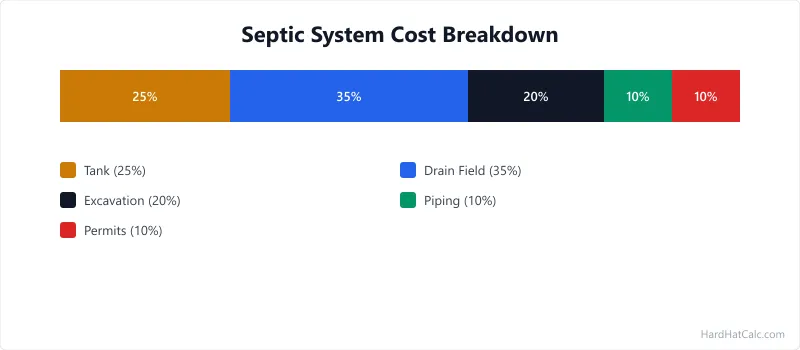
The table below breaks down a conventional gravity septic system into its major cost components. All figures are as of March 2026, US national estimates for conventional gravity systems; their former attribution was withdrawn on 2026-08-22 and they ship unverified. Actual costs vary by region, contractor, and site conditions.
| Component | Typical Range (March 2026) | % of Total |
|---|---|---|
| Septic tank (concrete, installed) | $1,500–$4,000 | 15–25% |
| Drain field (trenches, gravel, pipe) | $3,000–$15,000 | 40–55% |
| Excavation (tank hole + field trenching) | $2,000–$5,000 | 15–25% |
| Permits, perc test, engineering design | $500–$1,500 | 5–10% |
| Distribution box or pump chamber | $300–$2,500 | 3–15% |
The drain field consistently accounts for the largest share of total cost. On difficult soil, it can represent over half the project budget. This is why the perc test result is the single most important number in your septic budget — it determines drain field size, which cascades into excavation volume and total project cost.
Concrete tanks are the most common and cost-effective choice for most installations. Plastic (polyethylene) tanks cost $500–$1,000 less but require careful backfilling to prevent crushing and are not accepted by all health departments. Fiberglass tanks resist corrosion better in acidic soils but cost $200–$500 more than concrete.
The Perc Test: Your First Step
Septic system installation requires a health department permit in all US jurisdictions. A site evaluation (perc test and soil analysis) must be completed before the permit is issued. Do not begin excavation until you have the permit in hand.
The percolation test is where every septic project begins, and doing it before you buy undeveloped land can save you from a $15,000+ surprise. Here is the process from start to finish.
Contact the local health department. They issue septic permits in most US jurisdictions. Ask for the septic permit application and the list of approved perc test contractors in your county. Some counties require the health department to witness the test; others accept reports from licensed contractors.
Hire a licensed perc test contractor ($300–$700). The contractor digs test holes — typically 2 to 3 — at the planned drain field location. Hole depth is usually 24–36 inches, matching the depth of future drain field trenches. Costs vary by number of holes and local contractor rates (March 2026 US averages).
The contractor measures drainage speed. Each test hole is pre-soaked (filled with water and allowed to drain, then refilled), then measured at timed intervals. The rate at which water drops in the hole — typically measured in minutes per inch — is the percolation rate.
Results determine drain field size and system type. Fast perc rates (under 10 minutes per inch) mean smaller drain fields. Slow rates (over 60 minutes per inch) may require alternative systems. Most conventional systems work in the 10–60 minutes-per-inch range.
A septic designer uses perc results to create the system plan. This is usually a licensed engineer or a certified septic designer depending on your state. The design specifies tank size, drain field dimensions, pipe layout, and setback distances from wells, property lines, and structures.
Submit plans to the health department for permit. Review times vary from 2 weeks to 3 months depending on jurisdiction workload. Do not begin excavation before the permit is issued — unpermitted septic work carries heavy fines and may require the system to be removed and rebuilt.
For the structural elements that sit above your septic system — like the concrete foundation — a slab and footing rebar tool covers the steel for any slab or footing.
Common Mistakes That Increase Septic Cost
Building before the perc test is the most expensive mistake a rural homeowner can make. If you pour a foundation and then discover the soil fails the perc test, you may need an alternative system costing $15,000–$25,000 more than the conventional system you budgeted for. Worse, some soils fail entirely, meaning no on-site system is permitted and the lot is unbuildable without municipal sewer — which may not exist. Always perc test before purchasing land if septic is required.
Undersizing the tank saves $400–$600 upfront but costs more over the system's lifetime. A tank that is too small for the household's actual water usage fills with solids faster, requiring pumping every 1–2 years instead of every 3–5 years. Pumping costs $300–$500 per visit (March 2026 averages). Over 20 years, the extra pumping costs far exceed the savings from a smaller tank. Size for the future bedroom count, not the current one.
Ignoring setback requirements catches homeowners who design their house footprint first and figure out septic placement later. Every jurisdiction requires minimum distances between the drain field and the well (typically 100 feet), the property line (10–25 feet), the house foundation (10–20 feet), streams and ponds (50–100 feet), and large trees (10–25 feet). If the only viable drain field location is far from the house, you need longer sewer lines and potentially a pump station — adding $2,000–$5,000 to the project.
Driving or parking over the drain field compacts the soil and crushes the perforated pipes. This is not a temporary inconvenience — it is a system-killing mistake that requires excavating and rebuilding the entire field. Mark the drain field location permanently and keep all vehicles, heavy equipment, and storage off it.
For commercial site development that includes both septic planning and parking layout, the parking lot size calculator handles the surface infrastructure.
Worked Examples
Example 1
Scenario: A family building a 3-bedroom home on a rural lot with loam soil. 1,000-gallon concrete tank, 500 sq ft drain field, $500 local permit fee.
Calculation: Tank cost = $2,400 (1,000-gallon concrete, installed). Drain field = 500 sq ft x $15/sq ft (loam) = $7,500. Excavation = $1,200 tank hole + 500 x $3 trenching = $2,700. Permits & engineering = $500 permit + $400 perc test/design = $900. Total = $2,400 + $7,500 + $2,700 + $900 = $13,500.
What this means: $13,500 is mid-range for a conventional septic system in March 2026 US national averages. Loam soil costs more per square foot of drain field than sand but less than clay. The drain field is the biggest single cost component at 56% of total.
Takeaway: Soil type determines more of your septic cost than tank size. A 3-bedroom house on sandy soil might spend $8,000–$10,000 total; the same house on clay can reach $15,000–$20,000 because clay requires larger drain fields and sometimes alternative systems.
Example 2
Scenario: A couple building a small cabin (1 bedroom) with a 750-gallon tank on gravel soil with a 200 sq ft drain field and $350 local permit fee.
Calculation: Tank cost = $1,800 (750-gallon concrete, installed). Drain field = 200 sq ft x $8/sq ft (gravel) = $1,600. Excavation = $1,200 tank hole + 200 x $3 trenching = $1,800. Permits & engineering = $350 permit + $400 perc test/design = $750. Total = $1,800 + $1,600 + $1,800 + $750 = $5,950.
What this means: Under $6,000 for a complete conventional septic system is about as cheap as it gets. Gravel soil percolates quickly, requiring the smallest possible drain field.
Takeaway: Gravel sites are the lowest-cost scenario for septic, but they carry a trade-off: fast percolation means less filtration before wastewater reaches groundwater. Some health departments require additional treatment stages on highly permeable soils, which adds $2,000–$5,000 for a pretreatment unit.
Frequently Asked Questions
- How much does a new septic system cost to install in 2026?
A conventional gravity septic system costs $5,000–$15,000 in March 2026 on this page's estimate (the attributions behind it were withdrawn on 2026-08-22; the range ships unverified). Simple installations on sandy soil with good percolation sit at the low end. Complex installations on clay or high-water-table sites requiring pressure distribution or mound systems can reach $20,000–$30,000. The biggest cost variable is soil type — it determines drain field size, which drives 40–55% of total cost. For the earthwork portion of the job, the yardage-and-truckloads tool estimates cubic yards and truck loads.
- What size septic tank do I need for a 3-bedroom house?
Most codes require a minimum 1,000-gallon tank for a 3-bedroom home, based on an assumed flow of 120 gallons per day per bedroom (360 GPD total). Some states require 1,250 gallons for 3 bedrooms. Going one size up (1,250 vs 1,000) adds $400–$600 to the project but reduces pumping frequency from every 3–5 years to every 4–6 years. If you plan to add bedrooms later, size the tank for the future bedroom count now — replacing a tank is far more expensive than oversizing upfront. The concrete tank sits on a prepared base, and the concrete mix ratio guide explains the strength grades used for below-grade tanks and footings.
- What is a perc test and how much does it cost?
A percolation (perc) test measures how fast water drains through your soil, determining whether a conventional septic system will work and how large the drain field needs to be. A licensed contractor digs test holes (typically 2–3) at the planned drain field location, fills them with water, and times the drainage. Cost ranges from $300–$700 depending on the number of holes and local contractor rates (March 2026 US averages). The perc test is mandatory before a septic permit is issued and should be done before purchasing undeveloped land if you need septic. If the drain field sits near a structure, you can size the continuous footing and verify adequate setback between the foundation and the leach lines.
- How long does a septic drain field last?
A properly designed and maintained drain field typically lasts 20–30 years. Failure usually comes from the soil around the drain lines becoming saturated with biofilm (biomat buildup), which slows percolation over time. Contributing factors include overloading the system (too much water too fast), failing to pump the tank (solids migrate to the drain field), or vehicle traffic compacting the soil above the lines. Signs of failure: slow drains, sewage odour in the yard, soggy spots over the drain field. Replacement costs $5,000–$15,000 depending on system type. If the replacement involves grading near the house, the shed foundation calculator covers base preparation for any nearby outbuildings.
- Can I install a septic system myself to save money?
In most US jurisdictions, no. Septic installation requires a permit issued by the local health department, and the work must be done by (or at minimum supervised by) a licensed septic installer. Inspections at multiple stages are typically required. Even where self-installation is legal, the excavation alone requires heavy equipment (backhoe or excavator) that costs $300–$500/day to rent plus a skilled operator. The engineering savings from DIY are minimal since the system design must come from a licensed professional regardless. For other rural-build costs like parking and site grading, a site contractor typically bundles excavation across multiple scopes to reduce mobilisation charges.
More Materials calculators
Browse all materials calculators — Paint coverage, roofing bundles, tile adhesive, welding time, parking lot sizing, and more.