
Deck Cost Calculator
Free deck cost calculator estimating material, labour, and total price ranges by deck size, decking choice, height, and DIY-or-pro install.
Last updated:
Longer side of the deck footprint. Measure the finished deck outline.
Shorter side of the footprint. Length × width gives the deck area.
The surface board is the biggest single cost lever on a deck.
Raised decks need taller posts, bigger footings, and more labour.
Labour is 50-60% of an installed deck. DIY shows materials only.
How This Is Calculated
Area = length × width. Installed cost per sq ft by decking material (PT $15-50, cedar $20-45, composite $35-70, PVC $50-80, hardwood $50-80) is banded by deck height: ground-level uses the lower half of the range, raised uses the upper half. Material cost = area × rate × 0.45. Labour cost = area × rate × 0.55 (zero for DIY). Total = material + labour. Cost per sq ft = total ÷ area.
Source: Cost ranges aligned with the HardHatCalc Deck Building Cost Guide, which sources US national-average installed ranges (verified 2026) from HomeAdvisor, Ergeon, Fixr, NerdWallet, and the Zonda 2025 Cost vs Value report. Installed cost per square foot by decking material: pressure-treated $15-50, cedar $20-45, composite $35-70, cellular PVC $50-80, tropical hardwood $50-80. Material is taken as ~45% of an installed deck and labour ~55% (midpoint of the guide's 50-60% labour share); DIY removes the labour line. Deck height bands the per-material range (ground-level = lower half, raised = upper half) as a heuristic for the guide's "raising a deck adds 30-50%" — not a separately published height split.
5 min read
What Moves a Deck's Total Cost
The Deck Cost Calculator turns your deck size, decking material, height, and labour choice into material, labour, and total price ranges. Enter the footprint and a few choices, and it returns the spread a real quote is likely to fall inside rather than a single misleading number.
A single per-square-foot rate never answers "what will my deck cost", because five things move the total and they pull in different directions. Size sets the raw quantity of boards, joists, and footings. Decking material is the largest single lever: tropical hardwood runs three to four times the per-square-foot price of pressure-treated pine. Height multiplies the structure beneath the boards, since a raised deck needs taller posts, deeper footings, and more bracing than a ground-level platform. Labour is half to two-thirds of an installed deck, so who swings the hammer changes the bill more than any board choice. And region and season shift labour rates and lumber prices by a wide margin.
This tool keeps the focus on compute. It estimates the base deck — the surface and the structure that carries it — and leaves stairs, railing upgrades, lighting, and permits as separate add-ons. For the full picture of what those extras cost and how a deck pays back at resale, the deck building cost guide carries the deep narrative, while the joist span calculator sizes the framing the estimate assumes you will buy.
Material, Labour, and the Full Project Total
The estimate splits into two layers. Material is roughly 45 percent of an installed deck, labour the other 55 percent — the midpoint of the 50-to-60 percent labour share that holds across most professional deck jobs. Choosing DIY removes the labour line, which is why building it yourself is the single biggest saving on the whole project.
| Layer | Share of installed deck | What it covers |
|---|---|---|
| Decking surface | Part of material | The visible boards — the biggest cost lever |
| Substructure | Part of material | Joists, beams, posts, footings, ledger, hardware |
| Material subtotal | ~45% | Everything you buy at the yard |
| Labour | ~55% | Forming, framing, board install, finishing |
| Stairs, railing, lighting, permits | Extra | Added on top of the base deck |
The base deck this tool prices is the surface plus the structure. Stairs alone add roughly $500 to $2,600 and railing upgrades run $20 to $250 per linear foot, so a featured deck climbs well above the base estimate. Before you price boards, the deck board estimator turns your area and layout into a board and fastener count, which is the cleanest starting point for the material side.
Decking Material and the Price It Carries
The board you stand on sets the whole project's price band. Each material carries a different blend of upfront cost and upkeep, and the cheapest board today is rarely the cheapest deck over twenty years.
Pressure-treated pine ($15-$50 per sq ft installed) is the budget default and the most common decking in North America. It is the lowest-cost way to a sound, code-compliant deck, but it needs cleaning and re-sealing every two to three years or it greys and splinters.
Western red cedar ($20-$45) sits a step above pine. It resists rot naturally and feels softer underfoot, but still wants oiling every couple of years to hold its colour.
Composite ($35-$70) is a wood-and-plastic blend that never needs staining or sealing and carries 25-to-50-year warranties. The trade is a higher upfront price and more heat retention in direct sun.
Cellular PVC ($50-$80) is the all-plastic premium tier — the lightest and most stain-proof boards, at the top of the composite price band.
Tropical hardwood ($50-$80) such as ipe lasts 40-plus years untreated, but it is dense, slow to install, and demands a pre-drilled hole for every screw. Framing those heavier boards needs the right beam, and the wood beam cost calculator prices the carrying members by species and size.
From Estimate to Build Budget
The number this tool returns is a planning frame, not a quote. Turn it into a budget you can act on with these steps, working from the structure up.
Set the footprint and height honestly. Measure the real deck outline and decide how far off the ground it sits. Height drives post size, footing depth, and stair length, so an accurate height matters as much as the area. The post size calculator shows when load and height force you up to a 6x6.
Pick the decking material. Use the per-square-foot bands above and weigh the upkeep cost over the years you plan to stay. Run the calculator once per candidate material to see the spread side by side.
Add the features separately. Layer in a stair rise-and-run estimate, railing, lighting, and any permit on top of the base deck figure. These are the items that quietly turn a $9,000 deck into a $15,000 one.
Decide DIY, pro, or split. A common middle path hires out the footings, ledger, and framing — the parts that punish mistakes — and keeps the board install as DIY, banking most of the labour saving on the lower-risk work.
Get three local bids. Compare your estimate against three quotes. Wide gaps usually trace to material grade, deck height, or how each builder handles the ledger and footings.
DIY Savings, Hidden Costs, and Common Questions
A few practical points behind the numbers that catch first-time deck budgeters.
Why is DIY so much cheaper on paper? Because labour is 50 to 60 percent of an installed deck, removing it roughly halves the cash cost. The saving moves to time, tools, and risk: a first deck takes most people three to five weekends. Confirm the structure can carry the load with the deck weight limit check before any boards go down.
What does the estimate leave out? Stairs, railing upgrades, lighting, demolition of an old deck, and the permit. Permits run $50 to $500 and are rarely optional for an attached or raised deck. These add to the base figure rather than sitting inside it.
Why does raising a deck cost so much more? A ground-level deck needs short posts and simple footings. Raise it for a walkout and you add tall posts, bigger footings, lateral bracing, and a longer stair run, which is why this tool places a raised deck in the upper half of each material's price band.
Does a bigger deck cost proportionally more? Not quite. A larger deck spreads fixed costs like the ledger connection and footings over more square feet, so the per-square-foot rate often eases slightly as the footprint grows — though material grade and height still move the total more than area alone. Fencing the yard at the same time? A perimeter fence priced by material and labour follows the same per-foot logic, and a shade structure over the deck has its own estimate in the pergola cost calculator.
Worked Examples
Example 1
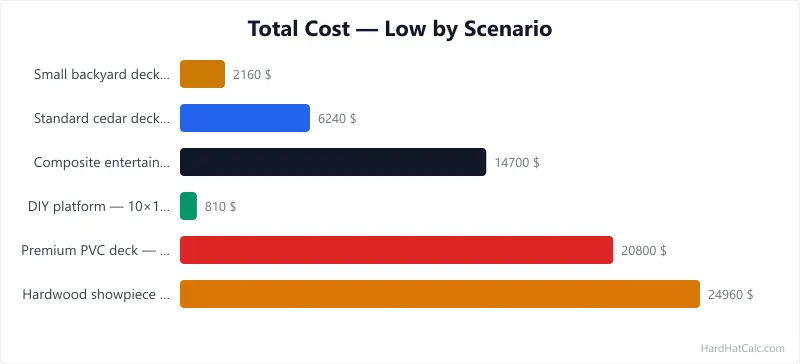
Scenario: A homeowner is pricing a 12×16-foot composite deck (192 sq ft) raised about four feet off a sloping yard, built by a contractor.
Calculation: Area = 12 × 16 = 192 sq ft. Composite installed range $35-70/sq ft, midpoint $52.50; raised takes the upper half, so the rate band is $52.50-$70. Material (45%): 192 × 52.50 × 0.45 = $4,536 to 192 × 70 × 0.45 = $6,048. Labour (55%): 192 × 52.50 × 0.55 = $5,544 to 192 × 70 × 0.55 = $7,392. Total = $10,080 to $13,440, or $52.50-$70 per sq ft.
What this means: A raised composite deck of this size lands at $10,080-$13,440 installed — squarely inside the deck cost guide's medium-deck band and at the upper end of the composite per-square-foot range, which is what a raised frame and a no-maintenance board both push toward.
Takeaway: Composite costs more per square foot than wood, and raising the deck moves you into the top half of that range. The trade is no staining or sealing for the life of the boards, which closes the gap against maintained pine over 20 years.
Example 2
Scenario: A DIY builder is laying a 16×16-foot western red cedar deck (256 sq ft) at ground level on a flat lot, doing all the labour themselves.
Calculation: Area = 16 × 16 = 256 sq ft. Cedar installed range $20-45/sq ft, midpoint $32.50; ground-level takes the lower half, so the rate band is $20-$32.50. DIY removes labour, so the estimate is the material share (45%) only: 256 × 20 × 0.45 = $2,304 to 256 × 32.50 × 0.45 = $3,744. Labour = $0. Total = $2,304 to $3,744, or $9-$14.63 per sq ft.
What this means: At $2,304-$3,744 this is the material-only figure for a ground-level cedar deck. Hiring the same job out would add labour worth a little more than the materials again, since labour is 50-60% of an installed deck — roughly $5,100-$8,300 installed.
Takeaway: Doing the work yourself removes the single largest line on a deck bill. The saving is real, but the ledger connection and footings punish mistakes, so price out the structure honestly before deciding which parts to hand to a crew.
Frequently Asked Questions
- How is deck cost calculated in this tool?
The calculator multiplies your deck area by an installed cost-per-square-foot range for the decking material you pick, then splits that into roughly 45 percent material and 55 percent labour — the midpoint of the 50-to-60 percent labour share typical of professional deck jobs. Choosing DIY zeroes the labour line and shows materials only. Deck height bands the result: a ground-level deck sits in the lower half of the material's price range and a raised deck in the upper half. For the cost drivers behind those ranges, the deck building cost guide explains what moves each number.
- Does the estimate include stairs, railing, and a permit?
No. The figure is the base deck — the decking surface plus the structure of joists, beams, posts, and footings that carries it. Stairs add roughly $500 to $2,600, railing upgrades run $20 to $250 per linear foot, lighting adds four figures, and a permit costs $50 to $500. Those are layered on top of the base estimate rather than built into it, which keeps the per-square-foot figure honest and comparable across decks. Size the stair run first with the staircase dimension calculator before adding it to your budget.
- How much more does a raised deck cost than a ground-level one?
Raising a deck adds roughly 30 to 50 percent to the cost of the same footprint, because a raised frame needs taller posts, deeper and wider footings, lateral bracing, and a longer stair run. This tool reflects that by placing a ground-level deck in the lower half of each material's installed price range and a raised deck in the upper half — a banding heuristic, not a separately published height split. The taller the deck, the more the structure beneath the boards drives the bill. Check whether load and height push you to a larger post with the post size calculator.
- Why is the result a range rather than a single price?
Because an honest deck estimate is a band, not a point. The same 200-square-foot deck can vary by thousands of dollars depending on material grade, deck height, regional labour rates, and the season you build in. A single figure would imply a precision that no planning estimate has, so the tool shows the low and high a real quote is likely to fall inside. Treat the low end as a simple build in a low-cost market and the high end as a premium build in an expensive one, then get three local bids. The deck board estimator sharpens the material side once you have settled on a board.
More Materials calculators
Browse all materials calculators — Paint coverage, roofing bundles, tile adhesive, welding time, parking lot sizing, and more.