
Pergola Cost Calculator
Free pergola cost calculator: material, labour, and total price ranges per square foot for wood, cedar, vinyl, aluminium, and composite pergolas.
Last updated:
Longer side of the pergola footprint. Length × width gives the area priced.
Shorter side of the footprint. Most freestanding pergolas run 10–16 ft each way.
The frame material is the biggest cost lever. Pressure-treated pine is cheapest; composite and louvered aluminium the most expensive.
An open-rafter top is the cheapest. Louvered, motorised, or solid-roof systems cost far more.
Labour is a fifth to nearly half of an installed pergola. DIY shows materials only.
How This Is Calculated
Area = length × width. Installed cost per sq ft by material at an open-rafter baseline (PT $20-40, cedar $25-50, redwood $40-50, composite $30-65, vinyl $15-50, aluminium $15-40) is split into material and labour using a per-material labour share (PT 35%, cedar/redwood 40%, vinyl 25%, aluminium 20%, composite 18%). Material = area × rate × (1 − labour share); labour = area × rate × labour share (zero for DIY). A louvered or covered roof multiplies the rate by 2.5. Total = material + labour. Cost per sq ft = total ÷ area.
Source: Installed cost per square foot by pergola material reflects US national-average ranges verified June 2026 against LawnStarter, HomeAdvisor, Fixr, Arrow Outdoor Living, and Aluglobus: pressure-treated pine $20-40, western red cedar $25-50, redwood $40-50, composite $30-65, vinyl $15-50, and open-rafter aluminium $15-40. Single-source premium ceilings were trimmed to consensus (cedar and redwood capped at $50, vinyl at $50, aluminium at $40). Labour share of the installed price is set per material (wood 35-40%, vinyl 25%, aluminium 20%, composite 18%) because custom wood pergolas are labour-heavy while bolt-together vinyl, aluminium, and composite kits are material-heavy; a DIY build removes the labour line. Prefab vinyl and aluminium kits start below a custom pressure-treated frame at the low end (a real kit-vs-custom price feature, not a costing error), while their ceilings sit mid-to-upper. A louvered or solid (covered) roof multiplies the open-rafter rate by 2.5 — a conservative-central heuristic for the 2.5-4x premium covered systems carry over an open structure, not a separately published per-material figure; louvered and motorised systems are predominantly aluminium and reach $65-200 per square foot at the top. Source-set correction of 2026-08-11: a sixth source, Bhumi, has been withdrawn. bhumicalculator.com publishes Indian land-measurement conversions (bigha, katha, guntha), names no author, company or proprietor, and its own disclaimer states that it "is operated from Patna, Bihar, India" and that its tools are "not specifically designed for or tailored to the legal, regulatory, or professional requirements" of other jurisdictions, so it cannot carry a US construction cost. On the same date the cited LawnStarter page returned HTTP 404 and its link has been removed; the figures it contributed remain unconfirmed. Costs vary by region, supplier, season, and site complexity.
6 min read
What a Pergola Costs to Build
The Pergola Cost Calculator turns your pergola footprint, frame material, roof type, and labour choice into material, labour, and total price ranges per square foot. Enter the size and a few choices, and it returns the spread a real quote is likely to fall inside rather than a single number that hides the variation.
Five things move a pergola's total cost, and they pull in different directions. Footprint sets the raw quantity of posts, beams, rafters, and footings. Material is the largest single lever: a bolt-together aluminium or composite system can cost three to four times the per-square-foot price of a basic pressure-treated frame. Roof type is the wild card unique to pergolas — an open-rafter top is the cheap baseline, while a louvered or solid covered roof can multiply the price two to four times over. Labour is a fifth to nearly half of an installed pergola depending on the material, so who builds it changes the bill more than almost any other choice. And site factors like a freestanding versus attached frame, sloped ground, or footings in rocky soil push a quote toward its high end.
This tool prices the structure itself: the frame plus the labour to build it. Footings, permits, electrical for lights or a fan, and add-ons like a fabric canopy sit on top of the base estimate. For the layout side — how many posts, how far apart, and the beam and rafter lengths your design needs — the pergola post and rafter layout tool builds the member list this estimate assumes you will buy.
Pergola Cost by Material
The frame material sets the whole price band. Each one trades upfront cost against maintenance and lifespan, and the cheapest frame today is rarely the cheapest pergola over twenty years.
Pressure-treated (PT) pine ($20-$40 per square foot installed) is the budget default. It builds a sound, paintable frame for the lowest price, but it wants cleaning and re-sealing every two to three years or it greys and checks.
Western red cedar ($25-$50) sits a step above pine. Cedar resists rot naturally, holds stain well, and looks richer, which is why it is the most popular wood for a visible garden structure. Most cedar jobs land in the $25-$35 range; the upper half is premium or heavily custom work.
Redwood ($40-$50) is the priciest common softwood. It carries the same natural rot resistance as cedar with a deeper colour, and the boards cost more, so its floor sits higher than any other wood.
Composite ($30-$65) is a wood-plastic kit product that never needs staining and carries long warranties. The upfront price is high, and most composite pergolas are sold as pre-engineered kits rather than custom builds.
Vinyl (PVC) ($15-$50) and aluminium ($15-$40 for an open-rafter frame) are the maintenance-free options, and both start cheaper than a custom wood frame. That floor is not a mistake: a bolt-together prefab kit genuinely undercuts custom carpentry at the low end, even though the ceilings for branded systems sit mid-to-upper. Aluminium is the material of choice once you want a louvered or motorised roof.
This calculator runs the same material-plus-labour split that the deck cost calculator uses for decking, so you can budget a deck and a pergola on the same basis.
Cost by Size and Roof Type
Two inputs swing the total hardest after material: how big the pergola is and what kind of roof sits on top. The table below shows the installed cost of an open-rafter western red cedar pergola (priced at the $25-$50 per square foot band) across common footprints.
| Footprint | Area | Installed cost (open-rafter cedar) |
|---|---|---|
| 10 × 10 ft | 100 sq ft | $2,500-$5,000 |
| 12 × 12 ft | 144 sq ft | $3,600-$7,200 |
| 12 × 16 ft | 192 sq ft | $4,800-$9,600 |
| 14 × 20 ft | 280 sq ft | $7,000-$14,000 |
Roof type is the multiplier most people underestimate. An open-rafter or slatted top is the baseline. A louvered or solid covered roof is a separate, higher tier: across the cost guides, a covered or louvered system runs roughly two and a half to four times an open structure of the same size. This tool applies a 2.5× multiplier to the open-rafter rate for a covered roof — a deliberately conservative central figure, not a separately published per-material price. Louvered and motorised systems are almost always aluminium, and a motorised aluminium roof can reach $65-$200 per square foot installed at the top of the market.
The estimate stops at the frame and its labour. Every post still needs a footing below the frost line, and a post footing size tool sets the diameter and depth each one needs for your soil and climate — a cost that sits outside this figure.
From Estimate to Pergola Budget
The number this tool returns is a planning frame, not a quote. Turn it into a budget you can act on with these steps.
Measure the real footprint. Use the finished outline of the pergola, posts included. Footprint drives every material quantity, so a tight measurement matters more than any single price.
Pick the material and roof honestly. Use the per-square-foot bands above, and weigh upkeep over the years you plan to stay. Decide early whether you want an open top or a covered roof, because that choice moves the total more than going up a material grade. If those choices are still open, work through the planning decisions in order before you price anything.
Size the posts and footings. Taller pergolas and bigger spans need heavier posts. The post size calculator shows when load and height push you from a 4×4 up to a 6×6, and footings add cost the base estimate leaves out.
Decide DIY, pro, or a split. A common middle path hires out the post setting and footings — the part that punishes mistakes — and keeps the frame assembly as DIY. On a wood pergola, where labour is close to half the bill, that saves the most; on a prefab metal or vinyl kit, the material is the expensive part, so DIY saves less.
Get three local bids. Compare your estimate against three quotes. Wide gaps usually trace to material grade, roof type, or how each builder handles the posts and footings. For the bigger picture on budgeting an outdoor build and what it returns at resale, the deck building cost guide walks through where the money goes.
DIY, Roof Upgrades, and Other Cost Questions
A few practical points behind the numbers that catch first-time pergola budgeters.
How much does DIY really save? It depends on the material. On a custom wood pergola, labour is 35 to 40 percent of the installed cost, so building it yourself cuts a large slice off the bill. On a vinyl or aluminium kit, labour is only a fifth to a quarter, so the saving is smaller — the panels and posts, not the assembly, drive the price. A first pergola takes most people a long weekend or two.
Why is a covered roof so much more expensive? An open-rafter top is mostly air. Adding a louvered, motorised, or solid roof brings panels, a heavier frame to carry them, and on motorised systems a motor, controls, and wiring. That is why a covered roof runs two and a half to four times an open structure, and why this tool treats it as a separate tier rather than a small add-on.
What does the estimate leave out? Footings, permits, electrical for lights or a fan, sloped-ground work, and add-ons like a retractable canopy. A permit for a freestanding pergola runs $50 to $150 in most areas, and an attached pergola almost always needs one because it modifies the house.
Does a bigger pergola cost less per square foot? Slightly. Fixed costs like mobilisation and the corner posts spread over more area, so the per-square-foot rate eases a little as the footprint grows — though material and roof type still move the total far more than size alone. Pricing a perimeter fence at the same time? The fence cost calculator runs the same material-and-labour split per linear foot.
Worked Examples
Example 1
Scenario: A homeowner is pricing a 12×16-foot western red cedar pergola (192 sq ft) with an open-rafter top, built by a contractor.
Calculation: Area = 12 × 16 = 192 sq ft. Cedar runs $25-$50 per sq ft installed at the open-rafter baseline (roof multiplier 1.0). Labour is about 40% of an installed cedar pergola, so material (60%) = 192 × {25,50} × 0.60 = $2,880 to $5,760, and labour (40%) = 192 × {25,50} × 0.40 = $1,920 to $3,840. Total = $4,800 to $9,600, or $25-$50 per sq ft.
What this means: A 192 sq ft open-rafter cedar pergola lands at $4,800-$9,600 installed, or $25-$50 per square foot. The low end is a simple build in a low-cost market; the high end is premium cedar, a tricky site, or a contractor at the top of the local rate. Material and labour split roughly 60/40.
Takeaway: Cedar is the most popular wood for a visible pergola because it resists rot and takes stain well. Doing the build yourself removes the labour line — the material-only figure for this pergola is $2,880-$5,760.
Example 2
Scenario: A contractor is quoting a 14×16-foot aluminium pergola (224 sq ft) with a louvered roof for a patio, professionally installed.
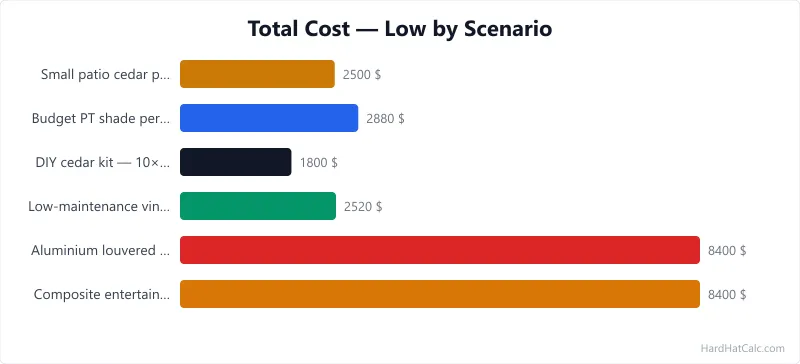
Calculation: Area = 14 × 16 = 224 sq ft. Open-rafter aluminium is $15-$40 per sq ft; a louvered roof multiplies that by 2.5 to $37.50-$100 per sq ft. Aluminium labour is about 20%, so material (80%) = 224 × {37.5,100} × 0.80 = $6,720 to $17,920, and labour (20%) = 224 × {37.5,100} × 0.20 = $1,680 to $4,480. Total = $8,400 to $22,400, or $37.50-$100 per sq ft.
What this means: The louvered roof is what drives this estimate past $8,000 and toward $22,000 — it carries panels, a heavier frame, and on a motorised version a motor and controls. Aluminium is material-heavy, so labour is only a fifth of the bill even on a complex roof.
Takeaway: A louvered aluminium pergola costs two to four times an open-rafter frame of the same size. The adjustable roof buys rain protection and sun control that an open top cannot, which is why most premium covered systems are aluminium.
Frequently Asked Questions
- How much does a pergola cost?
A pergola runs from about $15 per square foot for a basic prefab aluminium or vinyl kit to $65 or more for a composite system or a covered roof, with most custom wood pergolas landing in the $25-$50 per square foot range installed as of 2026. For a common 12 × 16 ft footprint, that is roughly $4,800 to $9,600 for an open-rafter cedar build. The figure depends on material, footprint, roof type, and whether you hire a crew or build it yourself. The deck cost calculator prices a deck on the same per-square-foot basis if you are planning both.
- Is a cedar or vinyl pergola cheaper?
It depends on where each lands in its range, but vinyl usually starts cheaper than cedar because a bolt-together vinyl kit costs less to install than custom cedar carpentry. Vinyl runs about $15 to $50 per square foot installed against cedar's $25 to $50, so basic vinyl undercuts cedar at the low end. Cedar wins on looks and holds value as a natural-wood structure, while vinyl never needs staining. If you want the cedar appearance, expect to pay for the joinery labour that a kit avoids. To plan the post and rafter layout for either one, the pergola size and spacing tool builds the member list.
- How is pergola cost calculated in this tool?
The calculator multiplies your footprint area by an installed cost-per-square-foot range for the material you pick, then splits that into material and labour using a per-material labour share — about 35 to 40 percent for wood and a fifth to a quarter for vinyl, aluminium, and composite kits. Choosing DIY zeroes the labour line and shows materials only. A louvered or covered roof multiplies the open-rafter rate by 2.5, a conservative central figure for the premium those systems carry. It prices the frame and leaves footings, permits, and electrical as separate add-ons, the same way the fence cost calculator handles gates and site work.
- What does the pergola estimate leave out?
The figure is the frame plus the labour to build it. It excludes the concrete footings every post needs, the building permit, any electrical run for lights or a ceiling fan, sloped-ground work, and add-ons like a retractable canopy or privacy screens. Footings alone can add a few hundred dollars per post once you account for the hole, concrete, and bracket. A post footing size calculator sets the diameter and depth each footing needs for your soil and frost line, which is the most common cost the base estimate does not capture.
More Materials calculators
Browse all materials calculators — Paint coverage, roofing bundles, tile adhesive, welding time, parking lot sizing, and more.