
Fence Cost Calculator
Free fence cost calculator: material, labour, and total price ranges per linear foot for wood, vinyl, chain-link, aluminium, and composite fencing.
Last updated:
Total linear feet of fence. Add up every straight run, including sections that jog around obstacles.
The material is the biggest single cost lever. Chain-link is cheapest; ornamental aluminium and premium composite the most expensive.
Most privacy fences are 6 ft. Taller fences cost more per foot and often need a permit.
Labour is a quarter to nearly two-thirds of an installed fence. DIY shows materials only.
How This Is Calculated
Total = fence length × installed cost per linear foot (banded by height), split into material and labour. Material = length × rate × (1 − labour share); labour = length × rate × labour share (zero for DIY). Installed rate by material at 6 ft: chain-link $10-29, composite $20-45, PT wood $22-58, cedar $25-60, vinyl $25-60, aluminium $25-65. Height multiplier: 4 ft ×0.80, 6 ft ×1.0, 8 ft ×1.40 (wood/cedar/composite) or ×1.20 (vinyl/aluminium/chain-link). Cost per foot = total ÷ length.
Source: Installed cost per linear foot by fence material reflects US national-average ranges verified June 2026 against HomeAdvisor, Fixr, Homewyse, Ergeon, and Bob Vila: chain-link $10-29, composite $20-45, pressure-treated wood $22-58, vinyl $25-60, aluminium $25-65. Cedar is calibrated to $25-60 to reflect solid privacy-grade cedar sitting above pressure-treated pine (cedar lumber costs more than PT); basic picket-grade cedar runs lower and clear/premium cedar $60-90 is a separate specialty tier. Labour share of the installed price is set per material (wood ~50-58%, vinyl 25%, composite 30%, aluminium 45%, chain-link 50%) because panel and metal systems are material-heavy and install faster than picket-by-picket wood; a DIY build removes the labour line. Height bands the 6-foot baseline (4 ft x0.80, 8 ft x1.40 for solid-privacy wood/cedar/composite and x1.20 for vinyl/aluminium/chain-link). Source-set correction of 2026-08-12: the Ergeon attribution for those height factors has been withdrawn and they now ship unverified. The factors themselves are unchanged, and no replacement figure has been substituted for them. The 6-foot baseline is unaffected and stays multi-sourced, Ergeon included.
6 min read
What Drives the Cost of a Fence
The Fence Cost Calculator turns your fence length, material, height, and labour choice into material, labour, and total price ranges per linear foot. Enter the run length and a few choices, and it returns the spread a real quote is likely to fall inside rather than a single number that hides the variation.
Five things move a fence's total cost, and they pull in different directions. Length sets the raw quantity of posts, rails, panels, and concrete. Material is the largest single lever: ornamental aluminium and premium composite run three to five times the per-foot price of basic chain-link. Height multiplies both the material per foot and the structure that holds it up, so an 8-foot privacy fence costs far more per foot than a 4-foot boundary fence. Labour is a quarter to nearly two-thirds of an installed fence depending on the material, so who does the work changes the bill more than almost any other choice. And site conditions like sloped ground, rocky soil, tree roots, or removing an old fence push a quote toward its high end.
This tool prices the run itself: the fence material plus the labour to install it. Gates, sloped-ground stepping, and tearing out an old fence are add-ons that sit on top of the base estimate. For the full material take-off (how many posts, rails, pickets, and bags of concrete the run needs), the fence material calculator builds the shopping list, and the fence post depth calculator sets how deep each post has to go for your soil and frost line.
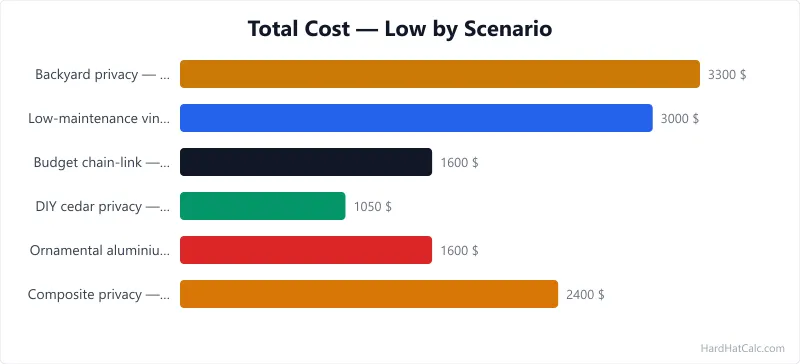
Fence Cost by Material
The material you pick sets the whole price band. Each one trades upfront cost against maintenance and lifespan, and the cheapest fence today is rarely the cheapest fence over twenty years.
Chain-link ($10-$29 per linear foot installed) is the cheapest way to mark a boundary or contain a dog. It offers no privacy on its own, but galvanised chain-link lasts 20-plus years with almost no upkeep.
Pressure-treated (PT) wood ($22-$58) is the budget privacy default across North America. It builds a solid, code-compliant fence for the lowest privacy-fence price, but it wants cleaning and re-sealing every two to three years or it greys and splinters.
Cedar ($25-$60) sits a step above treated pine. Cedar boards cost more than PT, but the wood resists rot naturally and takes stain well. Clear or premium grades run higher still, into the $60-$90 range.
Composite ($20-$45) is a wood-plastic composite (WPC) blend that never needs staining and carries long warranties. Budget privacy composite starts near wood prices; designer board systems climb past $50 per foot.
Vinyl (PVC) ($25-$60) is the maintenance-free option — no paint, no rot, no insects. The panels are expensive but install fast, so material, not labour, drives the price.
Aluminium ($25-$65) is the ornamental metal choice for front yards and pool surrounds. Powder-coated panels resist rust for decades; specialty ornamental styles can pass $100 per foot.
These bands are the typical 6-foot ranges — premium and specialty tiers sit above them and are called out separately. Pricing another outdoor build at the same time? The deck cost calculator runs the same material-plus-labour split for a deck, and the pergola cost calculator does the same for a pergola.
From Estimate to Fence Budget
The number this tool returns is a planning frame, not a quote. Turn it into a budget you can act on with these steps.
Measure the real run. Walk the fence line and measure every straight section, including the parts that jog around a shed, a tree, or a utility box. Each detour adds length and at least one more post.
Pick the material and height honestly. Use the per-foot bands above and weigh upkeep over the years you plan to stay. Run the tool once per candidate material to see the spread side by side, and set the height to what local zoning actually allows.
Add the extras separately. Gates run roughly $150-$600 each installed, sloped ground adds stepping or racking labour, and tearing out an old fence adds disposal cost. Budget the post footings too — the gravel calculator sizes the stone for a drained, frost-resistant post base.
Decide DIY, pro, or a split. A common middle path hires out the post setting — the part that punishes mistakes — and keeps the panel or picket hanging as DIY. For the bigger picture on budgeting an outdoor project this way, the deck building cost guide walks through where the money goes and what pays back at resale.
Get three local bids. Compare your estimate against three quotes. Wide gaps usually trace to material grade, fence height, or how each crew handles the posts and the terrain.
Where the Money Goes, and How This Tool Estimates It
Every fence estimate splits into two layers: the material you buy and the labour to install it. The share each takes depends heavily on the material, which is why this tool uses a different split for each one.
| Material | Installed $/ft (6 ft) | Labour share | What DIY removes |
|---|---|---|---|
| Chain-link | $10-$29 | ~50% | about half the bill |
| Pressure-treated wood | $22-$58 | ~50% | about half the bill |
| Cedar | $25-$60 | ~58% | most of the bill |
| Composite (WPC) | $20-$45 | ~30% | under a third |
| Vinyl (PVC) | $25-$60 | ~25% | about a quarter |
| Aluminium | $25-$65 | ~45% | under half |
Panel and metal systems are material-heavy and install fast, so labour is a small slice — a DIY vinyl fence still costs about three-quarters of the installed price in materials alone. Wood is the opposite: picket-by-picket labour is roughly half the bill, so doing it yourself saves the most.
Two honest notes on the numbers. First, the cedar range is calibrated, not lifted straight from one source. Raw aggregator data sometimes lists basic cedar below pressure-treated pine, which is backwards: cedar lumber costs more than treated pine. The $25-$60 band reflects solid privacy-grade cedar sitting just above PT, where the lumber-cost reality puts it; basic picket-grade cedar runs lower and clear or premium cedar reaches $60-$90. Second, the height adjustment (4-foot fences about 20% cheaper, 8-foot solid-privacy fences about 40% dearer) rests mainly on a single installer's published figures, so treat the 4-foot and 8-foot estimates as rougher than the well-sourced 6-foot baseline. For posts that carry real load (a gate, a pergola, or an arbor worked into the fence line), sizing moves beyond fence rules into the post size calculator.
DIY, Gates, and Other Cost Questions
A few practical points behind the numbers that catch first-time fence budgeters.
How much does DIY really save? It depends on the material. On a wood fence, labour is about half the installed cost, so building it yourself roughly halves the cash bill. On vinyl, labour is only a quarter, so the saving is smaller — the expensive part is the panels, not the hanging. The trade is always time and risk: a first fence takes most people several weekends.
What does the estimate leave out? Gates, sloped-ground stepping, old-fence removal, and permits. A walk gate adds roughly $150-$600 installed, and a permit for a privacy fence runs $25-$100 in most areas. These sit on top of the base run cost rather than inside it.
Why is a taller fence so much more expensive? An 8-foot fence uses more material per foot and a heavier structure to resist wind, and it often triggers a permit or engineering review. Digging the deeper post holes that height demands is its own job — estimate the spoil with the excavation volume calculator if you are renting a machine.
Does a longer fence cost less per foot? Slightly. Fixed costs like mobilisation and corner bracing spread over more length, so the per-foot rate eases a little as the run grows — though material grade and height still move the total far more than length alone.
Worked Examples
Example 1
Scenario: A homeowner is pricing a 150-foot pressure-treated wood privacy fence at 6 feet tall, hiring a contractor to build it.
Calculation: Pressure-treated wood runs $22-$58 per linear foot installed at 6 feet (the multi-sourced 2026 national band, no height adjustment). Total = 150 × $22 to 150 × $58 = $3,300 to $8,700 installed. Labour is about half of an installed wood fence, so material = 150 × {22,58} × 0.50 = $1,650 to $4,350 and labour is the same again, $1,650 to $4,350. That works out to $22 to $58 per linear foot.
What this means: A 150-foot PT wood fence lands at $3,300-$8,700 installed, or $22-$58 per foot. The wide spread is real: the low end is a simple build in a low-cost market, the high end is premium pickets, deeper posts, or a difficult site. Material and labour each carry about half the bill.
Takeaway: Pressure-treated pine is the budget default for a privacy fence. Doing the labour yourself removes roughly half the cost — the material-only figure for this fence is $1,650-$4,350.
Example 2
Scenario: A DIY builder is pricing 100 feet of vinyl privacy fence at 6 feet tall, doing all the work themselves.
Calculation: Vinyl runs $25-$60 per linear foot installed at 6 feet. Vinyl is material-heavy — the panels carry about 75% of the installed price and labour only 25% — so a DIY build keeps the material share: 100 × {25,60} × 0.75 = $1,875 to $4,500. Labour is zero. Total materials = $1,875 to $4,500, or $18.75 to $45 per linear foot.
What this means: At $1,875-$4,500, this is the material-only figure for a DIY vinyl fence. Because vinyl is mostly material cost, DIY saves less than it would on a labour-heavy wood fence — hiring a crew would add only about $625-$1,500 in labour, a quarter of the installed price.
Takeaway: Vinyl costs more upfront than wood but needs no staining for 20-plus years. The DIY saving is smaller than on wood because the panels, not the labour, drive vinyl's price.
Frequently Asked Questions
- How much does a fence cost per linear foot?
Installed fence cost runs from about $10 per linear foot for basic chain-link to $65 or more for ornamental aluminium and premium composite, with most privacy fences landing in the $22-$60 per foot range as of 2026. Pressure-treated wood is the budget privacy default; vinyl, aluminium, and composite cost more upfront but cut maintenance. The figure depends on material, height, terrain, and whether you hire a crew or build it yourself. For the material side of that figure — posts, rails, pickets, and concrete counts — the fence material calculator builds the full list.
- Is a vinyl fence or wood fence cheaper to install?
Installed, a wood fence is usually cheaper than vinyl at the low and middle of the market — pressure-treated wood starts around $22 per linear foot against vinyl's $25, and basic wood undercuts vinyl across most of the range. Vinyl closes the gap over time because it never needs staining, while wood wants re-sealing every two to three years. If you plan to skip the upkeep anyway, wood wins on cost; if you want zero maintenance, vinyl is worth the premium. The depth and concrete each material's posts need is the same job either way — the fence post depth calculator sets it from your soil and frost line.
- How does this calculator estimate fence cost?
The tool multiplies your fence length by an installed cost-per-linear-foot range for the material you choose, then splits that into material and labour using a per-material labour share — about half for wood, a quarter for vinyl, and so on. Choosing DIY zeroes the labour line and shows materials only. Fence height bands the result: a 4-foot fence sits below the 6-foot baseline and an 8-foot fence above it. It prices the run itself and leaves gates and site work as separate add-ons, the same way the deck cost calculator handles stairs and railing.
- Is it cheaper to build a fence yourself?
Yes, usually — DIY removes the labour line, which is a quarter to nearly two-thirds of an installed fence depending on the material. The saving is largest on labour-heavy wood fences and smallest on material-heavy vinyl, where the panels carry most of the cost. Budget for tool rental (a powered auger runs $40-$80 a day), the time of several weekends, and the risk of a leaning post if a footing is set wrong. Setting posts in a drained gravel or concrete base is the step most worth getting right — see how much stone each hole needs with the gravel calculator.
More Materials calculators
Browse all materials calculators — Paint coverage, roofing bundles, tile adhesive, welding time, parking lot sizing, and more.