
Roof Pitch Calculator
Free roof pitch calculator that turns rise and run into the pitch ratio, angle in degrees, percent grade, and the slope factor used for roofing estimates.
Last updated:
Enter a measured rise and run, or type an angle if you read one off a square or app.
Vertical height the roof climbs over the run distance below. Used by the Rise & Run method.
Horizontal distance. Use 12 for the standard X-in-12 pitch, or enter your measured run.
Slope angle in degrees. Used only when Calculation Method is set to Angle.
For estimation only. Structural work requires review by a licensed engineer. Local building codes take precedence over any calculator output.
How This Is Calculated
Slope angle = arctan(rise / run). Percent grade = (rise / run) x 100. Slope factor = sqrt(rise squared + run squared) / run. Pitch (rise in 12) normalises any rise/run to the X-in-12 form. Strict pitch = rise / span = slope / 2 for a symmetric gable.
Source: Roof slope is expressed as rise per 12 units of horizontal run (the X-in-12 convention) per IRC 2021 Chapter 9 (Roof Assemblies, Section R905) and the definitions in Section R202. Conversions use standard trigonometry: slope angle = arctan(rise / run); percent grade = (rise / run) x 100; slope factor = sqrt(rise squared + run squared) / run = sec(slope angle), the plan-area-to-surface-area multiplier used in roofing material estimating (NRCA practice; published slope-factor tables). Strict pitch (rise / span) = slope / 2 for a symmetric gable. Table values cross-checked against published pitch-to-degrees and slope-factor charts.
5 min read
Pitch, Slope, and the X-in-12 System
The Roof Pitch Calculator converts a roof's rise and run into its pitch ratio, angle in degrees, percent grade, and slope factor for material take-offs. Enter the rise and run you measured, or type in an angle, and the tool reports every form at once.
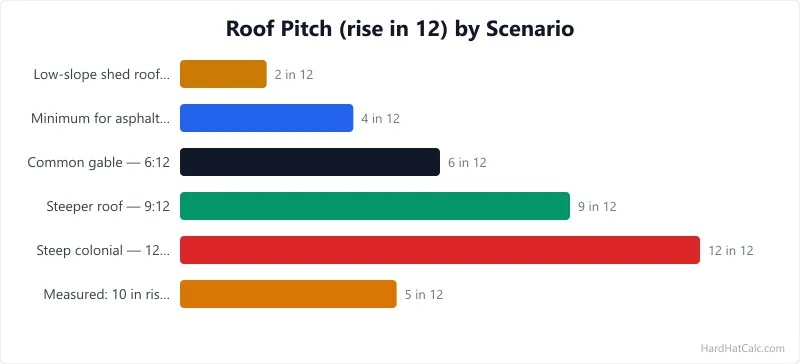
Roofers describe steepness with two numbers: the rise (how far the roof climbs vertically) and the run (the horizontal distance it covers). In the United States the run is fixed at 12 inches, so a roof that climbs 6 inches over 12 inches of run is a "6 in 12", written 6:12. That X-in-12 figure is what most people mean by "roof pitch", and it is the term the IRC leans on for sizing underlayment, fasteners, and roof coverings.
Strictly, that ratio is the slope, not the pitch. Slope is rise over run; true pitch is rise over the full span of the building, written as a reduced fraction. Because the span is twice the run on a symmetric gable, a 6:12 slope equals a 1/4 pitch (6 divided by 24). The two terms get used interchangeably on site, so this tool reports the field-standard X-in-12 figure as the headline and the strict span fraction on its own line. If you already have the pitch and need board lengths next, the rafter length tool takes it from there, and the roofing material guide covers turning a slope into shingle counts.
Measuring an Existing Roof With a Level and Tape
You do not need to climb onto the roof to find its pitch. The most reliable low-tech method uses a spirit level and a tape measure, and it works just as well from inside the attic against a rafter.
Use a level at least 12 inches long. A 24-inch level is easier to hold steady. Measure 12 inches in from one end and mark that point with a pencil — that mark sets your run.
Hold the level dead horizontal. Rest one end against the roof surface (or against the underside of a rafter in the attic) and bring the bubble to centre. The level now represents a horizontal 12-inch run.
Measure the rise. With the tape, measure the vertical distance from the 12-inch mark straight down to the roof surface, or straight up to the rafter if you are in the attic. That measurement, in inches, is the rise.
Read it as rise-in-12. A 6-inch drop is a 6:12 roof; a 4-inch drop is 4:12. Enter the rise and a run of 12 above to get the angle, percent, and slope factor.
Working from the attic is safer than standing on a slope, and it avoids the lumps of overlapping shingles that throw the reading off. A speed square with a torpedo level laid on its flat edge reads the same slope off its degree scale, and a calibrated phone inclinometer app gives a quick estimate — though confirm anything order-critical with the level method. To frame a whole roof from the pitch, pair it with the shed roof truss tool.
Pitch, Angle, and Slope Factor Conversions
Once you have the rise-in-12 figure, every other expression of slope follows from it. The angle comes from the arctangent, the percent grade is rise over run as a percentage, and the slope factor is the length of the sloped surface compared with its flat footprint.
| Pitch | Angle | Percent grade | Slope factor | Strict pitch |
|---|---|---|---|---|
| 1:12 | 4.76° | 8.3% | 1.003 | 1/24 |
| 2:12 | 9.46° | 16.7% | 1.014 | 1/12 |
| 3:12 | 14.04° | 25.0% | 1.031 | 1/8 |
| 4:12 | 18.43° | 33.3% | 1.054 | 1/6 |
| 6:12 | 26.57° | 50.0% | 1.118 | 1/4 |
| 8:12 | 33.69° | 66.7% | 1.202 | 1/3 |
| 9:12 | 36.87° | 75.0% | 1.250 | 3/8 |
| 12:12 | 45.00° | 100.0% | 1.414 | 1/2 |
The angle and slope factor both climb slowly at first, then quickly past 8:12. A 12:12 roof sits at exactly 45 degrees with a slope factor of 1.414 — the square root of 2 — because its rise equals its run. The slope factor column is the one that drives material cost, since it tells you how much actual roof surface hides above a given footprint. Feed that surface area into the shingle bundle tool to turn it into bundles.
Slope Factor and Roofing Material Estimates
What is the slope factor, and why does it matter for ordering materials?
The slope factor is the ratio between the sloped roof surface and the flat area it covers. A roof never uses the same amount of material as its footprint, because the covering follows the incline. Multiply the plan area (length times width, measured on the ground) by the slope factor to get the true surface area. A 1,500-square-foot footprint at 6:12 (factor 1.118) becomes 1,677 square feet of roof — 177 extra square feet of sheathing, underlayment, and shingles that a flat measurement would miss. The NRCA and every shingle manufacturer build this multiplier into their estimating tables.
Why not just measure the roof directly? On a finished, walkable roof you can, but for planning from drawings or a ground measurement the slope factor is faster and keeps you off the ladder. It is also the only way to estimate before the roof is built.
Does the slope factor change the underlayment and flashing too? Yes — every layer that follows the slope scales by the same factor, so apply it to the whole roofing take-off, not just the shingles. Drainage scales with pitch as well, which is why the gutter sizing tool asks for the roof slope before it sizes the downspouts.
Low-Slope vs Steep-Slope Roofs
Roofs fall into three slope bands, and the band decides what covering is allowed and how the roof is built.
Low-slope roofs (below 2:12) shed water too slowly for shingles. Standing water finds its way under any lapped covering, so these roofs need a continuous membrane — built-up bitumen, modified bitumen, TPO, or EPDM. They are common on porches, additions, and modern flat-roofed designs. The IRC sets 2:12 as the floor for asphalt shingles, and even then it requires a double layer of underlayment up to 4:12.
Conventional roofs (4:12 to 9:12) are the residential sweet spot. Shingles, tiles, and metal all work, a roofer can walk the surface with normal precautions, and the slope factor stays modest at 1.054 to 1.250 — so material overruns are manageable. The 6:12 pitch is the most common single pitch in US housing.
Steep roofs (above 9:12) shed water and snow fast and give a strong architectural look, but they cost more. The slope factor passes 1.25, so material and labour climb, and crews need roof jacks, fall-arrest gear, and staging to work safely. A 12:12 roof carries 41% more surface area than its footprint. When a steep roof is framed with trusses rather than rafters, the truss pricing tool reflects that extra web length in the cost.
Worked Examples
Example 1
Scenario: A homeowner held a 12-inch level against a rafter and measured a 6-inch vertical drop at the 12-inch mark. They want the pitch in every form, plus the area multiplier for ordering shingles.
Calculation: Rise = 6 in, run = 12 in. Pitch = (6 / 12) × 12 = 6 in 12 (a 6:12 slope). Angle = arctan(6 / 12) = arctan(0.5) = 26.57 degrees. Percent grade = (6 / 12) × 100 = 50%. Slope factor = √(6 squared + 12 squared) / 12 = √(180) / 12 = 1.118. Strict pitch = 6 / (2 × 12) = 6 / 24 = 0.25 (one-quarter pitch).
What this means: A 6:12 is the most common residential pitch, sitting at a 26.57-degree angle. The slope factor of 1.118 means the actual roof surface is 11.8% larger than the flat footprint, so a 1,500 sq ft footprint hides 1,677 sq ft of roof to cover.
Takeaway: Multiply your plan area by the 1.118 slope factor before ordering shingles, underlayment, and sheathing. Skipping that step under-orders a 6:12 roof by roughly 12%.
Example 2
Scenario: A contractor read 18.43 degrees off a calibrated inclinometer app laid on a rafter and wants the standard X-in-12 pitch and the slope factor for an estimate.
Calculation: Method = angle, angle = 18.43 degrees. Rise per 12 in run = tan(18.43 degrees) × 12 = 4.0, i.e. a 4:12 slope. Percent grade = (4 / 12) × 100 = 33.3%. Slope factor = √(4 squared + 12 squared) / 12 = √(160) / 12 = 1.054. Strict pitch = 4 / 24 = 0.167 (one-sixth pitch).
What this means: 4:12 is the practical floor for standard asphalt shingles. The IRC allows shingles down to 2:12 but requires a double layer of underlayment on any slope below 4:12, so 4:12 is where a single-layer shingle roof becomes straightforward.
Takeaway: Below 2:12 you need a membrane roof, not shingles. Between 2:12 and 4:12, budget for double underlayment; at 4:12 and above, a standard shingle assembly applies and the modest 1.054 slope factor keeps material overruns small.
Frequently Asked Questions
- How do you calculate roof pitch?
Measure the vertical rise over a fixed horizontal run of 12 inches, then read the result as rise-in-12 — a 6-inch rise over a 12-inch run is a 6:12 pitch. To convert that ratio into an angle, take the arctangent of rise divided by run (arctan(6/12) = 26.57 degrees); for the percent grade, divide rise by run and multiply by 100. If you measured the rise over a run other than 12 inches, this tool normalises it back to the standard X-in-12 form automatically. Once you know the pitch, the rafter length calculator converts it into the board lengths you need to order.
- What is a 6/12 roof pitch in degrees?
A 6/12 roof pitch is 26.57 degrees, found by taking the arctangent of 6 divided by 12 (arctan(0.5)). It is also a 50 percent grade and carries a slope factor of 1.118, which means the roof surface is about 12 percent larger than the flat footprint beneath it. A 6:12 is the most common residential pitch because it sheds water well, stays walkable for roofers, and keeps material overruns modest. To turn that slope factor into actual shingle quantities, see the roofing material guide.
- What is roof slope factor?
Roof slope factor is the multiplier that converts a roof's flat footprint area into its true sloped surface area, calculated as the square root of (rise squared plus run squared) divided by the run. A 6:12 roof has a slope factor of 1.118, so a 1,000-square-foot footprint hides 1,118 square feet of actual roof. Roofers apply this factor to every layer that follows the slope — sheathing, underlayment, and shingles alike. The shingle bundle calculator builds the slope factor in when it estimates how many bundles a roof needs.
- Is roof pitch the same as roof slope?
Not in the strict sense, though the two terms are used interchangeably on most job sites. Slope is the rise over the run, standardised to a 12-inch run and written as X:12 — that is the figure framing squares and building codes use. True pitch is the rise over the full span of the building, expressed as a reduced fraction, so a 6:12 slope works out to a 1/4 pitch because the span is twice the run. This tool shows both, leading with the X-in-12 slope that almost everyone calls "pitch".
More Structural calculators
Browse all structural calculators — Beam sizing, truss pricing, load calculations, wall framing, deck capacity, and foundation tools.