
Concrete Volume Calculator
Free concrete volume calculator for slabs, footings, columns, and walls — get cubic yards, cubic metres, 40/60/80-lb bag counts, and a waste allowance.
Last updated:
Slabs, footings, and walls are rectangular. Columns and piers are round.
Length of a slab, footing, or wall. For a round column or pier, enter the diameter here.
Width of a slab or footing. For a wall or column, enter the height here.
Slab, footing, or wall thickness in inches. Not used for round columns.
Number of identical elements — one slab, or several matching piers or footings.
Overage for spillage and uneven subgrade. 5% for clean flat slabs, 10% for footings and rough ground.
For estimation only. Structural work requires review by a licensed engineer. Local building codes take precedence over any calculator output.
How This Is Calculated
Rectangular (slab, footing, wall): V = length x width x (thickness / 12), in cubic feet. Round column or pier: V = pi / 4 x diameter squared x height. Total = unit volume x quantity. Cubic yards = cubic feet / 27; cubic metres = cubic feet x 0.0283168. Order volume = total x (1 + waste% / 100). Bag counts = ceil(order cubic feet / yield), where an 80-lb bag yields 0.60 cu ft, a 60-lb bag 0.45, and a 40-lb bag 0.30.
Source: Volume geometry uses standard prism and cylinder formulas: rectangular elements (slabs, footings, walls) as V = length x width x thickness, and round columns as V = pi/4 x diameter squared x height. Cubic feet convert to cubic yards (divide by 27) and cubic metres (x 0.0283168). Bag yields per the Quikrete Concrete Mix (No. 1101) and Sakrete High-Strength Concrete Mix product data sheets, both tested to ASTM C387: a 40-lb bag yields 0.30 cu ft, a 60-lb bag 0.45 cu ft, and an 80-lb bag 0.60 cu ft. Waste allowance follows standard ready-mix ordering practice of 5-10% overage.
5 min read
Concrete Volume by Shape
The Concrete Volume Calculator turns the dimensions of a slab, footing, column, or wall into the cubic yards, metres, and bag counts to order.
Every concrete take-off starts as a geometry problem. A slab, a strip footing, and a wall are all rectangular boxes, so you multiply length by width by thickness to get the volume. The one trick is units: thickness is usually quoted in inches while length and width are in feet, so a 4-inch slab is 4/12 of a foot thick, not 4 feet. A round column, pier, or Sonotube is a cylinder, so its volume is pi/4 times the diameter squared, times the height.
Concrete is sold two ways, and both use the same volume figure. Ready-mix plants quote in cubic yards, where one cubic yard is 27 cubic feet, while much of the world works in cubic metres of about 35.3 cubic feet each. This tool reports both alongside the raw cubic feet so you can talk to a batch plant or a builders' merchant without converting in your head.
If you do not yet know a footing's size, work out its width and depth from the load first with the footing sizing tool. Round deck piers and column pads are handled the same way by the pier and post footing sizer, and you bring the finished dimensions back here to price the pour.
Measuring Each Shape for a Volume Take-Off
A clean take-off comes from measuring the actual formed space, not the nominal size on a drawing.
Slabs and footings. Measure the length and width in feet and the thickness in inches. For an L-shaped or stepped slab, split it into rectangles, size each one on its own, and add the results. Over-dug ground swallows extra concrete, so check the trench first with the excavation volume tool when the dig is rough.
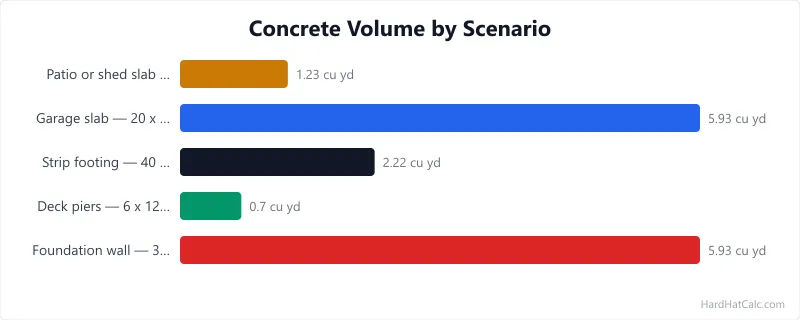
Walls. Enter the wall length and height in feet and the thickness in inches. A 30-foot foundation wall at 8 feet tall and 8 inches thick works out near 6 cubic yards, which almost always comes from a truck.
Round columns and piers. Enter the tube diameter as the length and the height as the width. A 12-inch Sonotube is 1 foot in diameter, so a 4-foot pier holds about 3.1 cubic feet.
Count the elements and the steel. Set the quantity field to the number of identical piers or footings so the tool totals them in one pass. Rebar and mesh displace a small amount of concrete, but common practice is to ignore that and let the waste allowance cover it. When the pour is reinforced, size the grid with the rebar and mesh tool before you order.
Bags per Cubic Yard by Bag Size
Bagged concrete is sold by weight but bought by volume. Each bag prints the cubic feet it yields once mixed, and the two big brands list the same numbers.
| Bag size | Yield per bag | Bags per cubic yard | Bags per cubic metre |
|---|---|---|---|
| 40 lb | 0.30 cu ft | 90 | 118 |
| 60 lb | 0.45 cu ft | 60 | 79 |
| 80 lb | 0.60 cu ft | 45 | 59 |
Yields are taken from the Quikrete Concrete Mix (No. 1101) and Sakrete High-Strength Concrete Mix data sheets, both tested to ASTM C387 at 4,000 PSI. The bags-per-yard columns divide 27 cubic feet by each yield, so they land on whole numbers only for a full yard. Real pours rarely land on a whole yard, which is why the calculator rounds each bag count up to the next full bag against your actual order volume.
A standard bagged mix already holds cement, sand, and stone in the right proportions, so you only add water. If you would rather match a named product to a job or batch your own from separate ingredients, the named-product and mix-strength guide maps each bag type to the strength it delivers.
Bagged Concrete vs Ready-Mix Delivery
The crossover between bags and a ready-mix truck sits at roughly one cubic yard.
Bagged concrete suits small, spread-out, or hard-to-reach pours. A single 80-lb bag yields 0.60 cubic feet, so a full cubic yard takes 45 bags and two to three hours of mixing. Bags cost more per yard than delivered concrete, but there is no delivery fee, no minimum order, and no truck idling while you place the pour. Fence posts, a handful of deck piers, a small pad, or a repair are textbook bag jobs.
Ready-mix wins once the volume passes about a yard. A truck holds 8 to 10 cubic yards batched to a set strength and places it in minutes rather than hours. The catch is the short-load charge: most plants add a fee on orders under about 5 cubic yards, and the truck needs access within reach of the pour or a pump line. A 20 by 24-foot garage slab at 4 inches needs close to 6 cubic yards, which is firmly truck territory.
Freshly placed concrete then has to cure before it carries load, and cold or hot weather stretches or shrinks that timeline. Check when a pour reaches walk-on and design strength with the curing time estimator before you strip forms or park a car on a new slab.
How Much Extra Concrete to Order
Why can't I just order the exact volume? Because the formed space is never as clean as the drawing. The subgrade dips, forms bow a little, and some concrete stays behind on the chute and in the wheelbarrow. Ordering the precise figure almost guarantees running short near the end of a pour, and a cold joint from a paused pour is a weak line you cannot easily fix later.
How much waste should I allow? Five to ten percent is the standard range. Use 5 percent for a small, flat, well-formed slab on firm ground, and 10 percent for footings, uneven subgrade, or anything with rough excavation. This tool defaults to 10 percent and lets you dial it between 0 and 20.
Is it better to have too much or too little? Too much, every time. A few leftover bags or a small surplus of ready-mix costs little, while a short pour can mean a second delivery, a second short-load fee, and a cold joint through the middle of the element. Order the volume-with-waste figure the tool shows, not the raw volume.
What about price? This tool sizes quantity, not cost. Concrete prices move with region, season, and fuel, so get a current quote from a local plant or merchant once you know the cubic yards you need.
Worked Examples
Example 1
Scenario: A homeowner is pouring a 10 by 10-foot patio slab at 4 inches thick and wants to know whether to order ready-mix or buy bags, plus a 10% waste allowance.
Calculation: Slab shape, 10 ft x 10 ft x 4 in, quantity 1, 10% waste. Volume = 10 × 10 × (4 / 12) = 33.33 cu ft = 33.33 / 27 = 1.23 cu yd (0.94 cu m). With 10% waste: 33.33 × 1.10 = 36.67 cu ft = 1.36 cu yd. Bags = ⌈36.67 / 0.60⌉ = 62 (80-lb), ⌈36.67 / 0.45⌉ = 82 (60-lb), or ⌈36.67 / 0.30⌉ = 123 (40-lb).
What this means: At 1.36 cubic yards to order, this slab is past the point where bags make sense. A ready-mix delivery places it in minutes, while 62 bags would take most of a day to mix by hand and cost more per yard.
Takeaway: For a slab this size, order about 1.4 cubic yards of ready-mix rather than mixing 62 bags. Keep bagged concrete for pours under roughly one cubic yard.
Example 2
Scenario: A DIY builder is setting 6 deck piers in 12-inch Sonotube forms, each 4 feet deep, and wants the total concrete with a 10% waste allowance.
Calculation: Column shape, 12 in (1 ft) diameter x 4 ft high, quantity 6, 10% waste. One pier = pi / 4 × 1 squared x 4 = 3.14 cu ft. Six piers = 18.85 cu ft = 0.70 cu yd (0.53 cu m). With 10% waste: 18.85 × 1.10 = 20.73 cu ft = 0.77 cu yd. Bags = ⌈20.73 / 0.60⌉ = 35 (80-lb) or ⌈20.73 / 0.45⌉ = 47 (60-lb).
What this means: Six 12-inch piers hold about 0.77 cubic yards once waste is added. That sits under the one-yard crossover, so 35 bags of 80-lb mix is a reasonable job for a couple of people with a mixer.
Takeaway: Set the quantity field to 6 and the tool totals every pier in one pass. Below one cubic yard, bagged concrete usually beats paying a short-load fee for a partial truck.
Frequently Asked Questions
- How many bags of concrete equal one cubic yard?
One cubic yard is 27 cubic feet, so the bag count depends on the size you buy. An 80-lb bag yields 0.60 cubic feet, which works out to 45 bags per cubic yard; a 60-lb bag yields 0.45 cubic feet (60 bags per yard); and a 40-lb bag yields 0.30 cubic feet (90 bags per yard). Because a full yard is 45 heavy bags and hours of mixing, most people switch to ready-mix once a pour passes a yard. For the footing case specifically, the footing volume tool works the bag count out from the trench dimensions.
- How do you calculate concrete volume for a pour?
For a slab, footing, or wall, multiply length by width by thickness with every measurement in the same unit, then divide by 27 to get cubic yards (or 35.3 for cubic metres). Keep thickness consistent: a 4-inch slab is 0.333 feet thick, so a 10 by 10-foot pad is 10 x 10 x 0.333 = 33.3 cubic feet, or 1.23 cubic yards. A round column or pier uses pi/4 times the diameter squared times the height instead. If the ground has been dug out roughly, size the hole first with the excavation-volume estimator so your concrete estimate matches the real formed space.
- How much concrete do I need for a slab?
Take the slab area in square feet, multiply by the thickness in feet, and divide by 27 for cubic yards. A 10 by 10-foot slab at 4 inches needs about 1.23 cubic yards; a 20 by 24-foot garage slab at the same thickness needs close to 6 cubic yards. Add 5 to 10 percent on top for waste and uneven subgrade, then order that larger figure. If you are placing rebar or wire mesh in the slab, the reinforcement calculator sizes the grid to go in before the pour.
- Should I order ready-mix or bags of concrete?
The practical dividing line is about one cubic yard. Below that, bagged concrete avoids delivery and short-load fees, and a small pour of a few bags is manageable by hand. Above a yard, a ready-mix truck is faster and usually cheaper per yard, since 45 bags of 80-lb mix take two to three hours to mix for every single yard. Match the bag or mix to the job with the types of concrete mix guide, which pairs each product with the strength and application it suits.
More Structural calculators
Browse all structural calculators — Beam sizing, truss pricing, load calculations, wall framing, deck capacity, and foundation tools.