
Types of Concrete Mix
Types of concrete mix by grade and job: UK designated mixes (GEN, FND, RC, PAV), US psi bags, and specialty concretes, with the right type for each pour.
Walk into a builders' merchant for concrete and you face a wall of named bags: general-purpose, fast-setting, high-strength, crack-resistant. Order a ready-mix lorry instead and the question turns into a code — GEN1, FND2, C25/30, or PAV1. Both are asking the same thing in different dialects: which concrete is right for this job? This guide to the types of concrete mix sorts the products and grades by what they are built to do, so you order by name and let the recipe take care of itself.
Concrete is not one material. The cement, sand, stone, and water blend dozens of ways, and each blend trades strength, working time, durability, and cost against the others. You rarely need to design a mix yourself, though. The named products and standard grades already lock in the proportions, so choosing the right type is mostly a matter of matching the label to the work. For the cement-to-aggregate proportions behind a hand-mixed batch, the companion guide on how concrete mix ratios are written covers the 1:2:3 notation in full; this article stays on which type to buy.
Two Ways Concrete Gets Named
Concrete is specified two ways, and which one you meet depends on where you build. In the United States, bagged products carry a brand name and a psi number, the 28-day compressive strength in pounds per square inch. A "4000" bag tests to 4,000 psi after 28 days of curing. In the UK and across Europe, concrete is ordered by a strength class such as C25/30, often wrapped inside a designated-mix code like GEN3 or RC28/35.
The strength class looks cryptic but reads simply. C25/30 means a characteristic compressive strength of 25 megapascals measured on a cylinder and 30 megapascals measured on a cube. The cube is the stiffer test piece, so its number is always higher, and UK specifiers quote that second figure. One megapascal is about 145 psi, so a C25/30 mix at 30 MPa cube lands near 4,350 psi — close to a US 4000 bag. The two systems describe the same concrete; they just measure it on different sample shapes.
The US psi ladder is worth knowing because it maps onto the grades. A 2,500 psi mix is the code minimum for residential footings and foundations. Most structural work pours 3,000 to 3,500 psi, driveways and garage floors run 3,500 to 4,000 psi, and 4,000 to 5,000 psi covers columns, retaining walls, and heavily loaded slabs. Read a higher number as a stronger, denser, and usually pricier concrete.
The UK Designated Mixes
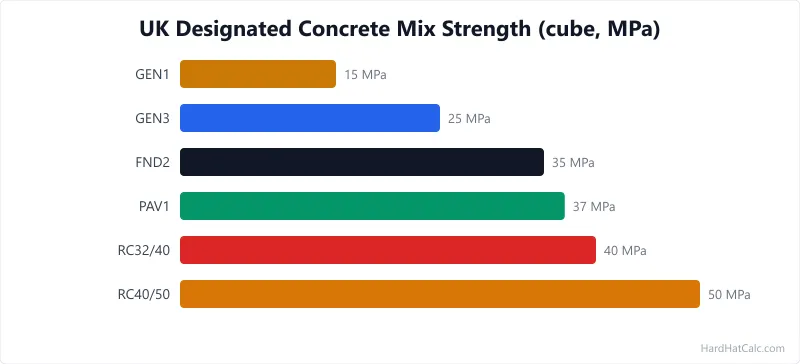
The UK system, set out in BS 8500, groups standard concretes into families. Each family has a code and a number, and ordering one tells the ready-mix plant exactly which tested recipe to supply. The table below covers the mixes a domestic or light-commercial job actually uses, with the strength class and cube strength behind each name.
| Designation | Strength class | Cube strength | Typical use |
|---|---|---|---|
| GEN1 | C12/15 | 15 MPa | Strip foundations, trench fill, drainage surrounds |
| GEN3 | C20/25 | 25 MPa | Garage and shed floors, unreinforced internal slabs |
| FND2 | C28/35 (DC-2) | 35 MPa | Foundations in sulfate-bearing ground |
| RC28/35 | C28/35 | 35 MPa | Reinforced slabs and footings with rebar |
| RC32/40 | C32/40 | 40 MPa | Industrial floors, forklift and heavy wheel loads |
| PAV1 | C30/37 | 37 MPa | Driveways, patios, paths (air-entrained) |
| PAV2 | C35/45 | 45 MPa | Surfaces exposed to de-icing salt |
Two families carry a property the others do not. The PAV mixes are air-entrained: they hold 4 to 7 percent microscopic air bubbles that give freezing water somewhere to expand, which stops the surface flaking after a few winters. Every exterior driveway and patio should be a PAV mix for that reason. The FND mixes are sulfate-resisting, built for ground where dissolved sulfates in clay or made-up land would slowly attack ordinary concrete. When I poured footings for a wall extension on heavy Northumberland clay, the supplier specified FND2 once the soil flagged sulfates; a plain GEN mix would have degraded below ground within a decade.
For a footing or trench fill with no sulfate problem, GEN1 is the workhorse, and the closely related ST2 standardised mix does the same job where third-party certification is not required. Once steel reinforcement enters the pour, the grade steps up to an RC mix, because reinforced concrete follows tighter durability rules. A pier and pad footing sizer works out how deep and wide those foundations need to be before you order the volume.
What the Bags at the Merchant Actually Are
Bagged concrete suits jobs too small for a lorry: posts, pads, repairs, and single footings. The product names describe a job rather than a chemistry lesson, and a handful cover almost everything a homeowner buys.
- General-purpose concrete reaches about 4,000 psi at 28 days and sets at a normal pace. It is the default for small slabs, footings, and setting heavy posts when you are not in a hurry.
- Fast-setting concrete (post mix) sets hard in 20 to 40 minutes and reaches the same 4,000 psi at 28 days. You pour it dry into the hole, add water, and the post stands firm in under an hour, which is why fence and mailbox jobs reach for it.
- High-strength concrete, sold as 5000, tests to 5,000 psi and gains strength fast, passing 1,500 psi within a day. It suits driveways, structural footings, and anything carrying heavy load.
- Crack-resistant concrete holds the same 4,000 psi but adds synthetic fibres that cut shrinkage cracking and can replace wire mesh in a thin slab on grade.
One label trips people up. Mortar mix and sand-topping mix are not concrete, because they contain no coarse stone and so lack the compressive strength a structural pour needs. Mortar beds brick and block; topping mix resurfaces thin areas. Reach for a true concrete whenever the pour carries load. Once the type is chosen, the same dimensions-to-quantity maths that prices a pour drives a footing concrete estimate in bags or cubic yards.
Where you buy the concrete also limits which types are on offer. A merchant's bagged range runs to a handful of named products, which suits posts, pads, and repairs. A ready-mix plant can supply the full BS 8500 designated range, from GEN1 through the RC and FND grades, so any larger or graded pour becomes an order rather than a stack of bags. Batching on site from loose cement and aggregate gives the widest choice of all, because you set the proportions yourself, though that hands you the job of getting them right. The bigger or more demanding the pour, the more the decision shifts from a product name on a bag to a strength class on an order sheet.
Specialty Concretes That Solve One Problem
Beyond the everyday grades sits a set of specialty concretes, each built to fix a single problem. You meet them when a job has a condition the standard mix cannot handle.
Air-entrained concrete, as in the PAV mixes, resists freeze-thaw scaling and is the rule for any exterior slab in a cold climate. Fibre-reinforced concrete carries steel or polypropylene fibres through the mix to control cracking, and in a slab on grade it can stand in for mesh. Sulfate-resisting concrete, the FND family, protects foundations in aggressive ground. Rapid-hardening concrete gains strength quickly for early loading or fast repairs, the same chemistry behind fast-setting post mix.
Lightweight concrete uses expanded clay or aerated cement to drop the density well below the roughly 2,400 kilograms per cubic metre of normal-weight concrete, which lowers the dead load a structure has to carry. Self-compacting concrete flows into formwork and around dense reinforcement under its own weight, with no poker vibration. Waterproof concrete adds a water-resisting admixture for tanks, basements, and retaining structures. Each is a standard mix with one property dialled up, so you only pay for the upgrade when the job demands it.
Which Concrete to Buy for Common Jobs
Most domestic decisions come down to a short list. Match the job to the type first, then size the quantity separately.
- Fence and gate posts: fast-setting post mix for a one-hour set, or a GEN1 bag mix. A quick, firm set matters more than high strength here.
- Garden wall footing: GEN1 (C12/15), stepping up to FND2 if the ground holds sulfates. The US equivalent is a 2,500 to 3,000 psi mix.
- House footings and foundations: GEN1 in clean ground, FND2 in sulfate clay. The US code minimum is 2,500 psi, though most pours use 3,000.
- Ground-floor slab: GEN3 (C20/25) for an unreinforced domestic floor, moving to RC28/35 once mesh or bar goes in.
- Driveway or patio: PAV1 (C30/37, air-entrained) in the UK, or a 3,500 to 4,000 psi air-entrained mix in the US.
- Reinforced or heavily loaded work: RC28/35 and up, or 4,000 to 5,000 psi for columns, lintels, and loaded slabs.
Reinforced pours change more than the grade. The steel has to be sized and spaced, which a rebar layout and spacing tool handles, and the bar sizes follow the figures in the rebar size and weight chart. With the type settled, the calculator below sizes the footing and converts it into a concrete volume and bag count for the pour.
Strip footings run under walls. Pad footings support individual columns.
PLF (per linear foot) for continuous footings, or total lbs for isolated pads.
IRC presumptive classes: clay/sandy clay/silt 1,500 PSF. Sand and silty sand 2,000 PSF. Gravel and sandy gravel 3,000 PSF. Sedimentary rock 4,000 PSF.
Local frost line depth. Footings extend 6 inches below this.
Total linear feet for strip footings, or number of pad footings.
Minimum 6 inches per IRC R403.1.1. Typical residential: 8-10 inches.
For estimation only. Structural work requires review by a licensed engineer. Local building codes take precedence over any calculator output.
How This Is Calculated
Continuous footing width (in) = max((load PLF / soil bearing PSF) × 12, 12). Isolated pad side (in) = max(ceil(sqrt(load lbs / soil bearing PSF x 144)), 12). Both rounded up to nearest 2 inches. Depth = max(frost depth + 6", 12"). Volume for strip = width x thickness x length. Volume for pad = side² x thickness x count. Cost = volume x $160/cu yd + form/rebar estimate.
Source: Footing width sizing per IRC 2021 Section R403.1.1 and Table R403.1(1) (light-frame construction). Frost depth requirements per IRC R403.1.4. Concrete volume calculations use standard geometric formulas. Presumptive soil bearing values per IRC Table R401.4.1 (clay class 1,500 / sand class 2,000 / gravel 3,000 / sedimentary rock 4,000 psf). Values verified July 2026 against four published code reproductions.
Specify the Type, Then Calculate the Quantity
The thread running through every grade and product name is the same: the type carries the recipe so you do not have to. Order GEN3 and the plant hits C20/25 without you naming a single proportion. Buy a fast-setting bag and the accelerator is already inside it. Pick the type by what the concrete has to survive — strength for load, air-entrainment for frost, sulfate-resistance for bad ground, speed for posts — and the mix design comes with it. Then size the pour, count the bags or yards, and book the delivery. Choose the concrete by the job rather than by guesswork, and the order goes in right the first time.
Frequently Asked Questions
- What are the main types of concrete mix?
Concrete types fall into three groups: everyday grades sorted by strength, bagged products sorted by job, and specialty mixes sorted by a single property. Strength grades run from a UK GEN1 or US 2,500 psi mix for footings up to RC32/40 or 5,000 psi concrete for heavy structural work. Bagged products such as general-purpose, fast-setting, high-strength, and crack-resistant cover small DIY pours, while specialty mixes like air-entrained, sulfate-resisting, fibre-reinforced, and lightweight each solve one problem such as frost, bad ground, or cracking. The cement-to-aggregate proportions inside each mix are set separately from the type itself.
- What grade of concrete do I need for house foundations?
Standard house footings use a GEN1 (C12/15) mix in the UK, or 2,500 psi concrete as the US code minimum, though many builders pour 3,000 psi for a safety margin. If a soil survey finds sulfates in the ground, which is common in heavy clay and made-up land, switch to a sulfate-resisting FND2 (C28/35) mix, because ordinary concrete slowly breaks down in sulfate-rich soil. Reinforced foundations step up again to an RC28/35 grade. Work out the footing size and the concrete volume with a footing calculator before you place the order.
- What is the difference between C25 and C30 concrete?
The number in a UK concrete grade is its characteristic compressive strength in megapascals, so C30 is stronger than C25. Written in full as C20/25 and C25/30, each pair is the cylinder strength and the cube strength of the same concrete, and the UK quotes the higher cube figure. In practice C20/25 (a GEN3 mix) suits unreinforced domestic floors, while C25/30 and above move into reinforced and structural work. Multiply the megapascal figure by about 145 to get the rough psi equivalent printed on US bags.
- Can I use the same concrete for a driveway and a fence post?
No, those two jobs need different concrete types. A driveway sits outside through every winter, so it needs an air-entrained mix, PAV1 in the UK or a 3,500 to 4,000 psi air-entrained mix in the US, that resists freeze-thaw flaking. A fence post needs a quick, firm set rather than high strength, which is exactly what fast-setting post mix delivers in under an hour. Using a plain interior-grade concrete outdoors leads to surface scaling within a few winters, while using slow-setting driveway concrete to set posts wastes a day waiting for it to firm up.