
Retaining Wall Cost Guide
How much does a retaining wall cost? Compare installed prices by wall type, the 4-foot rule that triggers an engineer, and DIY-vs-pro savings.
How much does a retaining wall cost? The honest answer is a range, because the price turns on the material you build from, how tall the wall has to stand, and the drainage and engineering hidden behind the face. A short timber or gabion wall along a garden bed and an engineered concrete wall holding back a driveway are both retaining walls, yet they sit at opposite ends of the budget. This guide sets out 2026 US price ranges by wall type, the height that pulls a permit and an engineer into the cost, the drainage spend you cannot skip, and where doing the work yourself genuinely pays off.
Every dollar figure below is a US national-average range verified in 2026 against HomeGuide, HomeAdvisor, Fixr, LawnStarter, and Lawn Love, with the height and permit rules cross-checked against the International Residential Code and technical guidance from the Concrete Masonry and Hardscapes Association. They are planning ranges, not quotes. Price moves with region, soil, site access, and season, so use the numbers as a frame and get three local bids before you commit.
Retaining Wall Cost by Material
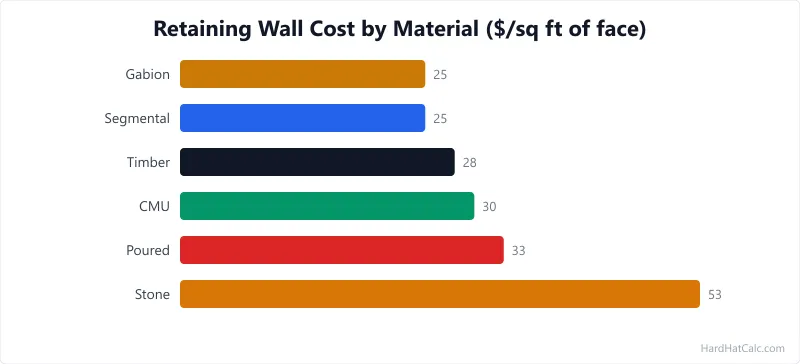
A professionally built retaining wall runs about $20 to $53 per square foot of wall face for a typical residential job, with the national average near $33 per square foot and a full spread from roughly $15 to $65. Measured another way, most homeowners spend between $3,200 and $9,400 on the finished wall, and the national average lands around $6,000 to $6,300. Priced by length, walls run $40 to $360 per linear foot — a band that wide because a 6-foot wall holds back far more soil, and needs far more structure, than a 2-foot wall of the same length.
Material is the first lever that moves the total, so the clearest way to read retaining-wall pricing is per square foot of face by what the wall is made from. The table below gives installed ranges (materials plus labour) for the six materials a homeowner actually chooses between.
| Wall material | Installed cost (per sq ft of face) | What you are paying for |
|---|---|---|
| Timber / wood | $15–$40 | Cheapest sound build; 15–25 year lifespan; rarely used above 4 ft |
| Gabion (rock-filled baskets) | $10–$40 | No concrete footing; free-draining; rugged, rustic look |
| Segmental block (SRW) | $15–$35 | Mortar-free interlocking units; the DIY-friendly choice to 3–4 ft |
| Concrete block (CMU) | $20–$40 | Mortared and rebar-filled; decorative block runs $30–$50 |
| Poured concrete | $20–$45 | Strongest and most watertight; needs formwork |
| Natural stone / boulder | $20–$85 | Dry-stacked fieldstone $20–$80; labour-heavy, longest-lived |
Timber and gabion sit at the budget end. A pressure-treated timber wall is the cheapest sound option at $15 to $40 per square foot, though wood is rarely used above 4 feet and a treated wall lasts 15 to 25 years before it needs replacing. Gabion walls — galvanised wire baskets packed with rock — start as low as $10 per square foot, need no concrete footing, and drain freely through the stone, which is why they suit slopes and stream banks.
The block family covers most domestic walls. Segmental retaining wall units, the interlocking blocks sold at every landscaping supplier, run $15 to $35 per square foot and stack without mortar, which is what makes them the standard choice for a DIY segmental wall. Mortared concrete block (CMU) runs $20 to $40 per square foot for plain grey block and $30 to $50 for decorative or split-face units, and the full CMU wall estimate including mortar and rebar shows how the reinforcement adds up. Poured concrete is the strongest and most watertight wall at $20 to $45 per square foot, but the formwork and the concrete truck mean it only earns its keep on longer or taller runs. Natural stone is the premium tier: dry-stacked fieldstone runs $20 to $80 per square foot and slate or boulder work reaches $85, almost all of it labour, because skilled masonry is slow.
The 4-Foot Rule: When You Legally Need an Engineer
Height is where a retaining wall stops being a landscaping job and becomes a structural one. Most US jurisdictions, following the International Residential Code, require a building permit and an engineered, stamped design for any retaining wall over 4 feet tall measured from the bottom of the footing to the top of the wall — not from the ground surface up. Some local codes drop the trigger to 3 feet, and local rules always take precedence over the model code, so the 4-foot line is a default to check, not a guarantee.
One exception catches people out. A wall under 4 feet that carries a surcharge — a driveway, a patio, a structure, stored material, or a slope rising above it — usually needs a permit and a structural design regardless of height, because that load pushes far harder than soil alone. If a car parks within a few feet of the wall top, treat it as a loaded wall whatever the tape measure says.
Crossing the threshold adds real money. A permit runs $40 to $500 depending on location and wall size. An engineered design with stamped drawings runs $500 to $2,000 and can climb past that for a tall or complicated wall, while a structural engineer bills $100 to $220 per hour, or $350 to $800 for a typical residential engagement. The engineering is not a corner to cut: a wall built over the legal height without approval shifts all liability to the property owner if it fails. A common workaround is terracing — two 3-foot walls with a planted step between them instead of one 6-foot wall — which keeps each wall under the threshold. Engineered walls usually sit on a reinforced footing, and a footing volume and size calculator works out the concrete before you order it.
Drainage: The Cost You Cannot Skip
The single biggest mistake in retaining-wall budgeting is treating drainage as optional. Water is what topples walls. Soil behind the wall soaks up rain and irrigation, and with nowhere to drain, that water builds hydrostatic pressure against the back of the wall while the saturated soil itself pushes far harder than dry ground. The result is a wall that bows, cracks, or collapses, and industry failure analyses from the Concrete Masonry and Hardscapes Association and segmental-wall manufacturers name the same three culprits every time: no drain pipe, no separating fabric, and too little clean stone behind the blocks.
A working drainage system has four parts. At least 12 inches of clean, angular crushed stone sits directly behind the wall units to give water a free path down. A non-woven geotextile fabric separates that stone from the native soil so fine particles cannot wash in and clog it. A 4-inch perforated pipe runs along the base, sloped about 2 percent, to carry collected water out to daylight or a storm drain. Weep holes through the face, spaced every few feet, give a second escape route. Skip any one part and the system fails as a whole.
That drainage adds $10 to $100 per linear foot to the build, with a basic gravel-and-pipe French drain at the lower end and full excavation-and-remediation work at the top; bundled with reinforcement it can add $8 to $25 per square foot of face. The clean stone is the bulk of it, and a crushed-stone volume and cost estimator turns the wall length and backfill depth into tonnage. When I rebuilt a failing garden wall on heavy Northumberland clay during our renovation, the original had no drainage stone behind it at all — the clay had held water against the back for years and pushed the wall out of plumb. Putting in the gravel, fabric, and a drain pipe cost more than the blocks, and it was the part that mattered.
Height, Soil, and Site Access
Beyond the material and the drainage, three site factors decide where a wall lands inside its range. The first is height, and it does not scale in a straight line. Doubling a wall's height more than doubles its cost, because a taller wall needs a deeper footing, heavier units, and often geogrid — sheets of polymer mesh laid back into the retained soil to anchor the wall to the earth behind it. Geogrid gets specified once a gravity wall passes its safe height or carries a surcharge, and it adds roughly $2 to $5 per square foot while pushing up the labour hours.
Soil is the second factor. Clay and other poor-draining or expansive soils press harder on the wall and call for more reinforcement and more drainage stone than free-draining sandy ground. Excavation and base preparation run about $2 to $8 per square foot of wall, and hiring an excavator costs $100 to $300 per hour, so a wall that needs deep digging or a rebuilt base costs more before a single block is laid. If the job means cutting into a slope, a cut-and-fill volume tool estimates how much soil comes out.
Site access is the third and most overlooked. A wall a machine can reach is far cheaper than one where every block, every ton of stone, and every barrow of concrete has to be carried by hand through a narrow side gate. Steep ground, soft going, and tight access all add labour hours that never show up in a per-square-foot table but land squarely on the final bill.
Where DIY Saves Money — and Where It Doesn't
Labour makes up 40 to 60 percent of a professional retaining-wall bill, so doing the work yourself is the largest single saving on the project. The catch is that the saving only holds for the right kind of wall.
A short dry-stack wall is a realistic DIY job. Segmental block, timber, and gabion walls under 3 to 4 feet stack without mortar, need no engineering, and forgive a slow pace. Get the base level and compacted, keep the drainage stone going in behind each course, and a capable homeowner can build a sound wall over a few weekends. The work is heavy — segmental blocks weigh 30 to 80 pounds each — but it is not specialised.
The walls to leave to a contractor are the ones where a mistake is expensive or dangerous. Poured concrete needs formwork, a pump or chute, and vibration equipment most homeowners do not own. Any wall over the 4-foot line needs an engineered design and often geogrid placed to spec. And the two parts that punish errors hardest, the footing and the drainage, are exactly the parts that are costly to redo once they are buried. A sensible middle path is to pay a pro for the footing, engineering, and any tall section, then stack a lower run yourself. If your wall sits on or beside a poured footing, the right concrete grade for the footing and any core fill matters as much as the volume you order.
Pricing Your Own Wall
You can turn these ranges into a real number in five steps, working from the structure up rather than the finish down.
- Pick the material. Match timber, gabion, segmental block, CMU, poured concrete, or stone to your budget and look, using the per-square-foot table above.
- Set the height — and check the 4-foot line. Decide how tall the wall must stand, measured from the footing base, and find out whether your jurisdiction needs a permit and an engineer at that height.
- Price the drainage. Add the gravel backfill, fabric, pipe, and weep holes. This is spend you commit to, not an upgrade you can drop.
- Add excavation and the permit. Layer in digging and base prep, plus the permit or engineering fee if the wall crosses the threshold.
- Get three bids. Compare your estimate against three local quotes; wide gaps usually trace to height, drainage, or site access.
For a segmental block wall, the estimator below counts the blocks and the drainage materials behind them and prices the whole system, which is the cleanest starting point for the material side of a budget. Run it with your wall length and height before you talk to a contractor.
Total visible height. Walls over 4 ft typically require engineering.
Horizontal face dimension. Standard: 12 inches.
Vertical face dimension. Common: 4 or 6 inches.
Front-to-back depth. 8 inches for small walls, 12 for taller.
Price per unit from your supplier.
For estimation only. Structural work requires review by a licensed engineer. Local building codes take precedence over any calculator output.
How This Is Calculated
Blocks per course = ceil(wall length in inches / block face length). Courses = ceil(wall height / block face height). Total blocks = blocks per course × courses × 1.10 waste factor. Base gravel = wall length (ft) × 2 ft wide × 0.5 ft deep / 27 cu ft per cu yd. Drainage gravel = wall length (ft) × 1 ft wide × wall height (ft) / 27. Total cost = blocks + gravel ($40/cu yd) + drain pipe ($1/ft) + filter fabric ($0.30/sq ft) + cap adhesive ($5/tube per 20 ft).
Source: Block count calculations based on standard segmental retaining wall unit dimensions per CMHA (formerly NCMA) TEK 2-4B (Segmental Retaining Walls). Drainage and base design per the CMHA Design Manual for Segmental Retaining Walls, 3rd Edition.
The cheapest retaining wall is not the one with the cheapest blocks — it is the one that drains, sits on a sound base, and stands for thirty years instead of three. Spend where the wall lives or dies, on drainage and a level footing, and treat the face material as the part you choose on looks and budget once the structure is right.
Frequently Asked Questions
- What is the cheapest type of retaining wall?
Timber and gabion walls are the cheapest options, both starting around $10 to $15 per square foot of wall face installed. A pressure-treated timber wall is the lowest-cost sound build, but it rarely lasts beyond 15 to 25 years and is not used above 4 feet. Gabion walls — wire baskets filled with rock — need no concrete footing and drain freely through the stone, which keeps both material and labour down. Segmental block is the next step up at $15 to $35 per square foot and is far more DIY-friendly than poured concrete or mortared block; the segmental block and drainage estimator prices that route in full.
- How much does a 4 foot retaining wall cost?
A 4-foot wall sits right at the height where most jurisdictions require a permit and an engineered design, so its cost includes more than just the blocks. As a rough guide, expect $40 to $200 per linear foot for a segmental or timber wall at that height, rising toward $300 or more per linear foot for poured concrete or stone. A 30-foot run, 4 feet tall, therefore lands somewhere between roughly $1,800 and $9,000 installed, depending on material, drainage, and whether engineering is required. The mortared CMU wall cost breakdown itemises the block, mortar, rebar, and labour for a concrete-block version of that wall.
- Do I need a permit for a retaining wall?
In most US jurisdictions you need a building permit for any retaining wall over 4 feet tall, measured from the bottom of the footing to the top of the wall, and some areas set the limit at 3 feet. A wall under that height usually still needs a permit and an engineered design if it carries a surcharge, such as a driveway, a structure, or a slope above it. Permit fees run from about $40 to $500 depending on location and wall size, and walls over the height limit also need stamped engineering drawings that add $500 to $2,000 or more. Local building codes take precedence over the model code, so confirm the rule with your building department first; if a reinforced footing is required, the footing size and concrete-volume tool sizes it.
- Is it cheaper to build a retaining wall yourself?
Yes — labour is 40 to 60 percent of a professional retaining-wall bill, so doing the work yourself removes the largest cost on the project. The saving is only safe on the right wall, though: short dry-stack segmental, timber, and gabion walls under 3 to 4 feet need no mortar and no engineering, while poured concrete and any tall or surcharged wall should go to a contractor. Even on a DIY build, you cannot save on the drainage stone or a level, compacted base, because those are the parts that fail expensively when skimped. Budget the crushed-stone backfill behind the wall as a fixed cost rather than an optional extra.