
How to Calculate Square Footage
How to calculate square footage with the length-by-width formula, measure rooms and walls, split L-shaped areas, and convert to square yards and metres.
Square footage is the size of a flat area measured in square feet, and it sits underneath almost every material order on a building site. Paint, flooring, drywall, tile, turf, and roofing are all priced and bought by the square foot, so a wrong area figure turns straight into wrong quantities, a second trip to the supplier, and money left on the counter. This guide shows how to work out square footage from scratch: the one formula that does most of the job, how to measure a real room or wall, how to handle L-shaped and angled spaces, and how to move between square feet, square yards, and square metres without losing accuracy.
The arithmetic is genuinely simple, which is exactly why it gets done carelessly. The figures and unit conversions below follow the United States customary definitions published by the National Institute of Standards and Technology (NIST), so the numbers match what a supplier's till and a building inspector both expect. Nothing here needs more than a tape measure, a calculator, and a sketch on the back of an envelope.
The One Formula: Length Times Width
Square footage starts with a rectangle. Measure the length and the width of the space in feet, multiply them together, and the answer is the area in square feet. A room that is 12 feet long and 10 feet wide is 12 × 10 = 120 square feet. That single multiplication covers any rectangle or square, which is the shape of most rooms, walls, slabs, and panels you will ever measure.
The detail that trips people up is units. Both measurements have to be in the same unit before you multiply, and for square feet that unit is feet. If a wall reads 12 feet 6 inches, convert the inches to a decimal first: 6 inches is half a foot, so the length is 12.5 feet, not 12.6. Each inch is one-twelfth of a foot (about 0.083 ft), so 9 inches is 0.75 ft and 3 inches is 0.25 ft. Multiply only once both numbers are clean decimals of feet. Never multiply a length in feet by a width in inches and expect a sensible area.
One square foot is a tile 12 inches by 12 inches, which works out to 144 square inches (12 × 12). Holding that picture in your head is a quick sanity check: if a room "calculates" to 12 square feet but you can clearly fit a sofa and a coffee table in it, the maths went wrong somewhere, usually a unit mix-up.
Measuring a Real Room, Wall, or Floor
The formula is the easy part; the measuring is where accuracy is won or lost. Work through a space in a fixed order so nothing gets counted twice or missed.
- Measure at floor level, wall to wall. Run the tape along the base of the wall, not at waist height where furniture and bowed walls throw it off. Skirting board and trim add an inch or two that does not belong in floor area, so measure to the wall face below the trim.
- Record length and width in feet. Note each in feet and inches, then convert the inches to decimals of a foot before multiplying. A laser distance meter reads to a fraction of an inch and is faster and steadier solo than a tape that sags across a long room.
- Multiply for the floor area. Length times width gives the floor square footage. For wall area instead, multiply each wall's length by the ceiling height: an 8-foot-high wall that runs 14 feet is 112 square feet of paintable or board-able surface.
- Add the rooms together. A whole floor is just the sum of its rooms. Work out each room on its own and total them, rather than trying to treat an entire storey as one shape, which the internal walls make impossible to measure directly anyway.
For wall-driven jobs, that wall figure is exactly where a paint or board estimate begins. Once you have the wall square footage you can turn wall area into paint, primer, and labour or convert it into a drywall sheet count without re-measuring. How coverage rates translate area into gallons is worth knowing before you buy; the breakdown of how far a gallon stretches by surface explains where the spread comes from.
Breaking Down L-Shaped and Irregular Areas
Few real rooms are perfect rectangles. The reliable method for anything with a corner cut out, a bump-out, or a wing is to split the floor plan into rectangles, work out each rectangle on its own, and add the areas together. An L-shaped room is two rectangles; a T-shaped or U-shaped room is three. Draw the plan, slice it along the inside corners into boxes, label each box with its length and width, and total them.
A worked case: an L-shaped living-dining room where the main block is 20 ft by 14 ft and the dining wing is 10 ft by 8 ft. The main block is 20 × 14 = 280 square feet, the wing is 10 × 8 = 80 square feet, and the room is 280 + 80 = 360 square feet. Splitting into rectangles works exactly, to the square inch, for any room whose walls all meet at right angles, which is the overwhelming majority of houses.
Angled and curved walls are the exception, and they need a different shape rather than another rectangle. A triangular alcove or a clipped corner is a triangle, and its area is one-half of the base times the height (½ × base × height), with the height measured straight out from the base at a right angle. A bay window's floor is usually a rectangle plus a shallow triangle or two, so work those triangles out and add them to your rectangle total. For a rounded bay, measure it as a rectangle that just contains the curve and accept a small over-estimate: when you are buying materials, a slight surplus beats running short.
From Square Footage to a Share of the Whole
Once you have an area, the next question is often what slice of a larger space it represents. A bedroom as a percentage of the whole house, a window as a percentage of a wall for an energy-code check, or one tenant's floor as a percentage of a building for a service-charge split are all the same calculation: divide the part by the whole and multiply by 100. A 250-square-foot kitchen in a 2,000-square-foot house is (250 ÷ 2,000) × 100 = 12.5% of the floor area.
That conversion has its own tool, so you do not have to do it by hand. Work out the square footage with the method above, then drop the part and the total into the area-to-percentage converter below to get the share and the remainder in one step.
Total building area, lot area, or reference area.
The portion you want to express as a percentage of the total.
How This Is Calculated
Percentage = (partial area ÷ total area) × 100. Remaining area = total area − partial area. Remaining percentage = 100 − percentage.
Source: Area measurement standards per BOMA International (Building Owners and Managers Association) Office Standard. Code thresholds per IRC R303.1 and IECC fenestration limits.
Converting Square Feet, Square Yards, and Square Metres
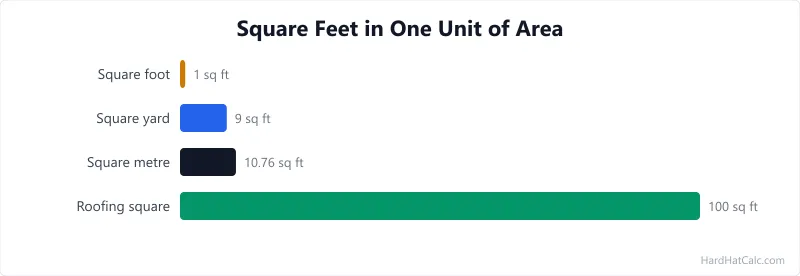
Different trades and different countries quote area in different units, so being able to convert is part of getting a quantity right. The conversions below are exact definitions, not rough rules of thumb. They come from NIST Handbook 44 and the NIST Guide to the SI (Special Publication 811).
| From | To | Multiply by | Quick check |
|---|---|---|---|
| Square feet | Square inches | 144 | 1 sq ft = a 12 in × 12 in tile |
| Square yards | Square feet | 9 | 1 sq yd = a 3 ft × 3 ft square |
| Square metres | Square feet | 10.7639 | 1 sq m ≈ a 3.28 ft × 3.28 ft square |
| Square feet | Square metres | 0.092903 | the reverse of the row above |
| Acres | Square feet | 43,560 | 1 acre ≈ a 209 ft × 209 ft block |
| Roofing squares | Square feet | 100 | 1 square = a 10 ft × 10 ft patch |
The one that catches people out is the jump from a linear conversion to an area conversion. One yard is 3 feet, but one square yard is 3 × 3 = 9 square feet, not 3. One metre is about 3.28 feet, but one square metre is 10.7639 square feet. Squaring the unit squares the conversion factor, so a carpet quoted at 20 square yards is 20 × 9 = 180 square feet, and a flat listed at 75 square metres is 75 × 10.7639 ≈ 807 square feet. Get that wrong and a metric floor plan turns into a material order that falls a third short.
Where the Square Footage Number Gets Used
Square footage is the input that nearly every material take-off multiplies against a coverage rate. Knowing how each trade uses it tells you how careful to be with the measurement.
- Flooring and tile are bought by the square foot, plus a waste allowance of 5–10% for straight layouts and 15% or more for diagonal or patterned work. Order the measured area plus the waste, not the bare area.
- Paint is bought against a coverage rate: a gallon covers roughly 350–400 square feet of wall in one coat, so wall square footage divided by the coverage rate, times the number of coats, gives the gallons.
- Drywall is sold in sheets of a fixed area (a 4 ft × 8 ft sheet is 32 square feet), so wall-plus-ceiling area divided by sheet area, rounded up with waste, gives the sheet count.
- Roofing uses its own unit, the "square," which is exactly 100 square feet. Roofers measure the sloped roof area, divide by 100 to get squares, and order shingles by the bundle at three bundles to a square.
The roofing square is the clearest example of why the unit matters: a roof quoted at "22 squares" is 2,200 square feet, and shingles are priced per square, so getting the area right directly sets the order. The full walkthrough for a roof (pitch, waste, and the bundle count) is laid out in the guide to ordering a complete roof's materials, and the shingle bundle estimator turns a roof's square footage into a bundle count directly. Whatever the trade, the chain is the same: measure carefully, convert to the right unit, then multiply by the coverage rate.
The Habit That Keeps the Number Right
When we re-measured rooms during our Northumberland renovation, the formula was never the problem; the tape was. A length read off a bowed wall, a closet left out of the floor plan, or inches multiplied as if they were tenths of a foot caused every quantity error we hit. Measure at floor level, split awkward rooms into rectangles and triangles before you multiply, and keep every figure in one unit until the very end. Build those three habits and the square footage, along with the material order that hangs off it, comes out right the first time.
Frequently Asked Questions
- How do you calculate the square footage of a room?
Measure the room's length and width in feet, then multiply the two figures together, so a room 12 feet long and 10 feet wide is 120 square feet. Take both measurements at floor level along the wall, and convert any inches to decimals of a foot first, since 6 inches is 0.5 feet, not 0.6. For a room that is not a plain rectangle, split it into rectangles, work out each one, and add the areas. Once you have the total, the area-to-percentage converter turns it into a share of a larger floor for room-by-room budgeting.
- How many square feet are in a square yard?
One square yard equals exactly 9 square feet, because a yard is 3 feet and a square yard is a 3-foot by 3-foot square (3 × 3 = 9). The factor is 9, not 3, because squaring the unit squares the conversion, which is the common slip when ordering carpet that is often quoted in square yards. To convert, multiply square yards by 9, so 20 square yards of carpet is 180 square feet. Flooring and tile that you price by the square foot, such as the area feeding a tile and adhesive estimate, should be converted to square feet first.
- How do you measure the square footage of an irregular room?
Split the floor plan into rectangles along the inside corners, calculate each rectangle as length times width, and add the areas together, so an L-shaped room is two rectangles and a U-shaped room is three. This rectangle method is exact for any room whose walls meet at right angles, which is nearly all of them. For an angled alcove or a clipped corner, measure it as a triangle instead and use one-half of the base times the height. When the irregular shape is a framed wall rather than a floor, the stud-wall area tool works the total surface out from the framing dimensions.
- How do you convert square metres to square feet?
Multiply the square-metre figure by 10.7639 to get square feet, since one square metre is 10.7639 square feet, an exact conversion fixed by the definition that one foot is 0.3048 metres. So a 75-square-metre flat is 75 × 10.7639, about 807 square feet. To go the other way, multiply square feet by 0.092903. Estimates that quote exterior wall area, like a siding material take-off, often mix metric plans with imperial product sizes, so converting before you order avoids a shortfall.