
Steel Weight Calculator
Free steel weight calculator for plate, round bar, square bar, and tube. Get weight per foot and total weight in carbon or stainless steel for any size.
Last updated:
Total length of the piece. A 20-ft length is 240 inches.
Used by Plate (width) and Square Bar (side length). Ignored for round shapes.
Used by Plate only. For tube wall, use the Wall Thickness field.
Round Bar diameter, or Round Tube outer diameter (OD). Ignored for flat shapes.
Used by Round Tube only. The pipe wall, measured radially.
Number of identical pieces in the order.
For estimation only. Structural work requires review by a licensed engineer. Local building codes take precedence over any calculator output.
How This Is Calculated
Area (sq in): plate = width × thickness; square bar = side²; round bar = (π/4) × diameter²; round tube = (π/4) × (OD² − ID²) where ID = OD − 2 × wall. Volume = area × length. Weight = volume × density. Density: carbon 0.2836 lb/cu in, stainless 304 0.285 lb/cu in, stainless 316 0.289 lb/cu in. Weight per foot = area × density × 12. Total = weight per piece × quantity.
Source: Structural carbon steel density 0.2836 lb/cu in (490 lb/cu ft, 7,850 kg/cu m): the 0.490 kcf design value the MnDOT LRFD Bridge Design Manual (Table 3.3.1), FHWA NHI-04-041 and the MoDOT Engineering Policy Guide 751.2 each apply under their own design authority (the AISC Manual and ASTM A6 use the same figure but were not opened). Stainless densities by grade from the producers' own data sheets: 304 = 0.285 lb/cu in (7.90 g/cm³) on ATI and Sandmeyer Steel; 316 = 0.289 lb/cu in (8.0 kg/dm³) on Outokumpu, with Sandmeyer printing 0.285 and ATI 0.29 for 316. Value correction of 2026-09-02: the single "304/316" option at 0.289 is split by grade, because every 304 producer sheet opened prints 0.285 and the 316 sheets disagree among themselves; 316 keeps 0.289. Cross-sectional areas from standard geometry (plate, square bar, round bar, hollow round section).
5 min read
A Cubic Foot of Steel Weighs 490 Pounds
Steel is dense and predictable, which is exactly why a weight figure is worth pinning down before you order, lift, or ship it. Carbon steel weighs 490 pounds per cubic foot, or 0.2836 pounds per cubic inch. That number does not change with the supplier or the season, so any steel weight you calculate from dimensions is as close to exact as construction estimating gets.
Three jobs depend on the figure. Fabricators price scrap and freight by weight, so a 10% error on a truckload of plate is real money. Installers plan lifts by weight, and the line between a two-person carry and a crane pick sits right around 50 to 100 pounds per piece. Engineers count the self-weight of steel members as dead load that every connection and footing below has to carry, the same way a steel beam size calculator folds member weight into its load checks.
The calculation is volume times density. The only real work is getting the cross-sectional area right for the shape you are weighing, because a solid bar, a flat plate, and a hollow tube of the same outside size weigh very different amounts.
Weight Formulas by Steel Shape
Every shape reduces to the same idea: find the cross-sectional area in square inches, multiply by length to get volume, then multiply by density. The area formula is what changes.
| Shape | Cross-section area (sq in) | What drives the weight |
|---|---|---|
| Plate / Sheet | width × thickness | Thickness, directly |
| Square Bar | side × side | The side dimension, squared |
| Round Bar | (π / 4) × diameter² | The diameter, squared |
| Round Tube / Pipe | (π / 4) × (OD² − ID²) | Wall thickness, via OD and ID |
For reference, a solid 1-inch round carbon bar weighs 2.67 lb/ft, a 1-inch square bar weighs 3.40 lb/ft, and a 1/2-inch plate weighs 20.4 pounds per square foot. The squared terms matter: doubling a round bar's diameter quadruples its weight, while doubling a plate's thickness only doubles its weight.
Hollow sections are the exception worth understanding. A round tube subtracts the inside area from the outside area, so most of the metal sits where it does the most structural good. That is why a tube column can carry similar bending loads to a solid bar at a fraction of the weight, a trade-off covered in steel beam versus wood beam.
Estimating the Weight of a Steel Order
Pricing a mixed order of steel is a four-step routine once the shapes are known.
Group the order by shape and grade. Keep plate, bar, and tube separate, and split carbon from stainless, because the density differs by up to 2% (304 sits 0.5% above carbon, 316 about 2% above).
Find the per-foot weight of each item. Enter the dimensions for one shape and read the weight-per-foot result. This is the number suppliers and mills publish, and it lets you sanity-check a quote.
Multiply by total length and quantity. Five 20-foot tubes is 100 feet, so multiply the per-foot weight by 100. The calculator does this when you set length and quantity.
Add a handling allowance. Mill tolerances on plate thickness and bar diameter run a percent or two over nominal, so add 2 to 3% for a delivered-weight estimate rather than a theoretical one.
For structural members that also need a cost figure rather than just a weight, the wood beam cost calculator shows how the same dimensions-to-quantity logic drives pricing on the timber side of a mixed frame.
Carbon Steel vs. Stainless: Density and Weight
Carbon and mild steels make up the bulk of structural and fabrication work, with a density of 0.2836 pounds per cubic inch. This is the figure the AISC manual uses for structural steel, and it applies to A36 plate, A992 wide-flange, and the carbon round and square bar sold at any steel yard.
Austenitic stainless steels are slightly denser because of their nickel and chromium content, and the two common grades differ from each other: grade 304 is 0.285 pounds per cubic inch (7.90 g/cm³) on the ATI and Sandmeyer Steel data sheets, while grade 316 is 0.289 (8.0 kg/dm³) on Outokumpu's sheet, with its higher molybdenum content. For a small part the difference is trivial, but on a large stainless order it adds up: a 1,000-pound carbon estimate becomes roughly 1,005 pounds in 304 and 1,019 pounds in 316 for the identical dimensions. The calculator switches densities automatically when you change the grade. Producers do not all agree on 316 (Sandmeyer prints 0.285 and ATI 0.29), so use your mill certificate's figure when a delivered weight matters.
The weight gap is the smallest reason to choose between them. Stainless is picked for corrosion resistance and costs several times more per pound, so it shows up in railings, food and marine work, and exposed architectural steel rather than hidden structural framing. When you weigh a stainless rail, the 2% density bump is real but minor next to the cost and finish decisions that drove the material choice in the first place.
What Changes the Final Weight of a Steel Part
A theoretical weight from dimensions is the right starting point, but a few real-world factors move the delivered number.
Why does my piece weigh slightly more than the calculator says? Mill tolerances. Plate rolls a touch over its nominal thickness and bar runs a touch over diameter, so actual stock usually lands a percent or two heavy. For an order estimate, add 2 to 3%; for a single small part, the nominal figure is close enough.
Does the weight change for galvanised or coated steel? Slightly. Hot-dip galvanising adds a zinc layer of roughly 0.003 to 0.006 inches, which adds well under 1% to most members but can matter on thin sheet with a lot of surface area. Paint and primer add a negligible amount.
How do I weigh a wide-flange beam or an angle that is not in the shape list? Use the published weight-per-foot from a steel table for those rolled shapes, since their cross-sections are not simple rectangles or circles. This tool covers plate, bar, and tube, which are the shapes you typically calculate from raw dimensions rather than look up. Welding those members together adds filler metal too, which the weld deposition rate calculator estimates by joint size.
Is a hollow tube always lighter than a solid bar? For the same outside diameter, yes, and usually by a wide margin. A 4-inch solid round bar weighs about 42.8 lb/ft, while a 4-inch tube with a 1/4-inch wall weighs about 10 lb/ft, because the hollow centre removes most of the steel while keeping the load-bearing material near the outside.
Worked Examples
Example 1
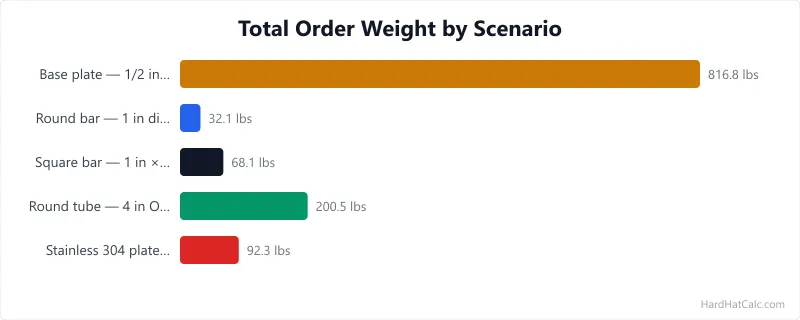
Scenario: A fabricator needs the weight of a carbon-steel base plate, 1/2 inch thick, 48 inches wide and 120 inches long, to plan the crane picks for a column install.
Calculation: Cross-section area = width × thickness = 48 × 0.5 = 24 sq in. Volume = area × length = 24 × 120 = 2,880 cu in. Weight = volume × density = 2,880 × 0.2836 = 816.8 lbs. Weight per foot = area × density × 12 = 24 × 0.2836 × 12 = 81.7 lb/ft.
What this means: At 816.8 lbs the plate is well past any manual lift, so it gets rigged and craned. Knowing the figure before the pick lets the crew pick the right slings and confirm the crane chart has margin at that radius.
Takeaway: A half-inch plate weighs about 20.4 lbs per square foot. Double the thickness to 1 inch and the weight doubles with it, because weight scales directly with thickness for flat stock.
Example 2
Scenario: An installer orders a 20-foot (240 inch) round structural column, 4 inch OD with a 1/4 inch wall, in carbon steel, and wants the per-length weight for freight.
Calculation: ID = OD − 2 × wall = 4 − 0.5 = 3.5 in. Area = (π / 4) × (OD² − ID²) = 0.7854 × (16 − 12.25) = 2.945 sq in. Volume = 2.945 × 240 = 706.9 cu in. Weight = 706.9 × 0.2836 = 200.5 lbs. Weight per foot = 2.945 × 0.2836 × 12 = 10.0 lb/ft.
What this means: A hollow section weighs far less than a solid bar of the same outside size: a solid 4-inch round bar runs about 42.8 lb/ft, so this tube saves roughly 77% of the weight while keeping most of the bending stiffness.
Takeaway: For columns and rails, a hollow round section is the efficient choice. Order by OD and wall, not OD alone, because the wall thickness drives both the weight and the strength.
Frequently Asked Questions
- How much does a 1/2-inch steel plate weigh per square foot?
A 1/2-inch carbon steel plate weighs 20.4 pounds per square foot. The math is thickness in feet times density: (0.5 / 12) × 490 lb/cu ft = 20.4 psf. The relationship is linear, so a 1/4-inch plate is half that at 10.2 psf and a 1-inch plate is double at 40.8 psf. Stainless plate of the same thickness weighs about 0.5% more in grade 304 and about 2% more in grade 316. To size a structural plate or beam for a given load rather than just weigh it, run the steel beam size calculator for the member dimensions first.
- What is the weight of steel per cubic inch and cubic foot?
Carbon and mild steel weigh 0.2836 pounds per cubic inch, which is 490 pounds per cubic foot (7,850 kg per cubic metre). This is the standard AISC value for structural steel and holds across A36, A992, and ordinary carbon bar and plate. Stainless is slightly denser because of its alloy content: grade 304 is 0.285 lb/cu in (7.90 g/cm³, about 7,900 kg/cu m) and grade 316 is 0.289 lb/cu in (about 8,000 kg/cu m). Multiply the volume of any piece by these figures to get its weight.
- How do I calculate the weight of a steel tube or pipe?
Find the hollow cross-section area, then multiply by length and density. The area is (π / 4) × (OD² − ID²), where the inside diameter ID equals the outer diameter minus twice the wall thickness. For a 4-inch OD tube with a 1/4-inch wall, ID is 3.5 inches, the area is 2.945 square inches, and a 20-foot length weighs about 200 pounds in carbon steel. Always order tube by both OD and wall thickness, because the wall sets the weight and the strength together.
- Why does steel weight matter for installation and structure?
Weight decides how a member is handled and how the structure below is sized. A piece under about 50 pounds is a one-person lift, 50 to 100 pounds needs two people or a hoist, and anything heavier calls for mechanical handling, so the figure drives crew and equipment planning. Structurally, the self-weight of steel is permanent dead load that beams, columns, and footings carry for the life of the building. When steel members frame into a bearing wall, a load-bearing wall check folds that dead load into the beam sizing.
More Structural calculators
Browse all structural calculators — Beam sizing, truss pricing, load calculations, wall framing, deck capacity, and foundation tools.