
Spray Foam vs Fiberglass Insulation
Spray foam vs fiberglass insulation compared on R-value per inch, air sealing, moisture, cost, and lifespan, plus a plain rule for when to pick each one.
Spray foam vs fiberglass insulation is the choice most people reach once they have decided to insulate and a contractor has quoted both. The two materials sit at opposite ends of the insulation market. Fiberglass is the cheap, familiar batt that has filled wall cavities for seventy years. Spray foam is the premium product that seals and insulates in a single pass. This guide puts them head to head on the six things that actually decide which one belongs in your wall: R-value per inch, air sealing, moisture behaviour, cost, installation, and how long each lasts. Then it sets out a plain rule for when to pick each.
The performance figures below come from US Department of Energy material data, ICC-ES evaluation reports, and manufacturer technical sheets, cross-checked in 2026 against current installed-price surveys. They are planning ranges, not single numbers, because insulation performance and price both move with product grade, climate, and who does the work. Where you need the exact R-value or the exact spend for your own wall, the calculators linked through this guide do the arithmetic.
Side by Side: Spray Foam vs Fiberglass
The fastest way to read the difference is in one table. Closed-cell spray foam leads on nearly every technical measure; fiberglass leads on price and simplicity. Open-cell spray foam sits in between, sharing foam's air seal but landing at an R-value close to fiberglass.
| Property | Fiberglass batt | Open-cell spray foam | Closed-cell spray foam |
|---|---|---|---|
| R-value per inch | R-2.9 to R-3.8 (about R-3.2) | R-3.5 to R-3.7 | R-6 to R-7 (about R-6.5) |
| Air sealing | None on its own | Air barrier | Air barrier |
| Moisture / vapour | Vapour-open; loses R when wet | Vapour-open; absorbs water | Vapour barrier at 2 in or more |
| Structural strength | None | None | Adds racking strength |
| Installed cost (per sq ft) | $0.65 to $2.00 | $1.50 to $3.00 | $3.00 to $7.00 |
| DIY-friendly | Yes | No | No |
| Lifespan (kept dry) | 80+ years | 80+ years | 80+ years |
The headline is simple. If the wall has deep, accessible cavities and your budget is tight, fiberglass does the job for a fraction of the price. If the cavity is shallow, the wall meets damp ground, or air leakage is the real problem, spray foam earns its premium. The rest of this guide explains why each row of that table falls the way it does.
R-Value per Inch and the Space You Have
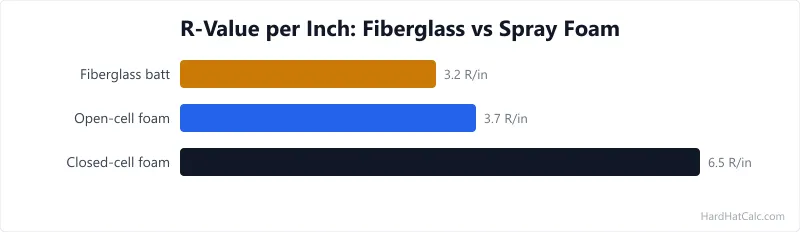
R-value per inch decides how much thermal resistance you can pack into a fixed cavity depth. Fiberglass batts deliver about R-3.2 per inch, open-cell foam about R-3.7, and closed-cell foam about R-6.5, roughly double the fiberglass figure. That gap only matters when space is limited, which in a stud wall it almost always is.
Take a standard 2x4 wall with 3.5 inches of cavity. A fiberglass batt fills it to about R-13, open-cell foam reaches a similar R-13, and closed-cell foam hits R-22.75 in the same depth, clearing the R-20 wall requirement that fiberglass cannot meet without a deeper wall. Where the cavity is generous, fiberglass closes most of the gap simply by being thicker, which is why the R-per-inch advantage rarely justifies foam on its own. For how layered assemblies and continuous insulation add up across every material, the way R-values stack from material layers covers the rules that apply to both products.
Air Sealing: The Difference That Decides Most Jobs
R-value measures resistance to heat conducting through solid material. It says nothing about air leaking through gaps, and in most homes that air leakage moves more heat than conduction does. This is the dimension where the two materials genuinely diverge. Fiberglass is air-permeable: it slows conducted heat but air drifts straight through it, so a fiberglass wall still needs a separate air barrier of taped sheathing or housewrap to perform.
Spray foam, both open and closed cell, expands to fill every void and cures into an air barrier in the same step. The US Department of Energy notes that this air-sealing action can remove the separate caulking, housewrap, and joint-taping tasks a fiberglass wall depends on. That is foam's real selling point, more than the R-value bump. A leaky wall packed with high-R fiberglass underperforms a sealed wall with modest foam, because the draft path defeats the insulation. Before you compare materials, it pays to size the R-value your climate zone actually requires, since the target sets how much of either material you need.
Moisture, Vapour, and What Happens When Walls Get Wet
Water behaviour separates these materials as sharply as air sealing does. Fiberglass is vapour-open and has no moisture control of its own; worse, when it gets wet the fibres clump and the batt loses much of its rated R-value until it dries. Open-cell foam is also vapour-permeable, which lets a wall dry in both directions in mixed climates, but it will absorb liquid water if a wall leaks. Closed-cell foam is the outlier: at two inches or more it becomes a vapour barrier in its own right, controlling moisture movement without a separate poly sheet.
That is why closed-cell foam is the standard pick for basements, crawl spaces, and any wall meeting damp soil, where fiberglass facing traps moisture against cold masonry and invites mould. If your wall needs a dedicated vapour layer instead, the poly sheeting estimate for crawl spaces and cavities sizes it, and for block walls the composite R-value of a CMU assembly shows how little the block itself contributes before any insulation goes on.
What You Pay, and Where the Money Goes
Price is where fiberglass wins outright. Installed, fiberglass runs roughly $0.65 to $2.00 per square foot, open-cell foam $1.50 to $3.00, and closed-cell foam about $3.00 to $7.00 on typical wall work. Across the board, spray foam costs two to three times what fiberglass does for the same area. The foam premium buys the air seal, the higher R-per-inch, and in the closed-cell case the vapour control, not a small upgrade to an otherwise identical product.
Those bands are planning figures; the real number turns on thickness, access, and region. A full closed-cell fill of a deep cavity or a cathedral roofline climbs well past the wall range, while open-cell on an attic floor stays cheap by volume. For a project-specific total, run your area and target thickness through the board-foot cost estimate for open and closed cell, and to weigh insulation against other envelope work the payback estimate across insulation, windows, and air sealing puts the spend in context.
Before you commit to either material, it helps to fix the target first. The tool below checks the minimum R-value your climate zone demands for walls, attics, and floors, which is the number both materials have to hit.
Find your zone at energy.gov/energysaver. Zones 1-2 are the Deep South; 6-7 are the northern US and Alaska.
Where the insulation will be installed. Each area has different R-value minimums.
Total surface area to insulate, not floor area.
Batts for new construction cavities, blown-in for retrofits and attics, spray foam for maximum R per inch.
Cavity depth limits achievable R-value for batts and blown-in. Select "Attic" for open attic floors.
Square feet one package of batts covers. 32 sq ft is a typical small package (a single 15 × 93 in batt covers about 9.7 sq ft) — check your product's coverage and enter it here. Used for batt types only.
Square feet one bag covers at R-13, printed on your product's bag or coverage chart. Blown fiberglass: Johns Manville Climate Pro B-7700 prints 181.3 sq ft per bag at R-13 (5.00 in., 5.5 bags per 1,000 sq ft; its 125.4 figure is the R-19 row); blown cellulose 65.6 to 72.3 sq ft per bag (Greenfiber SupremePlus: no joists to 2x6 joists). Used for blown-in types only.
How This Is Calculated
Required R-value = IECC 2021 Table R402.1.3 lookup by climate zone and application area. Achievable R-value = R-value per inch × cavity depth (inches). Batt packages needed = area ÷ package coverage (default 32 sq ft per package; enter your product's figure). Blown-in bags = area × (required R ÷ 13) ÷ bag coverage at R-13 (default 181.3 sq ft/bag fiberglass, 65 sq ft/bag cellulose; enter your product's figure). Spray foam board feet = area × (required R ÷ R per inch). Estimated cost = area × cost per sq ft.
Source: R-value requirements from IECC 2021 Table R402.1.3 (R-value alternative — insulation minimum R-values by component), including cavity-only and cavity-plus-continuous-insulation alternatives for wall assemblies, with the R402.2.1 ceiling exception. Source-set correction of 2026-08-22: the material-cost attribution to RS Means Residential Construction Cost Data 2026 is withdrawn (no such 2026 product; subscription-only, never opened), and the free-source sweep found no independent replacement: the NREL residential measures database itself lists RS Means among its inputs, and the DOE and NAIMA insulation guides publish no dollar figures (sweep record: audits/sourcing-1-retrieval/rsmeans/). The cost figures are unchanged and ship unverified. Source-set correction of 2026-09-02 (SF20-A7, Q-A6-4 ruling applied): blown-in bag coverage at R-13 previously carried a blanket "NAIMA technical bulletins" attribution that was never independently opened and is withdrawn. Blown fiberglass now defaults to 125 sq ft per bag (Johns Manville Climate Pro B-7700 prints 125.4, rounded down) and blown cellulose to 65 sq ft per bag (Greenfiber SupremePlus prints 65.6 sq ft per bag with no joists and 72.3 between 2x6 joists at 16 in., rounded down to the low end; the page read those two columns backwards until 2026-09-12, the figure itself is unchanged), each on its own manufacturer's coverage chart; both are now an editable per-product input (bagCoverage) rather than a fixed constant, replacing the prior fixed 40 / 36 sq ft per bag. R-per-inch by type and the 32 sq ft default batt-package coverage remain this site's typical values, unattributed; the "Insulation Types Compared" section names the manufacturer spread around each figure (Owens Corning Thermal Batt, ROCKWOOL Comfortbatt, Johns Manville Climate Pro, Greenfiber SupremePlus). Correction of 2026-09-12 (SF22-HHC-F1 E4, seat-ruled 2026-09-07): the 125.4 sq ft per bag figure read from the Johns Manville Climate Pro B-7700 attic card on 2026-09-02 is that card's R-19 / 7.00 in. row (8.0 bags per 1,000 sq ft); the R-13 / 5.00 in. row, the reference the bag formula scales from, prints 5.5 bags per 1,000 sq ft and 181.3 sq ft per bag, and the blown-fiberglass default is now 181.3 (the former default over-ordered by 45 percent; the Zone 2 attic preset moves 28 to 19 bags). Knauf Jet Stream MAX prints 178.2 sq ft per bag at R-12 / 4.5 in. (5.6 bags per 1,000 sq ft) on its Canadian fact sheet, the same range. The bag formula scales bags linearly with R from the R-13 row; the makers' own charts run steeper at depth (Johns Manville prints 22.4 bags per 1,000 sq ft at R-49 against the linear 20.7 from its R-13 row, and 27.9 at R-60 against 25.4), so at attic R-values the linear count runs 8 to 16 percent under the printed chart: enter your chart's figure at the target R for an exact count. The IECC 2021 Table R402.1.3 minimums are on record from three renderings: the DOE / PNNL Building America Solution Center table (every zone and component, the 2021 column matches the seven-zone table this page uses cell for cell, with the basement-wall figure taken as the continuous-insulation option), the DOE Building Energy Codes Program 2021 IECC determination (Table D.5, ceiling R-49 zones 2-3 and R-60 zones 4-8) and Delaware DNREC's 2021 IECC residential changes guide (ceiling 49 to 60, wood-frame wall 20 or 13+5 to 30 or 20+5ci or 13+10ci or 0+20ci).
Installation, Lifespan, and Health
Fiberglass is a genuine do-it-yourself material. Batts cut with a knife, press into cavities, and need no special kit, so a careful homeowner can insulate a room over a weekend for the cost of the batts alone. Spray foam is not a DIY job at any real scale. It needs heated, pressurised equipment that holds a tight chemical ratio, and off-ratio foam fails to cure, emits isocyanate vapour, and triggers a re-entry delay after spraying. That work belongs with a certified installer. One install upside for open-cell foam is sound: it damps airborne noise better than fiberglass at the same thickness, so the partition design for quieter interior walls often leans on it.
On lifespan, both materials last the life of the building when kept dry, but they age differently. Fiberglass holds its R-value for 80 years or more if it stays dry and uncompressed, yet it can sag or settle in wall cavities and is ruined by repeated wetting. Spray foam adheres permanently and does not slump, though closed-cell foam sheds a small amount of R-value in its first year or two as the blowing agent stabilises, after which it holds steady.
How to Choose Between Them
Strip away the marketing and the decision comes down to the surface in front of you and what problem it has. The four cases below cover almost every residential wall, ceiling, and floor.
- Choose fiberglass when the budget leads, the cavity is deep and accessible, the job is a DIY one, and the wall already has a sound air barrier in the sheathing. This is most new-build interior framing.
- Choose closed-cell spray foam when the cavity is too shallow to hit your R-value target with batts, the wall meets damp ground, or air leakage is the real fault you are fixing. Basements, rim joists, and cathedral rooflines are its home ground.
- Choose open-cell spray foam when you want foam's air seal in a generous interior cavity, value the vapour-open drying, or are chasing sound control on a partition rather than maximum R-value.
- Use flash-and-batt when you want the air seal without paying foam prices for the full depth: an inch or two of closed-cell against the sheathing, then fiberglass to fill the rest of the cavity.
Notice that three of the four cases are not all-or-nothing. Flash-and-batt in particular gets you foam's air-tightness at the sheathing and fiberglass economics for the bulk of the wall, which is why it has become the default on many gut renovations.
Matching the Material to the Job
When we opened the walls during our Northumberland renovation, the old fiberglass had slumped in the cavities and gone damp where the gable wall had been letting water in for years, doing almost nothing. We sprayed closed-cell foam on that cold, damp gable to seal and insulate it in one go, and used cheap fiberglass batts in the dry interior partitions where air sealing was already handled and budget mattered more. The same house took both materials, each on the surface that suited it. That is the honest way to read spray foam against fiberglass: not which is best in the abstract, but which is right for this wall, this moisture risk, and this budget, with flash-and-batt waiting whenever the answer is a bit of both.
Frequently Asked Questions
- Is spray foam better than fiberglass insulation?
Spray foam outperforms fiberglass on R-value per inch, air sealing, and moisture resistance, but it is not automatically the better buy for every job. Closed-cell foam reaches about R-6.5 per inch and seals the air leaks fiberglass leaves open, which counts most in shallow cavities, below-grade walls, and draughty older homes. Fiberglass wins on price and is the sensible choice when the cavity is deep and accessible and the wall already has a good air barrier. The right answer depends on the surface and the budget, not on one material being best everywhere. Size the target first with the climate-zone R-value tool before you compare quotes.
- Is spray foam insulation worth the extra cost over fiberglass?
Spray foam typically costs two to three times more than fiberglass, so it earns its premium mainly through air sealing rather than R-value alone. Homes sealed with foam test far tighter than fiberglass-insulated ones, which cuts the draught-driven heat loss that R-value figures never capture. In a leaky older house or a shallow 2x4 wall that cannot fit enough fiberglass, that air seal can pay back within several years; in a tight new build with deep cavities, the cheaper material often makes more sense. Run your area and thickness through the spray foam cost estimate to see the real spread before deciding.
- Can you put fiberglass over spray foam?
Yes, and the combination has a name: flash-and-batt. An installer sprays one to two inches of closed-cell foam against the sheathing for the air seal and vapour control, then fills the rest of the cavity with fiberglass batts for cheaper R-value. A 2x6 wall with two inches of closed-cell plus an R-15 batt reaches about R-28 at roughly 60 percent of the cost of filling the whole cavity with foam. It is a common way to get foam air-tightness without paying foam prices for the full depth. The R-values explained guide shows how layered assemblies add up.
- Which lasts longer, spray foam or fiberglass insulation?
Both can last the life of the building, but they fail in different ways. Fiberglass keeps its rated R-value for 80 years or more as long as it stays dry and uncompressed; once it gets wet the fibres clump and lose effectiveness, and batts can sag or settle in wall cavities over decades. Spray foam adheres permanently, does not slump, and holds its shape, though closed-cell foam sheds a small amount of R-value in its first year or two as the blowing agent stabilises. For masonry walls, where the block itself adds almost no R-value, the masonry R-value tool shows the baseline before insulation.