
Board Foot Calculator
Free board foot calculator for lumber. Enter thickness, width, length, and quantity to get board feet, linear feet, and an optional cost by board foot.
Last updated:
Board thickness in inches. Softwood: the nominal size (a 2-by is 2). Hardwood: the quarter size (4/4 = 1, 8/4 = 2).
Board width in inches. Softwood: the nominal width (a 2x6 is 6). Hardwood: the actual measured width of the rough board.
Length of one board in feet. A 96-inch board is 8 feet, not 96 — length is the one dimension that is always the real size.
Number of identical boards of this size.
Overage for end-trim, cutting, and defect cull. About 10% for softwood framing; 15-30% for hardwood project work.
Optional. Enter your local price per board foot for a material cost. Leave at 0 to skip. Rates vary by species, grade, region, and season.
How This Is Calculated
Board foot = 144 cubic inches. Board feet per board = thickness (in) x width (in) x length (ft) / 12. Total = per board x quantity. Order = total x (1 + waste% / 100). Linear feet = quantity x length. Metric volume = order board feet x 0.00235974 cubic metres. Cost = order board feet x price per board foot. Softwood framing uses nominal dimensions (a 2x6 counts as 2 by 6); hardwood uses the quarter-system thickness (4/4 = 1 inch) and the board's actual measured width.
Source: A board foot is 144 cubic inches — a piece 1 inch thick, 12 inches wide, and 1 foot long — so board feet = thickness (in) x width (in) x length (ft) / 12 (equivalently, all dimensions in inches divided by 144). Softwood dimensional lumber is measured and priced on its nominal size per the American Softwood Lumber Standard PS 20 (ALSC): a 2x6 is billed as 2 by 6 though it dresses to 1.5 by 5.5 inches. Hardwood is measured rough using the quarter-inch thickness system (4/4 = 1 inch, 8/4 = 2 inches) established by the National Hardwood Lumber Association (NHLA), at the board's actual measured width. Prices per board foot are user-entered and vary by species, grade, region, and season.
6 min read
What a Board Foot Measures
The Board Foot Calculator turns a board's thickness, width, length, and quantity into the board feet you order and an optional material cost.
A board foot is a unit of volume, not area or length. One board foot is 144 cubic inches — the wood in a piece one inch thick, twelve inches wide, and one foot long. A plank twice as thick at half the width holds the same board foot, which is why yards quote thick or rough stock by this single measure instead of juggling three separate dimensions. It prices a one-inch shelf board and a three-inch beam blank on the same scale.
The formula is short. Board feet equal thickness in inches times width in inches times length in feet, divided by twelve. A 1-inch by 8-inch board that runs 10 feet is 1 times 8 times 10, divided by 12, or 6.67 board feet. The tool above runs that for one board, multiplies by your quantity, adds a waste allowance, and returns the material cost if you enter a price per board foot. It also reports total linear feet, because some yards quote by the running foot instead.
One point trips people up more than the arithmetic: which dimensions to enter. Softwood framing and hardwood are measured on different figures, and getting that wrong throws the estimate off before you start. The sections below cover the procedure, then the softwood-versus-hardwood rule, so the number you carry to the yard matches the number they charge you on. For why a board's name and the size your tape reads never quite agree, the nominal-versus-actual lumber guide lays out the full dressed-size chart.
Working Out Board Feet Step by Step
Calculating board feet by hand takes four steps, and the tool automates all of them once you know what to enter.
Put each dimension in the right unit. Thickness and width go in inches, length in feet. Entering every dimension in inches is the common slip, and it inflates the answer twelvefold. If a board is 96 inches long, enter 8 feet.
Enter the dimensions your supplier prices on. For softwood framing, use the nominal size on the tag: a 2x6 counts as 2 by 6, even though it dresses to 1.5 by 5.5. For hardwood, use the quarter-system thickness (a 4/4 board is 1 inch) and the board's actual measured width. The next section explains why the two trades differ.
Multiply, then divide by twelve. Board feet per piece equal thickness times width times length, divided by twelve. Set the quantity field for a batch of identical boards, or run each size on its own and add the results.
Add a waste allowance and, if pricing, a rate. Cutting, end-trim, and defect cull mean you buy more than the finished job needs. Ten percent covers most softwood framing; hardwood project work runs 15 to 30 percent because grade defects waste more of a rough board. Enter a price per board foot to convert the order into a cost. When the job is built-up beam stock, pricing a wood beam by species and grade uses the same board-foot basis with species rates already built in.
Softwood Nominal vs Hardwood Rough Measure
The biggest source of board-foot errors is mixing up which size to measure. Softwood and hardwood follow opposite conventions, and both are right within their own trade.
Softwood dimensional lumber is measured on its nominal size. A 2x4, 2x6, or 2x10 is priced as though it were the full 2 by 4, 2 by 6, or 2 by 10 named on the tag, even though drying and planing shave it to 1.5 by 3.5, 1.5 by 5.5, and 1.5 by 9.25. The nominal name reflects the rough size the board was sawn from, and the American Softwood Lumber Standard PS 20 fixes both the nominal name and the dressed size. So board-foot maths for framing uses the name, while span and fit maths uses the dressed dimension. Size a joist off its real 9.25-inch depth, but buy it by its nominal 2x10 board feet.
Hardwood is measured rough, at its actual size. Cabinet and furniture hardwoods such as oak, maple, walnut, and cherry are sold as random-width boards graded before surfacing, so there is no 2x4-style name to fall back on. Thickness uses the quarter system set by the National Hardwood Lumber Association (NHLA): 4/4 is 1 inch, 5/4 is 1.25 inch, 8/4 is 2 inches, each naming the rough thickness. Width is whatever the board actually measures. You pay for the rough volume, then lose some of it when the board is planed flat, which is part of why hardwood carries the larger waste allowance.
Both conventions price the wood the yard cut, not the wood you carry home after dressing. That gap is exactly why a framing estimate and a furniture estimate read different figures off the same tape. Once joist sizes are settled off the dressed depth, matching a floor joist to its span and species works from the actual dimension, and you then order the lumber by its nominal board feet.
Board Feet for Common Lumber Sizes
The table gives board feet per linear foot and for typical lengths, using the nominal size for softwood framing and the rough size for hardwood. Multiply the per-foot figure by your length, or read the common lengths straight off.
| Board (nominal / rough) | BF per linear foot | 8 ft | 10 ft | 12 ft |
|---|---|---|---|---|
| 1x4 softwood | 0.33 | 2.67 | 3.33 | 4.00 |
| 2x4 softwood | 0.67 | 5.33 | 6.67 | 8.00 |
| 2x6 softwood | 1.00 | 8.00 | 10.00 | 12.00 |
| 2x8 softwood | 1.33 | 10.67 | 13.33 | 16.00 |
| 2x10 softwood | 1.67 | 13.33 | 16.67 | 20.00 |
| 2x12 softwood | 2.00 | 16.00 | 20.00 | 24.00 |
| 4/4 x 6 hardwood | 0.50 | 4.00 | 5.00 | 6.00 |
| 8/4 x 8 hardwood | 1.33 | 10.67 | 13.33 | 16.00 |
Two patterns fall out of the numbers. A 2x6 is exactly one board foot per running foot, which makes it a mental anchor: a 12-foot 2x6 is 12 board feet, and you can scale other sizes against it. And every 2-by softwood doubles cleanly, so a 2x12 holds twice the board feet of a 2x6 of the same length because doubling the width doubles the volume.
These are ordering figures, not finished volumes. A boarded deck surface is counted by coverage instead, so a deck board and fastener take-off works from deck area and board width rather than board feet. For the whole deck as a priced project, a full deck cost estimate rolls framing, boards, and labour into one figure.
Pricing, Waste, and Buying by the Board Foot
A few practical points decide whether your order matches the yard's invoice.
Why buy by the board foot at all? It is the only unit that prices thick, wide, or random-width stock fairly. A running foot of 8/4 walnut holds four times the wood of a running foot of 4/4, so a linear-foot price would be meaningless across thicknesses. Board feet fold thickness, width, and length into one number, which is why hardwood dealers and rough-sawn softwood suppliers both quote it.
How much waste should I add? For softwood cut to length, 10 percent covers end-trim and the odd cull. For hardwood furniture and cabinet work, add 15 to 30 percent: rough boards carry knots, splits, and wane that you cut around, and you lose thickness when the board is planed flat. Wide clear cuts push the figure toward the top of that band.
Does the price include the wood I plane away? Yes. You pay for the rough board foot, then surface the board down to its finished size, so a 4/4 board that dresses to 13/16 inch still costs its full 4/4 board feet. That built-in loss is the main reason hardwood projects budget extra stock rather than ordering the exact finished volume.
Is a board foot the same as a linear foot? No. A linear foot measures length only; a board foot measures volume. A 2x6 happens to be one board foot per linear foot, but a 2x12 is two and a 1x4 is a third of one. When wood outgrows what dimensional lumber can carry and steel enters the picture, the trade-offs between a steel and a timber beam turn on more than volume, though the board-foot cost of the wood option is one input to that call.
Worked Examples
Example 1
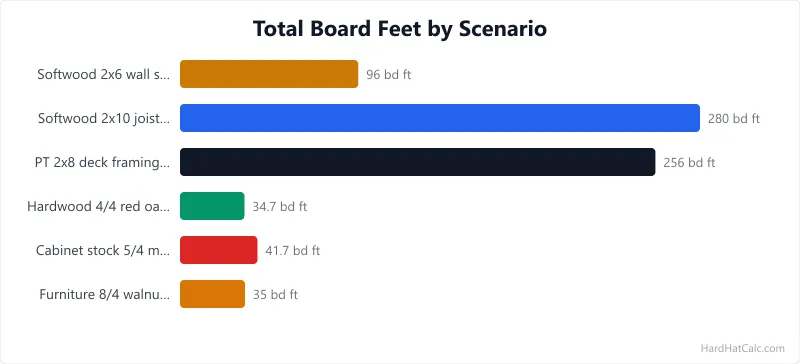
Scenario: A framer is buying twelve nominal 2x6 softwood studs at 8 feet each for a wall and wants the board-foot total to compare two yard quotes, with a 10% cutting allowance.
Calculation: Softwood uses the nominal 2x6 size. Per board = (2 × 6 × 8) / 12 = 8 board feet. Twelve boards = 96 board feet, and 96 linear feet of stock. With a 10% cutting allowance, order 96 × 1.10 = 105.6 board feet. No price entered, so the cost line stays at $0.
What this means: Twelve nominal 2x6 studs come to 96 board feet, or about 105.6 once the waste allowance is added. Board feet let you line up a yard that quotes by the board foot against one that quotes by the linear foot on the same 96 feet of stock.
Takeaway: Softwood board feet use the nominal size — a 2x6 counts as 2 by 6 even though it dresses to 1.5 by 5.5. That nominal figure is what the yard prices on, so it is the one to enter here.
Example 2
Scenario: A cabinetmaker is ordering eight rough 4/4 red oak boards, each about 6.5 inches wide and 8 feet long, at an example $6.50 per board foot, with a 20% allowance for defect cull and cutting.
Calculation: Rough 4/4 hardwood is 1 inch thick (the quarter-system name for 1 inch), measured at its actual width. Per board = (1 × 6.5 × 8) / 12 = 4.33 board feet. Eight boards = 34.67 board feet. Hardwood needs a bigger allowance, so at 20% the order is 34.67 × 1.20 = 41.6 board feet. At $6.50 per board foot, that is 41.6 x $6.50 = $270.40.
What this means: The order works out to about 41.6 board feet and $270 at the quoted rate. Hardwood is sold by the board foot at the rough size, so the 4/4 thickness and the measured width — not a dressed dimension — set what you pay.
Takeaway: Hardwood board feet use the quarter-system thickness (4/4 = 1 inch) and the board's actual measured width. Add 15-30% for hardwood because grade defects and planing waste eat more of a rough board than a softwood stud.
Frequently Asked Questions
- How do you calculate board feet?
Board feet equal thickness in inches times width in inches times length in feet, divided by 12. A 2x6 that runs 12 feet is 2 x 6 x 12 / 12, or 12 board feet. If every measurement is in inches, divide by 144 instead, since one board foot is 144 cubic inches. For a batch of identical boards, work out one board and multiply by the count, then add a waste allowance for cutting and cull. The same board-foot basis prices a built-up wood beam by species and grade once you know the volume.
- What is a board foot of lumber?
A board foot is a unit of volume equal to 144 cubic inches — the wood in a piece one inch thick, twelve inches wide, and one foot long. It measures how much wood a board contains, not how long or wide it is, which is why lumber yards use it to price boards of different thicknesses on one scale. A one-inch board covering a square foot is exactly one board foot, and a two-inch board of the same face area is two. Thicker or wider stock holds more board feet for the same length, so the figure captures all three dimensions at once.
- Is a board foot based on nominal or actual dimensions?
It depends on the lumber. Softwood dimensional lumber is measured on its nominal size, so a 2x6 is billed as 2 by 6 even though it actually measures 1.5 by 5.5 inches after drying and planing. Hardwood is measured rough at its actual size, using the quarter-inch thickness system (4/4 is 1 inch) and the board's real measured width. Both price the wood as it was sawn, before it is surfaced down to a finished size. For the full breakdown of why nominal and actual sizes differ across every board, the lumber sizes chart sets out the dressed dimensions in inches and millimetres.
- How many board feet are in a 2x4?
A nominal 2x4 holds two-thirds of a board foot per linear foot, because 2 times 4 divided by 12 is 0.67. So an 8-foot 2x4 is 5.33 board feet, a 10-foot is 6.67, and a 12-foot is 8. Softwood uses the nominal 2 by 4 even though the board dresses to 1.5 by 3.5 inches, since that is the figure the yard prices on. When you are sizing framing rather than buying it, a floor joist span and size tool works from the real dressed depth instead of the nominal name.
More Materials calculators
Browse all materials calculators — Paint coverage, roofing bundles, tile adhesive, welding time, parking lot sizing, and more.